
8 November 2025 The Future is the Product of the Past

One of the Largest Early Medieval Silver Hoards Ever Found in Sweden Unearthed Near Stockholm

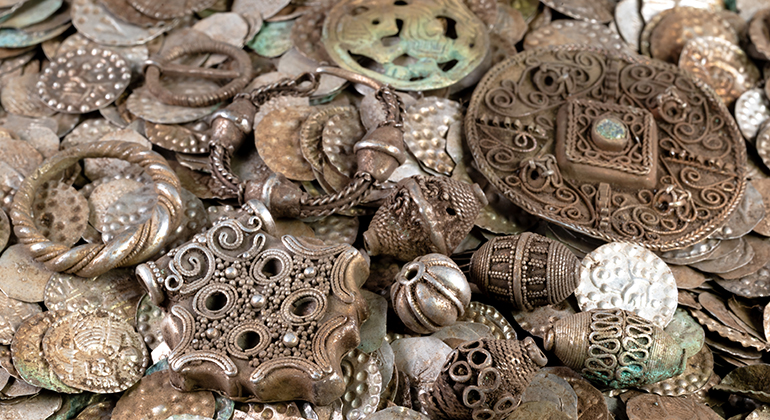
In an astonishing find that could reshape our understanding of early medieval Scandinavian wealth, a private individual digging for earthworms near their summer residence in the Stockholm area discovered a vast hoard of silver coins and jewelry. The hoard, estimated to weigh about six kilograms, may contain up to 20,000 silver coins, along with silver rings, pendants, beads and other artifacts, all evidently buried together in a now-degraded copper cauldron.

Archaeologists and conservators are currently working under the supervision of the Stockholm County Administrative Board and Länsstyrelsen, based on a formal report of the find, in order to examine, conserve, and document each piece. The precise find location is being held secret until the excavation and analysis are complete, with care taken to protect the site from looting or unauthorized disturbance.

A Royal Inscription: “KANUTUS” and the Age of Knut Eriksson

Preliminary analysis has dated most of the coins to the 12th century, and many bear the inscription KANUTUS — the Latin form of “Knut” — pointing to King Knut Eriksson (ruled c. 1173–1195). Under Knut’s reign, Sweden saw a revival of minting. After a long hiatus in domestic coin production, the king supported the reestablishment of a coinage system around c. 1180, issuing coins marked KANVTVS or KANVTVS REX, likely influenced by coin typologies from the German realm.

Knut Eriksson, also known as Canute I, was a critical figure in consolidating royal authority in medieval Sweden. His reign marked a turning point in Swedish politics: the monarchy’s power was strengthened, church structures consolidated, and international ties — for example with German principalities — were fostered. The resumption of coinage under his aegis represented a symbol of sovereignty and integration with continental ecclesiastical and monetary norms.
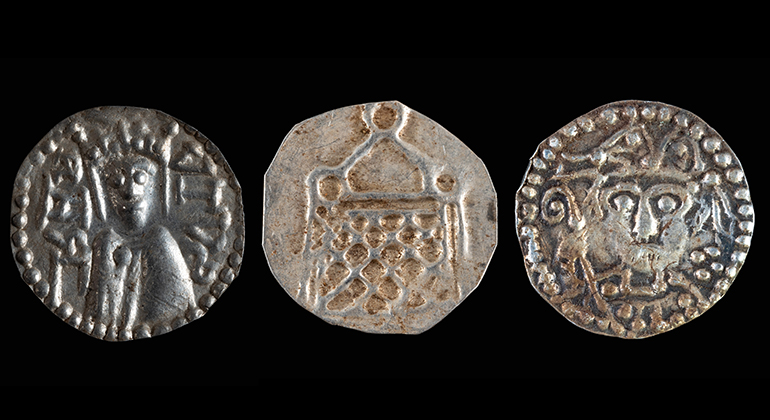
Three silver coins from the hoard: on the left, a coin with the inscription KANUTUS depicting King Knut Eriksson; in the center, a Gotland coin possibly showing a church building; and on the right, a so-called bishop coin. Collage. Photo: Stockholm County Administrative Board
Three silver coins from the hoard: on the left, a coin with the inscription KANUTUS depicting King Knut Eriksson; in the center, a Gotland coin possibly showing a church building; and on the right, a so-called bishop coin. Collage. Credit: Stockholm County Administrative Board

Rare “Bishop Coins” and Ecclesiastical Currency

Beyond the royal coins, the hoard includes several “bishop coins” — ecclesiastical coinage minted under episcopal authority, featuring a bishop holding a crozier (a pastoral staff) in his hand. Such coins are rare and historically illuminating: they reflect the close ties (and sometimes tensions) between church and state, and the financial autonomy of bishops as local authorities.


📣 Our WhatsApp channel is now LIVE! Stay up-to-date with the latest news and updates, just click here to follow us on WhatsApp and never miss a thing!!


These ecclesiastical coins may have circulated in cross-border contexts, especially within the ecclesiastical networks of northern Germany or the Baltic region. Their presence in a Swedish hoard suggests complex financial networks across the Baltic Sea in the later 12th century.

Why Bury a Fortune?

The manner in which the hoard was concealed — bundled into a copper cauldron with coins, jewelry, and beads — suggests a deliberate act of safekeeping. The fact that it was never retrieved hints at a sudden crisis: perhaps conflict, internal political tension, or unrest during a border campaign or regional dispute.

Interestingly, the discovery predates the founding of Stockholm (traditionally dated to 1252), showing that significant activity, wealth, and settlement must have existed in the region long before the city became formalized. Archaeologists will now search for traces of any nearby settlement, farmstead, or contemporaneous structures that may explain who buried the hoard, and under what circumstances.
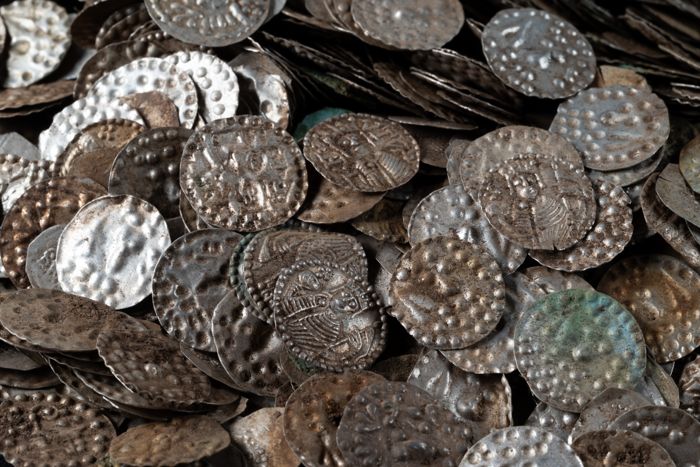
Details of coins from the medieval silver treasure found in the Stockholm area. Photo: Stockholm County Administrative Board
Details of coins from the medieval silver treasure found in the Stockholm area. Credit: Stockholm County Administrative Board

Legal Implications and Cultural Heritage

Under Sweden’s Cultural Environment Act (“kulturmiljölagen”), any discovery of precious-metal hoards or ancient deposits must be reported to the state. The treasure is now under consideration by the Riksantikvarieämbetet (National Heritage Board), which will decide whether the state should offer to redeem (liquídate) the find from its discoverer — in effect providing compensation in return for keeping it in the public domain.

The finder is commended for following the legal procedure. As Sofia Andersson, antiquarian at the Stockholm County board, notes: “According to the Cultural Environment Act, the person who finds a silver hoard or deposit is obliged to offer it for acquisition by the state.”

If the state redeems the hoard, it may end up in a national museum, where scholars and the public alike can study and appreciate this singular window into medieval Scandinavian society.

A Landmark in Swedish Archaeology

This discovery ranks among the largest medieval silver hoards ever unearthed in Sweden — not only in weight but also in volume and numismatic rarity. The mix of royal and ecclesiastical coinage makes it especially valuable for understanding economic, political, and religious networks of the 12th century.

As the excavation proceeds, each coin, ring, pendant or bead may shed new light on the trade routes, political alliances, local elites, and religious institutions of a medieval world that is still, in many ways, mysterious. Keep watching this space — further analyses, catalogues, and perhaps even digital exhibits are sure to follow.

Länsstyrelsen Stockholm

Cover Image Credit: Länsstyrelsen Stockholm

Related Articles

6th Century Anglo-Saxon Warriors May Have Fought in Northern Syria

7 July 2024

7 July 2024

Researchers have suggested compelling evidence that Anglo-Saxon warriors from late sixth-century Britain participated in Byzantine military campaigns in the eastern...

Ancient Water Pipeline Unearthed on 65-Meter Hill in Tajikistan Reveals Engineering Marvel of the Past

19 August 2025

19 August 2025

Archaeologists in Tajikistan have made a groundbreaking discovery at the Mugtepa settlement in Istaravshan: an ancient water pipeline system, constructed...

Czech experimental archaeologists successfully completed their 1-month voyage in the Aegean Sea using a replica of a prehistoric vessel

17 July 2023

17 July 2023

Radomír Tichý, an archeology professor at the University of Hradec Králové who is also the director of the Všestary Archeopark,...

Researchers Define the Borders of El Argar, the First State-Society in the Iberian Peninsula

18 March 2025

18 March 2025

Recent research conducted by scholars from the Autonomous University of Barcelona (UAB) and the Max Planck Institute for Social Anthropology...

Ancient Herpes DNA Points to Oral Herpes’ Beginnings: First kisses may have helped spread cold sore virus

28 July 2022

28 July 2022

The ancient genomes of the herpes virus, which commonly causes lip sores and currently infects about 3.7 billion people worldwide,...

New fortification walls discovered in the ancient city of Pergamon

14 February 2022

14 February 2022

2,500-year-old fortification walls were found in the Ancient City of Pergamon (Bergama), which was included in the World Heritage List...

1,000-Year-Old Kufic-Inscribed Tombstone Unearthed at Dowlatshahi Mosque in UNESCO-Listed Yazd, Iran

29 July 2025

29 July 2025

In a remarkable archaeological discovery, a nearly 1,000-year-old Kufic-Inscribed tombstone has been unearthed during restoration efforts at the Dowlatshahi Mosque,...

1800-year-old statue head found in Ancient Smyrna Theater in western Turkey

30 July 2022

30 July 2022

A statue head dated to the 2nd century AD was unearthed during the excavations at the Ancient Smyrna Theater, located...

Sidamara, the largest sarcophagus of the Ancient World, got Eros relief 140 years later

1 July 2022

1 July 2022

The Sidamara Sarcophagus, which is considered to be one of the largest sarcophagi of the ancient world and weighs many...

The oldest Celtic Dice ever discovered in Poland

24 September 2023

24 September 2023

A dice, probably dating from the 3rd and early 2nd centuries BC, was discovered at the Celtic settlement of Samborowice...

Iron Age Fortification Unearthed on the Trave: A Forgotten Stronghold of the Roman Imperial Period

26 September 2025

26 September 2025

Archaeologists investigating the Stülper Huk, a headland on the River Trave located in the German federal state of Schleswig-Holstein, have...

A Colonnaded Hall with Extraordinary Frescoes of Still Life Found in Pompeii

27 December 2024

27 December 2024

Archaeologists in the famous ancient Roman city of Pompeii, one of the world’s most iconic archaeological sites, have revealed extraordinary...

A previously unknown subterranean tract of an Augustan-era aqueduct has been rediscovered in Naples

4 February 2023

4 February 2023

A previously unknown subterranean tract nearly half a mile long of an Augustan-era aqueduct has been rediscovered in Naples, southern...

Hoysala temples inch closer towards UNESCO recognition

7 February 2022

7 February 2022

The Indian Union government recently proposed the Somanathapura temple in Mysuru district and Chennakeshava and Hoysaleshwara temples in Belur and...

Medieval Secrets Revealed: Archaeologists Discover Reading Stone Beneath World-Famous University

30 October 2025

30 October 2025

Archaeologists at Oxford uncover a perfectly preserved medieval reading stone alongside ancient halls, manuscripts, and artifacts that shed new light...