

9 February 2026 The Future is the Product of the Past

Rare Beetle Ornament Found in 2,500-Year-Old Hallstatt Period Child’s Burial

Archaeologists working in south-west Poland have made a remarkable discovery: a funerary ornament crafted from beetle parts, buried with a child over 2,500 years ago. The find, unearthed at the Hallstatt-period Lusatian Urnfield cemetery in Domasław, sheds new light on the symbolic and ornamental practices of prehistoric European communities.

A Unique Discovery in Grave 543

The cemetery at Domasław, excavated between 2005 and 2007, contains more than 800 cremation graves dating from around 850–400 BC, during the Hallstatt period. Among these, grave number 543 stands out as one of the most impressive. Inside its chamber, researchers uncovered several urns, each holding the remains of an individual.

Urn 1 contained the cremated bones of a child, aged about 9 to 10 years. Alongside the remains were fragments of goat or sheep bones, a harp-shaped bronze fibula, birch bark pieces, and traces of dandelion pollen. Most extraordinary, however, were the 17 fragments of insect exoskeletons carefully deposited in the urn.

Detailed analysis revealed these belonged to Phyllobius viridicollis, a green weevil beetle still found in Europe today. Twelve whole pronota (the beetle’s shield-like thoracic plate) and five fragmentary pieces were preserved. Remarkably, several of these had been strung on a blade of grass, resembling a necklace or decorative ornament.
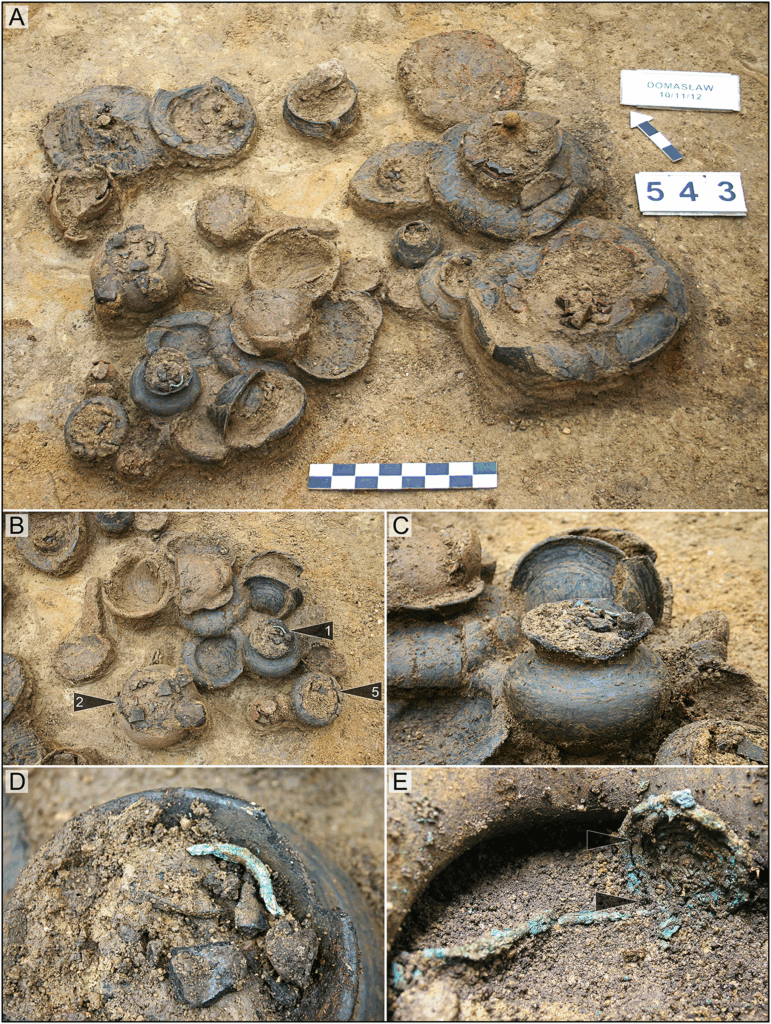
Chamber grave no. 543: A) arrangement of vessels in situ; B) close-up on the south-east part of the burial with urns 1, 2 and 5; C & D) urn no. 1 in situ; E) harp-shaped fibula in urn no. 1 with the insect fragments marked with arrows (figure by A. Woźniak & A. Hałuszko). Credit: Hałuszko, A., Kadej, M., & Józefowska, A. (2025)

Intentional and Symbolic Placement

What makes this discovery so significant is the apparent intentional preparation of the beetle parts. The heads, legs, and abdomens had been removed in a uniform fashion, suggesting that the beetles were deliberately modified for ornamental use. The fact that some were strung together reinforces the interpretation that they were crafted into jewelry, possibly created specifically for the burial ritual.


📣 Our WhatsApp channel is now LIVE! Stay up-to-date with the latest news and updates, just click here to follow us on WhatsApp and never miss a thing!!


Dr. Agata Hałuszko, who led the research, explained how such delicate organic remains survived for more than two millennia. The corrosion of the bronze fibula released copper compounds, which impregnated and preserved nearby organic materials—including the fragile beetle shells. This natural process, combined with meticulous excavation and electron microscopy analysis, allowed archaeologists to study the artifact in rare detail.

A Window Into Seasonal Rites

The presence of Phyllobius viridicollis also offers a unique clue to the timing of the burial. These beetles typically appear in May and live until July, while dandelions bloom from April through August. Taken together, the ecofacts suggest that the child’s burial likely took place in late spring or early summer, providing rare insight into the seasonal aspects of prehistoric funerary practices.

Cross-Cultural Parallels

The symbolic use of beetles in ornaments is not without precedent. Ethnographic accounts of the Hutsuls, a Slavic ethnic group from western Ukraine and northern Romania, describe necklaces made from rose and copper chafers, worn by girls as protective talismans. In the Victorian era, beetle wing cases were also fashionable in jewelry and textiles, celebrated for their iridescent shine.

Although it is impossible to know exactly what meaning the beetle ornament held for the community of Domasław, these parallels suggest that insects were valued both for their beauty and for their symbolic or magical associations. As insects often symbolize transformation and the fleeting nature of life, their use in a child’s burial may have carried profound spiritual significance.
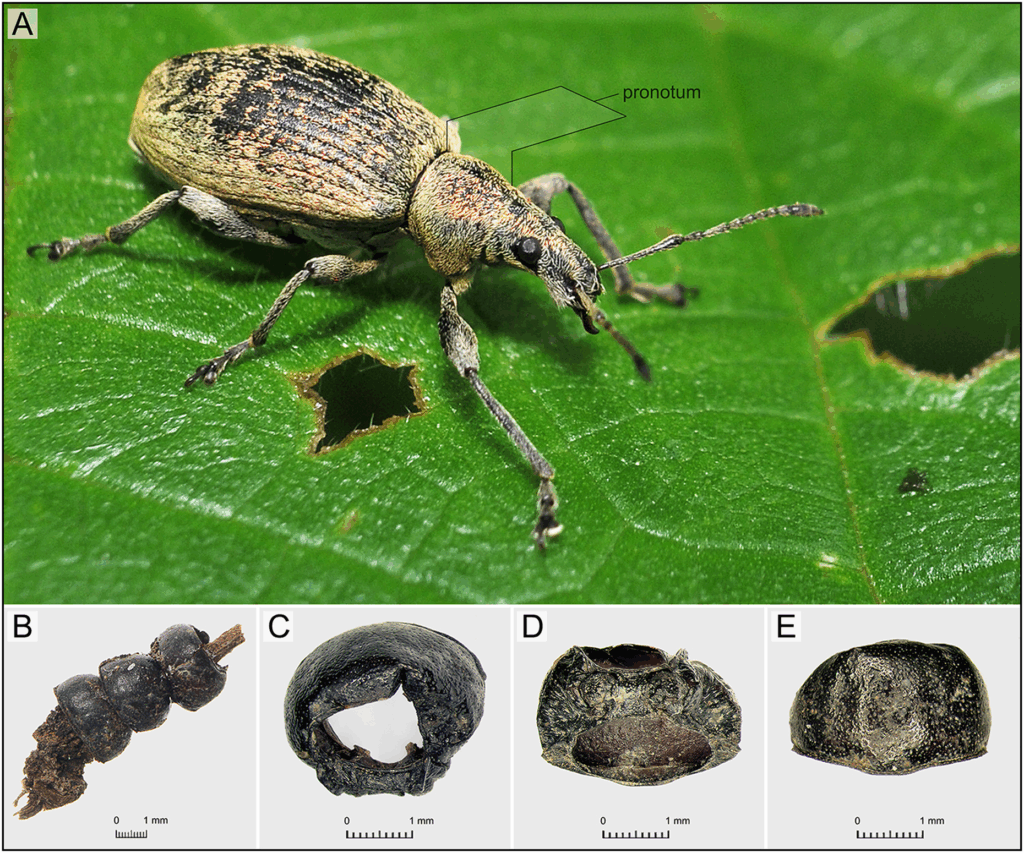

Pronota of Phyllobius sp. beetles: A) contemporary representative of Phyllobius sp. with pronotum marked; B) pronota of Phyllobius viridicollis strung on a blade of preserved grass; anterior (C), ventral (D) and dorsal (E) side of one of the pronota of P. viridicollis from grave 543, urn no. 1 (figure by J. Józefczuk, J. Kania & A. Hałuszko). Credit: Hałuszko, A., Kadej, M., & Józefowska, A. (2025)

Rare Evidence of Fragile Traditions

Because beetle exoskeletons are so delicate, ornaments made from them rarely survive in the archaeological record. Most would have decayed within months or years of burial. This makes the Domasław discovery particularly exceptional, offering direct evidence of ephemeral practices that would otherwise be invisible to history.

“Insects discovered in funeral contexts are most often associated with magical practices and the symbolism of life and death,” the research team notes. “The beetle pronota from grave 543 highlight the deliberate utilization of faunal materials in symbolic or ornamental capacities—evidence that is exceedingly rare in archaeology.”
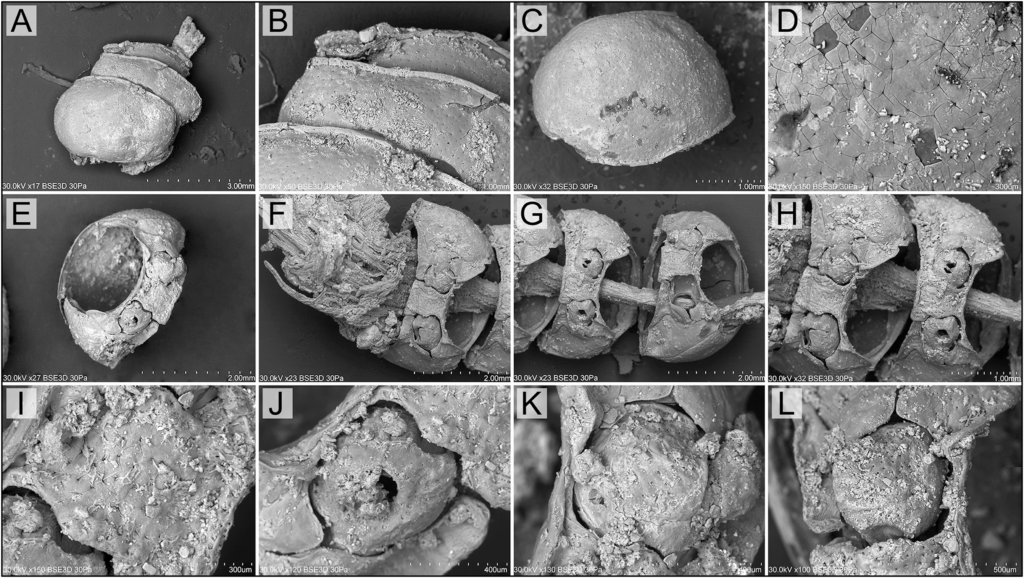
SEM-BSE imaging of the preserved pronota of Phyllobius viridicollis: A–D) dorsal side; E–H) ventral side; I) central ventral side; J–L) coxa (figure by A. Hałuszko). Credit: Hałuszko, A., Kadej, M., & Józefowska, A. (2025)

Expanding Our Understanding of Prehistoric Europe

The discovery of the beetle ornament not only enriches our understanding of the Hallstatt culture but also broadens the scope of archaeological interpretation. By combining traditional excavation with advanced microscopic techniques, researchers can recover and study even the most fragile organic materials, deepening our knowledge of ancient societies.

This find from Domasław serves as a reminder that prehistoric communities expressed meaning and identity through more than just durable artifacts like bronze and pottery. Even fleeting, delicate objects—such as necklaces of beetle shells—carried symbolic weight in rituals of life, death, and memory.

As more discoveries like this come to light, they paint a richer, more complex picture of the human past, where even the smallest creatures played a role in the ceremonies of ancient Europe.

Interestingly, insects have also appeared in remarkable archaeological finds far from Europe. Just a few months ago, archaeologists in South Korea unearthed a 1,400-year-old Silla crown adorned with jewel beetle wings—the first of its kind. If you’d like to read more about this extraordinary discovery, click here: “First of Its Kind: 1,400-year-old Silla Crown Adorned with Jewel Beetle Wings Unearthed in South Korea.”

Hałuszko, A., Kadej, M., & Józefowska, A. (2025). Beetle body parts as a funerary element in a cremation grave from the Hallstatt cemetery in Domasław, south-west Poland. Antiquity, 1–9. doi:10.15184/aqy.2025.10182

Cover Image Credit: Hałuszko, A., Kadej, M., & Józefowska, A. (2025)

Related Articles

The very unknown ancient city of the Mediterranean; Syedra

3 July 2022

3 July 2022

Known as Turkey’s holiday paradise, the Antalya region is a treasure when it comes to ancient cities. Close to the...

The ancient city of Karkamış “House of the Seal” brings a different perspective to the Hittite-Assyrian relations with its important finds

6 May 2022

6 May 2022

Historical artifacts discovered during excavations by Turkish and Italian teams in the ancient city of Karkamış (Carchemish) in southern Gaziantep...

A Remarkable Discovery from a Gaza Shipwreck: Olive Pits from 1100 Years Ago

10 March 2025

10 March 2025

The recent underwater excavations off the coast of Türkiye have unveiled an extraordinary find that has captivated scientists: olive pits...

Archaeologists Uncover Remarkably Preserved 2,600-Year-Old Monumental Grave in Switzerland

8 December 2025

8 December 2025

A newly uncovered monumental burial mound in the Swiss canton of Fribourg is rewriting what researchers know about social hierarchy...

Ancient Babylon Excavation Uncovers 478 Artifacts Including Cuneiform Tablets, and Cylindrical Seals

16 October 2024

16 October 2024

The Iraqi State Board of Antiquities and Heritage (SBAH) announced that 478 artifacts were uncovered during an excavation expedition in...

A burial complex and an Ancient Dog Statue have been unearthed during excavations in Appio Latino quarter the Rome

8 January 2022

8 January 2022

Workers laying pipes for utility company Acea at Via Luigi Tosti in Rome’s Appio Latino quarter have unearthed an ancient...

Unprecedented 1800-year-old marble bathtub recovered in Turkey

23 April 2022

23 April 2022

The 1800-year-old marble bathtub, which was seized when it was about to be sold by historical artifact smugglers in Aydın’s...

“Human evolution” Migration out of Africa was affected by climate constraints.

25 August 2021

25 August 2021

The story of modern man’s migration from Africa still remains unclear in many aspects. Why did people migrate? Is it...

4,000-Year-Old Lion Jaw Bone Unearthed in Kültepe

14 September 2021

14 September 2021

Excavations continue in Kültepe, the starting point of Anatolian written history. During the excavations, a 4,000-year-old lion jawbone was unearthed....

Buried Secrets: How a Roman Sailor’s Gravestone Resurfaced in a New Orleans Yard

9 October 2025

9 October 2025

A routine yard cleanup in New Orleans turned into an international archaeological mystery when a homeowner uncovered a 2nd-century Roman...

New Archaeological Discovery Extends Human Settlement of Kodiak Island by 7,800 Years

26 August 2025

26 August 2025

Archaeologists at the Alagnaruartuliq site (KAR-00064) on Kodiak Island’s Karluk Lake have uncovered evidence of one of the oldest known...

Turkey’s second ancient lighthouse found in the Bathonea

28 July 2023

28 July 2023

The excavations in the ancient Greek city of Bathonea, located in the Küçükçekmece Lake basin in the Avcılar district of...

Excavations at the ‘Westminster Abbey of Wales’ Yielded a Few Surprises: a lost Aqueduct and a Buried Celtic Treasure

12 March 2024

12 March 2024

Archaeologists working in Wales revealed recently they may have discovered a Celtic monastery at the site of a 12th-century Cistercian...

Giant handaxe discovered at Ice Age site in Kent, UK

8 July 2023

8 July 2023

Researchers in Kent in southeastern England have discovered a prehistoric handaxe so big it would have been almost impossible to...

‘Astonishingly Preserved’ Ancient Roman Well Found in Cambridgeshire was An Engineering Failure

22 August 2024

22 August 2024

In an excavation at the site of future highway improvements in Cambridgeshire, the team from MOLA (Museum of London Archaeology)...