
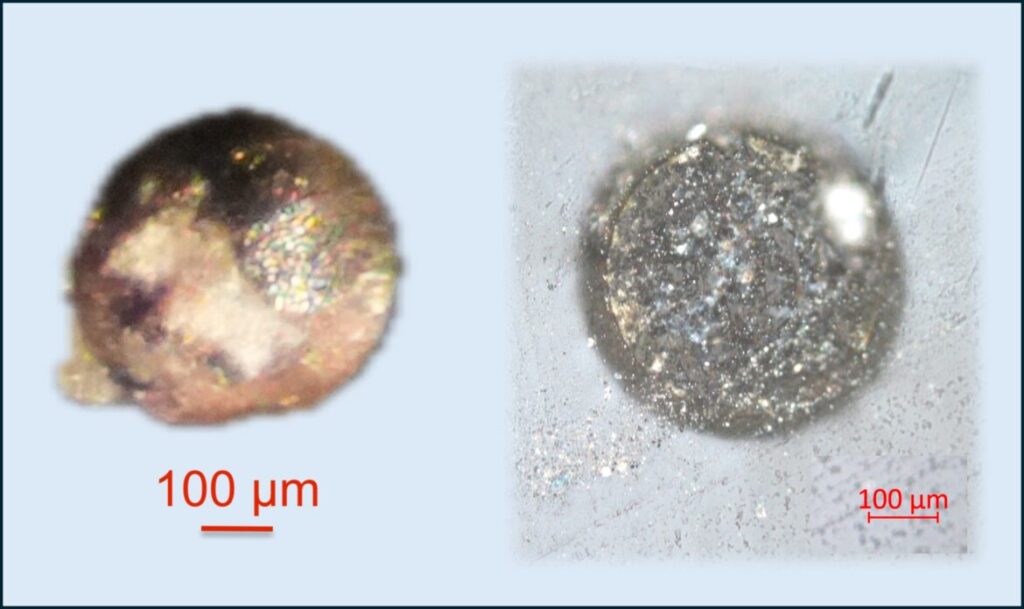
A microscopic grain preserved in the sands of Hiroshima Bay has revealed a material never identified before: a complex metallic alloy created during the atomic bombing of Hiroshima.
A research team led by the University of Florence has identified a previously unknown metallic alloy trapped inside glassy debris created by the atomic bomb dropped on Hiroshima on August 6, 1945 — a discovery that reveals how nuclear explosions can act as natural laboratories for forging materials impossible to create through ordinary means.
The bombing killed tens of thousands of people and remains one of the defining tragedies of the 20th century. Eight decades later, the physical debris it scattered across the city and its bay continues to offer scientists a unique, if sobering, window into the extreme physics of that morning — research that aims not to diminish its human cost, but to understand, document, and learn from an event whose consequences are still felt today.
A Microscopic Time Capsule from 1945
The alloy was found embedded in a tiny metallic grain inside a hiroshimaite particle, the name given to the glassy fallout debris produced by the Hiroshima detonation and preserved for decades in the sediments of Hiroshima Bay. The particle itself is a quenched, impact-like spherule, its glassy matrix recording an ultra-fast history of melting, mixing, and solidification that took place in seconds during the blast.
Led by Luca Bindi of the University of Florence’s Department of Earth Sciences, alongside researchers from the University of California, Berkeley, and independent collaborator Mario Wannier, the team examined 34 hiroshimaite samples using electron microscopy, microprobe analysis, and single-crystal X-ray diffraction. One sample stood out: it contained numerous microscopic iron-chromium (Fe-Cr) fragments, and among them, one tiny grain with an unusual, silicon-rich chemistry.
“Nuclear explosions generate extremely transient physicochemical environments, with extraordinarily high temperatures, vaporization of heterogeneous materials, and ultra-rapid cooling,” Bindi explains. “Under these conditions, crystalline and metallic phases can form that are never observed in ordinary natural or industrial processes.”
An Alloy That Shouldn’t Exist
Chemical analysis showed the newly discovered phase is dominated by iron, with chromium, nickel, manganese, molybdenum, silicon, and aluminum woven into its structure — a genuinely multicomponent alloy. X-ray diffraction revealed something even more surprising: the grain crystallizes in a cubic structure known as the AlAu4-type, an ordered derivative of the β-manganese structure, complete with distorted icosahedral atomic clusters.
That combination is what makes the find so unusual. Alloys with this kind of chemical complexity typically settle into simple, disordered body-centered or face-centered cubic structures — the same kind found in stainless steel. Instead, this Hiroshima-forged material adopted a fully ordered, intermetallic-type architecture, blurring the line between conventional “high-entropy alloys” and classic ordered intermetallic compounds.
According to Bindi, the alloy most likely condensed directly from a mixed metallic vapor. The fireball’s heat — estimated to have exceeded 7,000°C — vaporized structural steel, aluminum components, copper-bearing materials, and other industrial and urban debris into a swirling plasma cloud. As that cloud expanded and cooled within moments, atoms from wildly different metal sources mixed together and solidified almost instantly, freezing an atomic arrangement that never had time to settle into an equilibrium state.
“The alloy would have formed through condensation from a complex metallic vapor generated by the vaporization of urban, industrial, and geological materials swept up in the nuclear fireball,” Bindi says. “The subsequent ultra-fast cooling would have ‘frozen’ a metastable atomic configuration, preserving it until today.”
A Natural Laboratory for Nuclear Forensics
The discovery’s significance reaches beyond mineralogy. It confirms that nuclear detonations can function as inadvertent “materials acceleration experiments,” producing extreme temperature and pressure trajectories that sample regions of chemical possibility rarely — if ever — accessible through conventional metallurgy, additive manufacturing, or lab-based alloy design.
The find also strengthens the emerging field of nuclear forensics, the science of analyzing radioactive or blast-derived materials to trace their origin, history, and composition. Glasses and micro-alloys formed in a nuclear fireball can retain a chemical fingerprint of the event itself — the materials present, the temperatures reached, and the speed of cooling.
This isn’t the first time blast debris has yielded a materials surprise. Trinitite, the glassy residue from the 1945 Trinity test in New Mexico, previously yielded an accidentally formed icosahedral quasicrystal and a never-before-described clathrate compound.
The new Hiroshima alloy extends that pattern, showing that different nuclear events — with their own unique blast heights, yields, and debris compositions — can generate a whole spectrum of unconventional atomic arrangements: complex multi-element mixtures, ordered periodic crystals, and even quasiperiodic quasicrystals, all through the same extreme sequence of vaporization, violent mixing, and near-instantaneous quenching.
The discovery may also have practical implications. Its atomic arrangement could provide a structural model for researchers developing new iron-chromium-nickel-silicon alloys through rapid solidification, powder metallurgy or additive manufacturing. The precise Hiroshima composition may not be suitable for engineering, but its crystal framework could point toward materials with unusual combinations of hardness, thermal stability, corrosion resistance or magnetic properties.
Atomic-blast glasses and microscopic alloys may also be valuable to nuclear forensics. Their chemistry and crystal structures can preserve information about the materials present during an explosion, the temperature and oxidation conditions inside the fireball, and the speed at which the debris cooled.
Luca Bindi et al., Discovery of a multicomponent alloy forged by the Hiroshima atomic blast.Sci. Adv.12,eaeg8299(2026). DOI:10.1126/sciadv.aeg8299
