
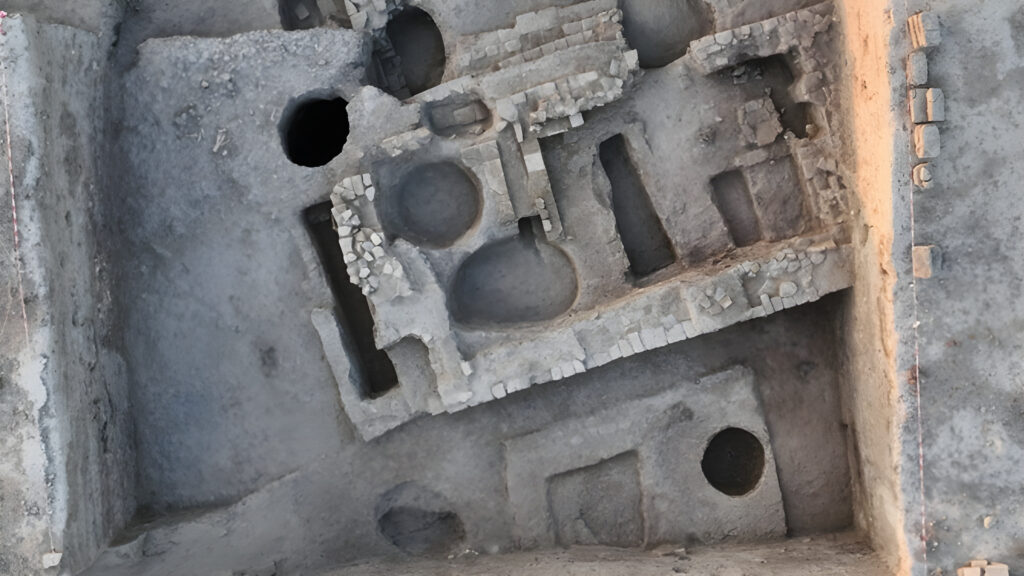
Archaeologists working at the ancient city of Otrar in Kazakhstan’s southern Turkistan Region have uncovered the first dakhma-type collective burial ever documented at the site. The excavations also revealed part of a Golden Horde-period mosque, a large stone-paved street and artifacts linked to Otrar’s extensive commercial connections.
The discoveries were reported by Kazakhstan’s Kazinform news agency on August 3, 2026. The excavation team was led by Professor Mukhtar Kozha, a chief researcher at the Archaeology Research Institute of Khoja Akhmet Yassawi International Kazakh-Turkish University. The work was supported by the International University of Tourism and Hospitality.
Five Building Layers Beneath Otrar
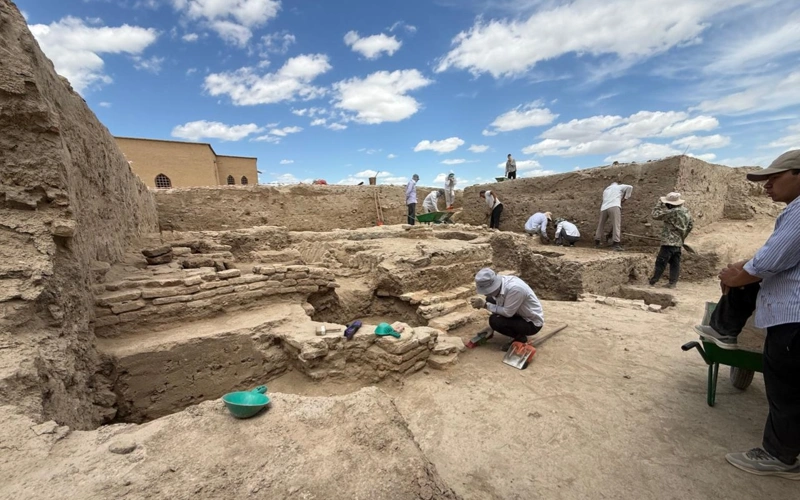
Fieldwork began in June 2026 and exposed archaeological remains belonging to five successive building horizons.
The upper levels contained residential and service rooms, brick-firing kilns, and brick-paved streets. In the fourth building horizon, archaeologists identified a collective burial described as dakhma-type.
The fifth and lowest excavated horizon contained walls belonging to a mosque dated through its ceramic finds to the 13th or 14th century. A broad street paved with large stones ran beside the building and continued into a staircase constructed from fired bricks.
According to Kozha, this is the first stone-paved street of such scale found at Otrar. Further excavation could establish its direction and reveal shops, public buildings or other structures that once stood along it.
What Is a Dakhma-Type Burial?
The term “dakhma” requires careful explanation because it has not always referred to the same type of funerary structure.
In Zoroastrian tradition, a dakhma is generally understood as a raised structure—often called a Tower of Silence—where bodies were exposed rather than buried directly in the earth. The practice was intended to prevent a corpse from contaminating sacred elements such as soil, water and fire.
In parts of Central Asia, however, the word was also used for raised funerary platforms, burial vaults or groups of tombs. The Shaybanid dakhma in Samarkand, for example, was an Islamic-period burial monument associated with members of the Shaybanid dynasty.
The Kazinform report describes the Otrar discovery only as a “collective burial place of the dakhma type.” It does not provide a complete architectural plan, a firm date for the burial or evidence showing that the structure was used for Zoroastrian exposure practices.
The safest interpretation is therefore that archaeologists have found an unusual collective funerary structure whose form resembles a regional type known as a dakhma. Its exact construction, chronology, and religious context will require further study.
Remains of Around 50 People Found Near the Mosque
Archaeologists found human remains belonging to approximately 50 individuals near the mosque. The bones will undergo anthropological examination before being reburied, according to the excavation team.
Only part of the mosque has so far been uncovered. Completing the excavation could clarify the building’s original dimensions and its relationship with the nearby burials, paved street and surrounding urban quarter.
Other finds include part of a painted window grille, fragments of an inkpot and metal fittings that may have belonged to a door or gate.
One of the most distinctive discoveries is an inscribed ring. Rings of this kind could serve as personal seals during the medieval period. Researchers have proposed two preliminary readings of the inscription: “Al-Mahdi” or “Al-Muluk.” The reading has not yet been conclusively established.
Chinese Coins Reveal Otrar’s International Connections
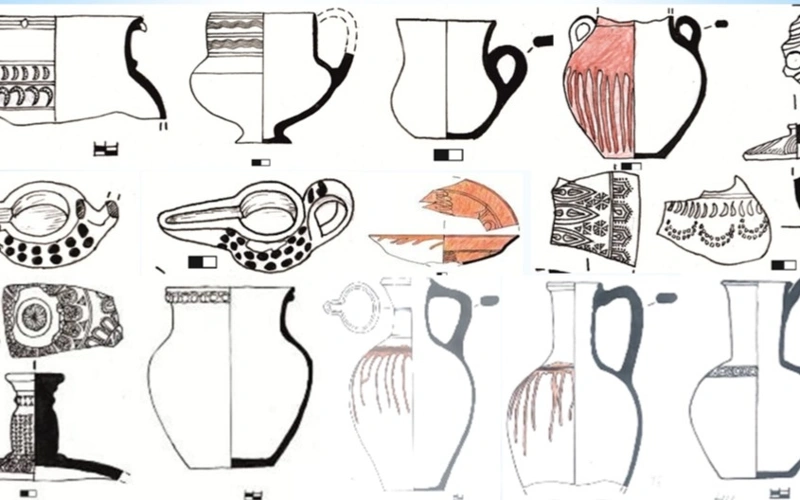
The excavation also produced fragments of ceramic vessels decorated with Chinese-style patterns, Chinese coins, and coins struck in the names of Golden Horde khans.
These objects support archaeological evidence that Otrar was connected to commercial and cultural networks extending across Central Asia and beyond. Imported objects and foreign artistic influences reached the city through the caravan routes that crossed the Otrar oasis.
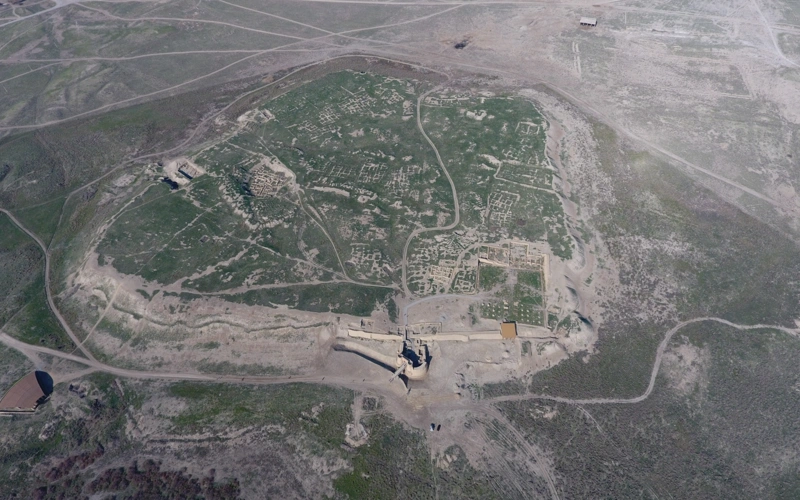
Located close to the Syr Darya and Arys river systems, Otrar stood at the junction of routes linking Central Asia’s settled agricultural regions with the Eurasian steppe. Historical routes connected the city with Taraz and eastern Turkestan, as well as Sogdiana, Khorezm, the Volga region, Iran and routes leading toward China and India.
Medieval sources also referred to the city as Farab or Tarban. It developed into the political and commercial center of an oasis containing numerous settlements, irrigation works and agricultural areas.
Otrar was destroyed during the Mongol invasion of the early 13th century but later recovered. Workshops, baths, religious buildings and commercial facilities once again made it one of southern Kazakhstan’s principal urban centers.
Earlier Excavations Revealed an Eighth-Century House
The new discoveries follow excavations conducted in Otrar’s suburban area in 2025.
Researchers uncovered several residential rooms, two of which contained mihrabs—architectural niches indicating the direction of Muslim prayer. The houses also contained raised platforms, tandir ovens, storage spaces, ritual features, waste pits, and ceramic installations associated with sanitation.
Charcoal taken from one of the tandir ovens was radiocarbon dated at a laboratory in Türkiye. The result placed the house in the mid-eighth century, providing evidence for an early Islamic-period residential quarter at Otrar.
Vessels with animal-shaped handles, relief-decorated lids, lamps and fragments of large storage jars resembled material known from archaeological sites in Sogdiana, Tashkent, the Fergana Valley and Zhetysu.
Conservation Work Begins
Conservation and protective work has begun on the newly exposed structures. Archaeologists believe the paved street and brick staircase could eventually help visitors understand the appearance and organization of medieval Otrar.
The ancient settlement is also one of the components included in Kazakhstan’s proposed Silk Roads: Fergana–Syr Darya Corridor, submitted to UNESCO’s World Heritage Tentative List in 2021.
Further excavation will be needed before researchers can determine the complete plan of the mosque and the date and precise function of the dakhma-type collective burial.
