
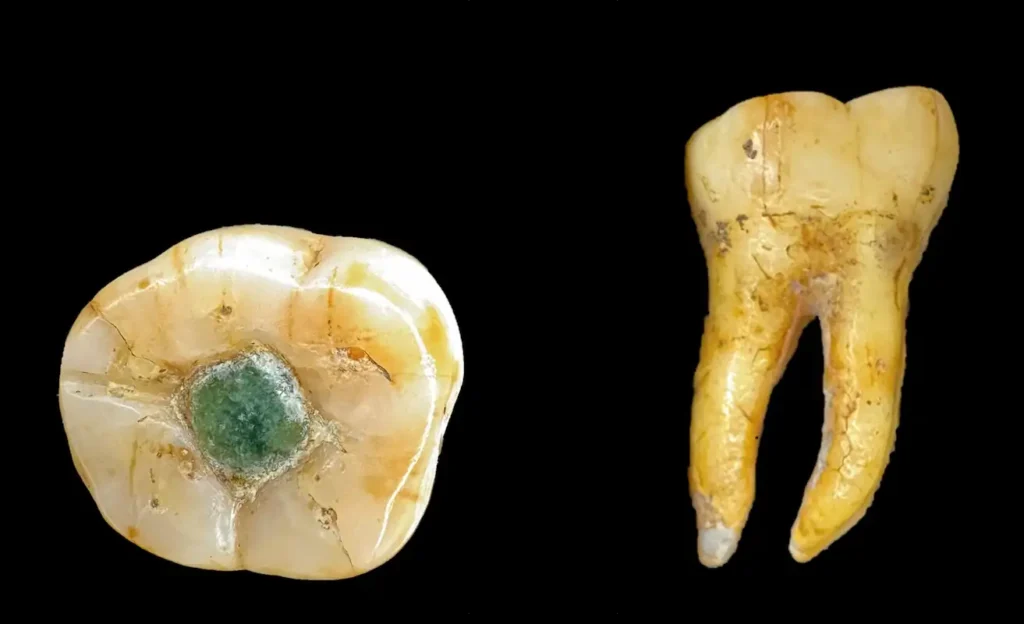
A remarkable archaeological discovery is reshaping what we know about ancient dental practices in Mesoamerica. Researchers have identified the first confirmed case of a gemstone filling inserted into a posterior tooth among the ancient Maya—challenging long-held assumptions that their dental modifications were purely aesthetic and limited to visible teeth.
The study, based on an isolated molar housed at the Popol Vuh Museum of Universidad Francisco Marroquín, presents compelling evidence that this intricate procedure was performed on a living individual. Yet, the true purpose behind it—medical, symbolic, or otherwise—remains an intriguing mystery.
A Unique Archaeological Find
The tooth in question is a lower left first molar dating to the pre-Hispanic Maya period. At the center of its chewing surface lies a carefully inserted green stone, likely jadeite—a material highly valued in Maya culture.
Unlike previously documented Maya dental modifications, which typically involved visible front teeth such as incisors and canines, this intervention was performed on a molar, a tooth hidden from view. This crucial detail immediately rules out purely decorative or social-display purposes.
Macroscopic examination revealed that the stone was precisely embedded in a cavity carved at the intersection of the molar’s four main cusps. The inlay sits flush with the tooth’s surface, ensuring it did not interfere with chewing—suggesting both technical skill and anatomical understanding.
Scientific Imaging Confirms Procedure During Life
To determine whether the gemstone was placed before or after death, researchers used cone beam computed tomography (CBCT), a modern imaging technique that allows detailed internal analysis without damaging the specimen.
The results were striking. The scans revealed extensive dystrophic calcification within the pulp chamber—mineral deposits that form as a biological response to stress or trauma. These calcifications were located directly beneath the carved cavity, indicating that the tooth’s living tissue reacted to the drilling process.
This provides strong evidence that the procedure was carried out while the individual was alive.
Additionally, the tooth’s internal structure—featuring a wide pulp chamber and well-defined root canals—suggests the individual was a young adult, likely between 24 and 30 years old.
Rethinking Maya Dental Practices
The Maya civilization are well known for their advanced and visually striking dental modifications. Archaeological evidence shows that they frequently drilled small holes into front teeth to insert decorative materials such as jade, turquoise, or hematite.
These practices were closely tied to identity, status, and beauty standards. However, they were almost exclusively limited to anterior teeth—those visible when speaking or smiling.
The newly discovered molar challenges this narrative.
Its hidden location strongly suggests that the procedure was not intended for visual display. Instead, researchers are exploring alternative explanations, including therapeutic or palliative purposes.
Was It Ancient Dental Treatment?
One leading hypothesis is that the gemstone inlay functioned as an early form of dental treatment.
The irregular shape of the cavity suggests it may have been carved to remove decayed tissue caused by a cavity. After cleaning the affected area, the practitioner could have inserted the stone as a filling to seal and protect the tooth.
Supporting this idea, previous studies on Maya dental materials have identified the use of natural resins and plant-based compounds with antibacterial and anti-inflammatory properties. These substances may have acted as a type of cement, helping to secure the inlay while also reducing the risk of infection.
Interestingly, while the CBCT scans did not reveal clear signs of active decay, researchers note that the drilling process itself may have removed all traces of the original cavity.
A Rare Example of Ancient Innovation
Dental interventions are not entirely unknown in ancient history. Evidence from prehistoric Europe and Asia shows that early humans used tools to clean cavities, drill teeth, and even apply substances like beeswax for protection.
However, the use of a gemstone as a filling material in a molar is unprecedented in the Maya world—and extremely rare globally.
This discovery highlights not only the technical sophistication of Maya dental practitioners but also their potential experimentation with treatments beyond aesthetics.
Or Something More Personal?
Despite the medical plausibility, researchers cannot rule out alternative explanations.
It is possible that the inlay had symbolic, ritualistic, or even personal significance unrelated to health or appearance. Without additional archaeological context—such as the individual’s burial site, social status, or associated artifacts—these interpretations remain speculative.
The tooth’s isolated nature is one of the study’s main limitations. Because it was collected without precise excavation records, key details about the individual and their cultural background are unknown.
Expanding the Understanding of Ancient Dentistry
Whether therapeutic or symbolic, this singular molar is reshaping our understanding of ancient dental knowledge in Mesoamerica.
It suggests that the Maya may have experimented with more complex and varied dental interventions than previously believed—including procedures that addressed pain, damage, or disease.
As researchers continue to investigate similar collections, more examples may emerge, helping clarify whether this was an isolated case or part of a broader, yet undocumented, practice.
For now, this tiny gemstone embedded in a molar stands as a powerful reminder: even in the ancient world, innovation often appears in the most unexpected places.
Mata-Castillo, E., Cucina, A., et al. (2026). A Prehispanic Maya molar with occlusal jadeite inlay. Journal of Archaeological Science: Reports, 72, 105731. https://doi.org/10.1016/j.jasrep.2026.105731
Cover Image Credit: External view of the molar. Occlusal surface with the jadeite stone view and buccal aspect view. E. Mata-Castillo et al. 2026, Journal of Archaeological Science: Reports
