
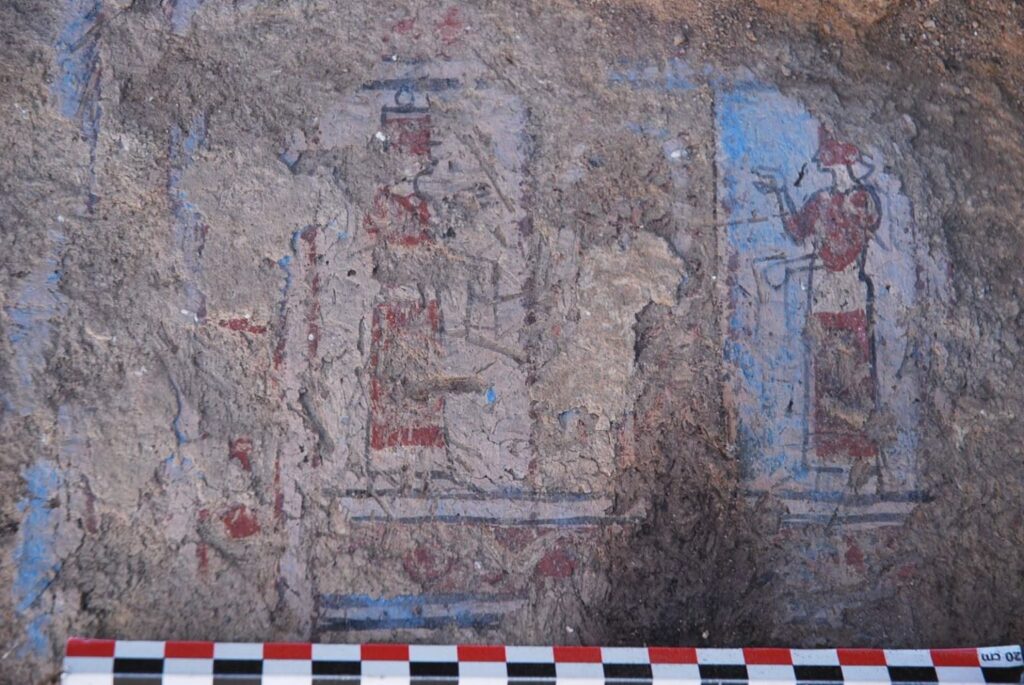
A joint French-Armenian archaeological mission has uncovered a rare painted wall panel at Erebuni Fortress in Armenia, with much of its original color still visible after more than 2,500 years.
The French Embassy in Armenia announced the discovery, describing it as an unprecedented find at the archaeological site. According to the preliminary dating, the mural may belong to the second half of the seventh century BC or the beginning of the sixth century BC—one of the most turbulent periods in the history of the Kingdom of Urartu.
The embassy has not yet released a detailed interpretation of the painting’s figures or decorative motifs. Its exceptional state of preservation, however, is already attracting attention. Ancient wall paintings are especially vulnerable because their pigments can fade or separate from the plaster following centuries of exposure to moisture, soil pressure and changing environmental conditions.
The newly uncovered panel could allow specialists to examine the materials, colors and techniques used by Urartian painters. Scientific analysis may also reveal how the painted surface was prepared and whether the pigments were produced from minerals available in the surrounding region.
A Fortress Built to Display Royal Power
Erebuni was founded in 782 BC by King Argishti I, one of Urartu’s most powerful rulers. The fortress was constructed on Arin Berd hill, overlooking the Ararat Plain in what is now the Armenian capital, Yerevan.
A cuneiform inscription discovered at the site records the foundation of Erebuni, providing unusually direct evidence for the establishment of the ancient settlement. Archaeologists have found 23 stone inscriptions at the site documenting the construction and development of the fortress under successive Urartian rulers.
Erebuni was not simply a military outpost. Its fortified walls enclosed temples, administrative buildings, storage rooms and residential areas. At the center of its religious complex stood a temple dedicated to Haldi, the chief deity of the Urartian kingdom.
Fragments of earlier frescoes discovered at Erebuni show that its buildings were once considerably more colorful than their surviving mud-brick and stone ruins suggest. Religious figures, geometric patterns and other decorative motifs covered the walls of important rooms, transforming the fortress into a carefully designed center of royal and sacred authority.
A Painting from Urartu’s Final Centuries
Urartu emerged as a major regional power during the ninth century BC. From its capital at Tushpa, near modern Van in eastern Türkiye, its kings controlled territories extending across parts of present-day Türkiye, Armenia and northwestern Iran. They built fortified cities, temples, canals and large storage complexes while competing with neighboring states, particularly Assyria.
The proposed date of the Erebuni mural places it close to the final phase of Urartian rule. During the late seventh and early sixth centuries BC, the political landscape of the ancient Near East was changing rapidly. Assyria had collapsed, new regional powers were emerging, and Urartu gradually disappeared from written records.
This makes the mural important not only as a surviving work of Urartian art but also as evidence from a poorly understood period in Erebuni’s history. Further excavation and laboratory analysis may determine where the panel originally stood, what it depicted, and whether it belonged to the fortress’s final Urartian occupation or the cultural transition that followed.
For now, its surviving colors offer a rare impression of how vivid Erebuni’s palaces, temples and ceremonial spaces must once have appeared.
Ambassade de France en Arménie (Embassy of France in Armenia)
Cover Image Credit: Ambassade de France en Arménie via Facebook
