
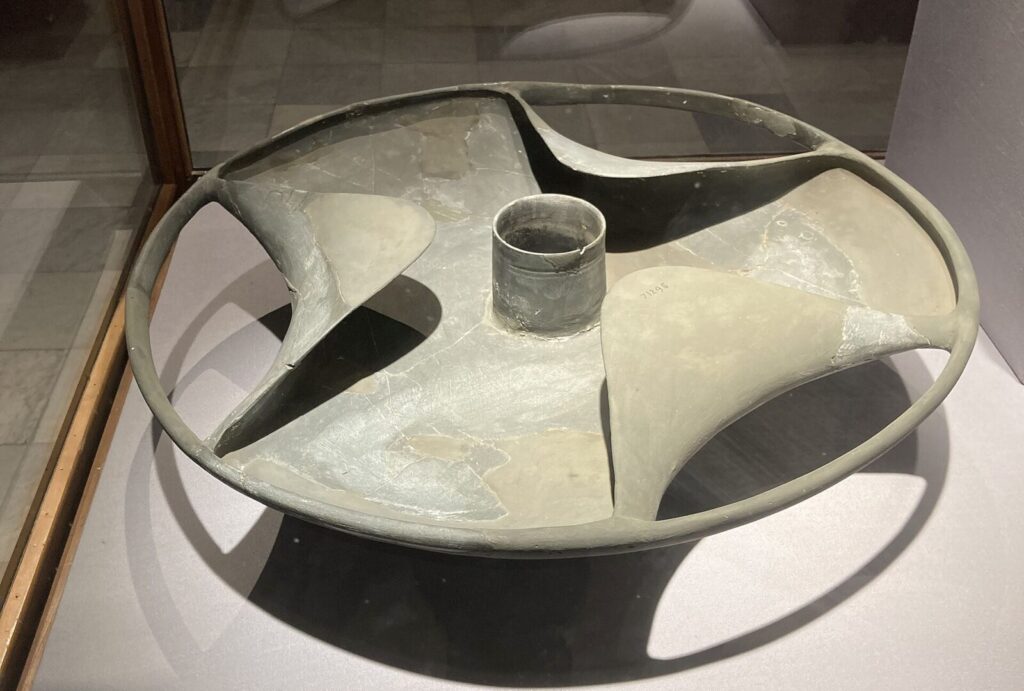
The Sabu Disk resists easy classification. Carved from schist and dated to Egypt’s First Dynasty, it bears three undulating lobes around a raised central collar — a form so unlike typical funerary ware that early observers likened it to machined components rather than ancient craft. Nearly 90 years after it emerged from a tomb at Saqqara, its purpose remains unresolved.
The artifact was discovered in 1936 by British Egyptologist Walter Bryan Emery while excavating Mastaba S3111 in northern Saqqara. The mud-brick tomb belonged to Sabu, a high-ranking official who lived during Egypt’s First Dynasty, when the newly unified kingdom was beginning to develop the institutions, artistic traditions, and monumental ambitions that would later define pharaonic civilization.
A Stone Vessel Unlike Any Other
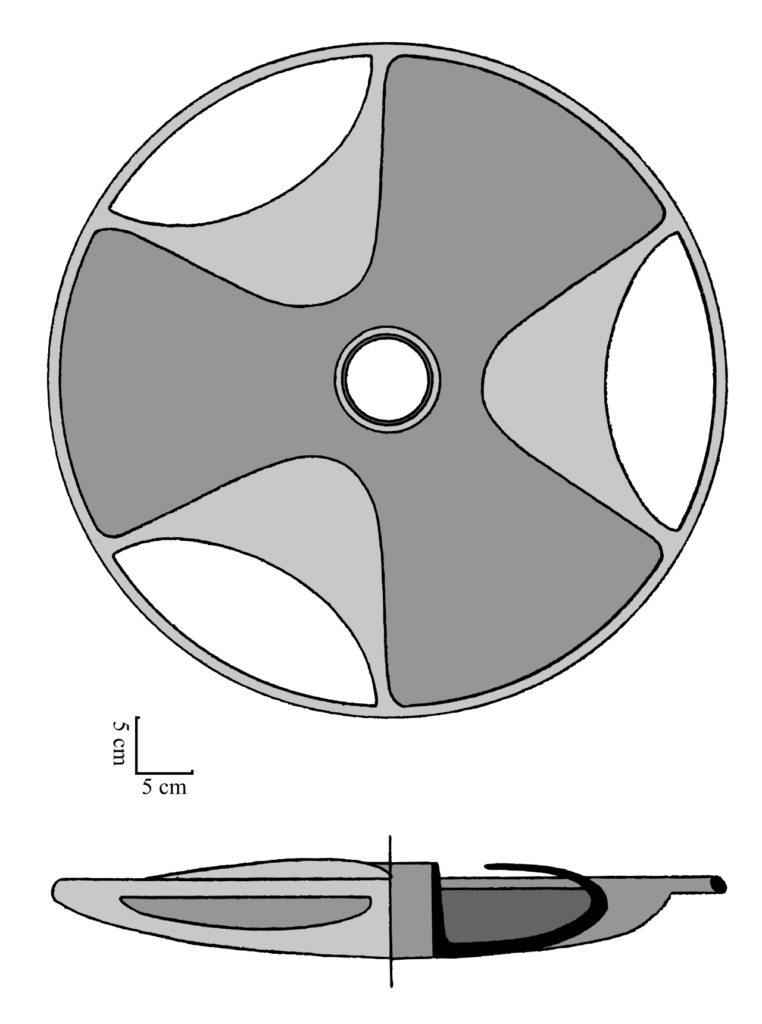
Measuring approximately 61 centimeters across and just over 10 centimeters high, the disk was carved from metasiltstone, a relatively delicate stone often described in older accounts as schist.
Its design is difficult to forget. Three thin, curved lobes rise from the shallow circular body and bend inward toward a central socket. The surviving outer rim connects the lobes in a shape that has been compared to a car hubcap, a propeller or an industrial turbine.
Those comparisons are modern, but the craftsmanship is unmistakably ancient Egyptian.
Stone vessels were not unusual during Egypt’s earliest dynasties. Craftspeople produced bowls, jars and ceremonial containers from materials that could be extremely difficult to shape. Yet no close parallel to the Sabu Disk’s three-lobed form has been identified among the many surviving vessels from the period.
The artifact was found broken and later reconstructed. Its damaged condition has not prevented its unusual geometry from becoming the subject of decades of debate.
Bowl, Lamp—or Something More Complicated?
The most cautious interpretation is also the simplest: the disk may have been an elaborate vessel created for ceremonial or funerary use.
Because it was placed inside a tomb, it could have held food, oil or another offering intended for Sabu in the afterlife. Its fragile material and thin projecting lobes would have made it poorly suited to heavy everyday use, supporting the possibility that it was primarily symbolic or decorative.
Another theory suggests that the stone object copied an earlier metal design. Ancient Egyptian craftspeople sometimes reproduced forms in stone that may originally have been developed in materials that rarely survived. If so, the disk’s curved elements might make more sense as an imitation of a thinner metal prototype.
Other explanations have been more adventurous. The object has been described as a large oil lamp, a device connected with brewing and even part of a system designed to move water. One study proposed that it could have functioned as a rotating tool for mixing grain and hot water during beer production.
None of these interpretations has been conclusively demonstrated.
The Machine Theories
Its mechanical appearance has inevitably pulled the Sabu Disk into the world of alternative history.
Online claims have presented it as an ancient turbine, pump component or evidence that early Egyptians possessed lost engineering technologies. Some versions go even further, linking the artifact to extraterrestrials or an unknown advanced civilization.
The problem is context.
No matching machinery, shafts, housings or associated mechanical installations were recovered from Sabu’s tomb. The disk’s stone is also too fragile for many of the high-speed or high-pressure functions proposed for it. Experiments with modern replicas may show that the shape can move water, but that does not prove that ancient Egyptians designed the original for that purpose.
An object can resemble a machine part without ever having been one.
A Mystery Surviving from Egypt’s Beginning
The enduring appeal of the Sabu Disk comes from the tension between its age and its appearance. It was created around five millennia ago, yet its curved, symmetrical form looks unexpectedly familiar to modern eyes.
That visual resemblance has generated countless theories, but the disk may ultimately belong to a category that archaeology often struggles to recover: objects whose meaning depended on ceremonies, materials or traditions that left little trace.
Today, the reconstructed vessel is held by the Egyptian Museum in Cairo. Its shape can be measured, reproduced and tested, but its original purpose remains beyond reach.
For now, Egypt’s ancient “hubcap” continues to do what it has done since 1936: invite explanations—and refuse to confirm any of them.
Emery, W. B. (1949). Great Tombs of the First Dynasty: Excavations at Saqqara (Vol. 1). Cairo: Government Press. Pages: 98- 99
