
15 February 2026 The Future is the Product of the Past

A Rare Glass Jewel Depicting the Crucifixion Found in an Abandoned Anglo-Saxon Village

Archaeological investigations ahead of the Sizewell C nuclear power station project in Suffolk have revealed a remarkable discovery: a rare medieval glass jewel depicting the Crucifixion, uncovered alongside evidence of an entire abandoned Anglo-Saxon village. The find adds a deeply human and spiritual dimension to one of the largest archaeological surveys ever conducted in eastern England.

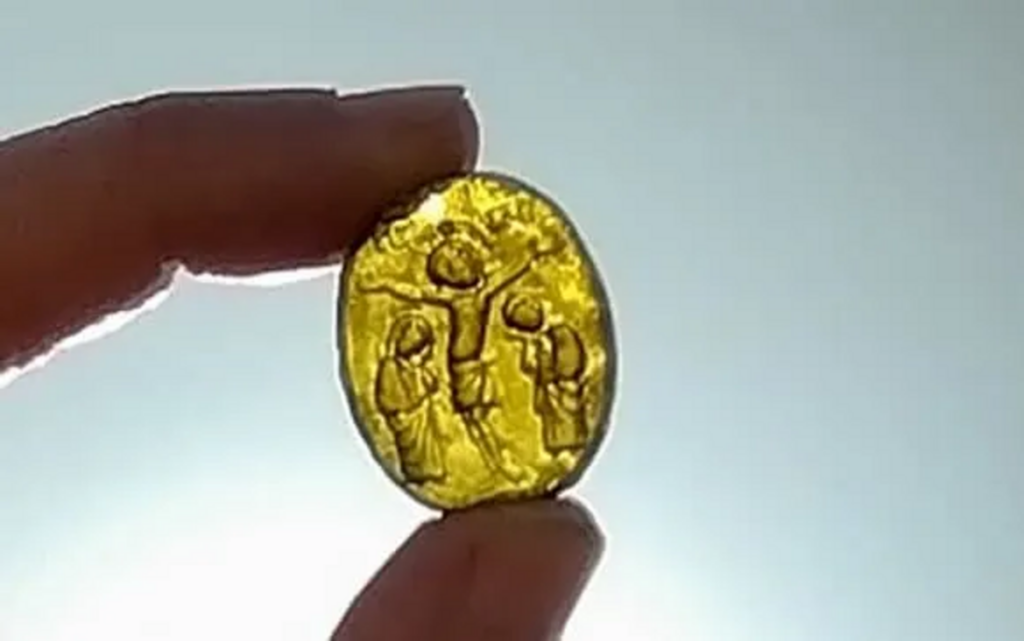
The jewel, a translucent light-green oval measuring just under an inch in height, was discovered by a keen-eyed excavator working with Oxford Cotswold Archaeology. Despite its small size, the object carries immense historical value. Cast in relief glass, it shows Christ on the cross flanked by the Virgin Mary and St John, with the Greek inscription “IC XC” above, an abbreviation for Jesus Christ. This iconography reflects strong Byzantine influence, even though the jewel itself was manufactured in 13th-century Venice, a major hub of medieval glassmaking and international trade.

Experts believe the piece was created using a mould either imported from Byzantium or crafted under Eastern Christian artistic traditions. The back of the jewel is bevelled, suggesting it was once mounted as a pendant or devotional object. When worn, it would have appeared more subdued than its current luminous appearance under direct sunlight.

While more than 200 similar glass reliefs are known across Europe, most lack archaeological context, having entered museum collections centuries ago without precise findspots. This makes the Sizewell discovery especially valuable. A closely related red-glass example is held by the British Museum, though even that object has inconsistencies in its historical description, highlighting how much context can be lost without controlled excavation.
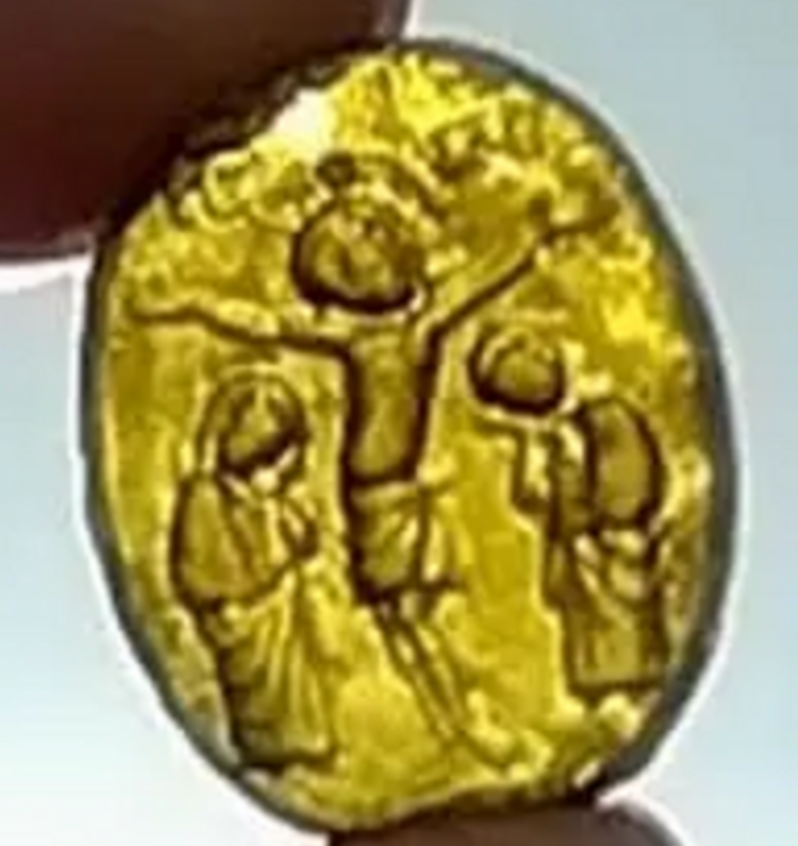
Experts believe the piece was created using a mould either imported from Byzantium or crafted under Eastern Christian artistic traditions.  Credit: Oxford Cotswold Archaeology
Experts believe the piece was created using a mould either imported from Byzantium or crafted under Eastern Christian artistic traditions. Credit: Oxford Cotswold Archaeology

The jewel was found close to the ruins of Leiston Abbey, raising the possibility that it was dropped by a medieval visitor or pilgrim. Leiston Abbey, founded in 1363 for the Premonstratensian order, has a layered history that mirrors the changing landscape of the Suffolk coast. The canons originally settled nearer the sea but were forced inland due to repeated flooding and storm damage. Stones from the earlier, Norman-period site were reused in the new abbey, embedding centuries of history into its walls. Today, the abbey remains a site of quiet character, with its thatched Lady Chapel restored for worship in the 20th century.


📣 Our WhatsApp channel is now LIVE! Stay up-to-date with the latest news and updates, just click here to follow us on WhatsApp and never miss a thing!!


Unlike common pilgrim badges of the medieval period, typically cast in cheap lead alloys and sold as souvenirs at holy sites, this glass jewel was a more personal devotional item. Pilgrim badges often depicted symbols associated with specific shrines, such as St Thomas Becket at Canterbury or St Werburga at Chester, and many examples have been recorded through the Portable Antiquities Scheme. The Sizewell jewel, however, was likely owned by someone of modest means but deep faith, reflecting private devotion rather than mass-produced pilgrimage culture.

Beyond the jewel itself, the Sizewell C excavations have uncovered traces of an entire Anglo-Saxon settlement, abandoned centuries before the medieval period. Suffolk is renowned for its rich archaeological heritage, from the royal burial ship at Sutton Hoo to Roman roads, medieval monasteries, and coastal trading sites. Its position along the North Sea made it a gateway for cultural exchange, invasion, and commerce, shaping its complex historical identity.

The discoveries at Sizewell demonstrate how modern infrastructure projects can, when carefully managed, unlock extraordinary insights into the past. As plans for the new power station progress, archaeologists continue to document and preserve finds that connect contemporary Britain with its deep and multifaceted history. The small green glass jewel, lost for centuries in Suffolk soil, now stands as a powerful symbol of faith, craftsmanship, and the enduring human presence beneath the modern landscape.

Cover Image Credit: Oxford Cotswold Archaeology.

Related Articles

A protected Punic-Roman tower “Tal-Wilġa” has been turned into a building site

15 August 2021

15 August 2021

The Tal-Wilga tower, one of Malta’s Punic-Roman heritage sites, is in danger from construction work near it. The Superintendent of...

New Archaeological Discoveries in Abu Dhabi shed light on Umm an-Nar Bronze Age culture (2700-2000 BCE)

1 February 2024

1 February 2024

New findings demonstrate the resilience and inventiveness of local Bronze Age societies (Umm an-Nar Bronze Age culture), as well as...

The discovery of great importance for Urartian archeology in Çavuştepe castle: Discovered a horse skeleton with a bronze curb bit in its jaw

28 September 2023

28 September 2023

Archaeologists unearthed a horse skeleton with a bronze curb bit (a metal piece inserted into its mouth to guide the...

Archaeologists Uncover 8 Graves Dated 6,500 Years Ago in Lausanne, Swiss

30 October 2021

30 October 2021

Archaeologists have unearthed eight prehistoric tombs between 5,500 and 6,500 years old in the Swiss town of Pully. The site...

Restoration Complete: Athena Temple in Side Reopens to the Public

24 March 2025

24 March 2025

The Athena Temple, once overshadowed by the more prominent Temple of Apollo, has emerged as a significant historical and cultural...

Marmore, the Highest and Oldest Artificial Waterfall in Europe, Created by the Romans

4 March 2024

4 March 2024

Approximately eight kilometers away from the town of Terni in Umbria, Italy, there is a waterfall that is one of...

‘Remarkable Archaeological Find’ Metal detectorist unearths Roman cavalry swords in North Cotswolds

18 September 2023

18 September 2023

Authorities announced Monday that two incredibly rare Roman cavalry swords were uncovered in the Cotswolds, England, during a metal detectorist...

Archaeologists in Peru discover a mummy tied with 800-year-old ropes

28 November 2021

28 November 2021

On Peru’s central coast, archaeologists discovered a mummy estimated to be at least 800 years old. The mummy’s body was...

Archaeologists Discover Old Bulgarian Inscription and Rich Finds at Nikopol Fortress Excavations

2 September 2025

2 September 2025

This summer’s archaeological season at the Nikopol Fortress has yielded one of the most remarkable discoveries in recent years: an...

A 2,000-year-old monumental Roman villa Found Under a Seaside May Be Pliny the Elder’s house

23 January 2024

23 January 2024

Researchers have discovered the remnants of a massive Roman villa thought to have ties to Pliny the Elder while working...

Sixth-Century Sword Unearthed in Anglo-Saxon Cemetery near Canterbury, England

28 December 2024

28 December 2024

A spectacular sixth-century sword has been unearthed in an Anglo-Saxon cemetery in southeast England, and archaeologists say it is in...

Largest Anglo-Saxon cemetery discovered in Britain illuminates ‘Dark Ages’

16 June 2022

16 June 2022

Archaeologists working on HS2 (the purpose-built high-speed railway line) have discovered a rich Anglo-Saxon cemetery in Wendover, Buckinghamshire, where almost...

In western Turkey, inscriptions and 2,500-year-old sculptures were found

11 July 2021

11 July 2021

Two 2,500-year-old marble statues and an inscription have been found during excavations at the ancient city of Euromos, in Turkey’s...

Hidden past of Ani ruins in eastern Turkey to be uncovered by excavations

31 May 2021

31 May 2021

Archaeological excavations will reveal the historical mystery behind the ruins of Ani on the present-day Turkey-Armenia border. The Ani archaeological...

The sword, thought to be a replica, turned out to be an authentic 3000-year-old Bronze Age sword

22 January 2023

22 January 2023

A sword in Chicago’s Field Museum that was previously thought to be a replica has been revealed to be an...