
15 February 2026 The Future is the Product of the Past

Anglo-Saxon Prince Buried With His Horse Discovered at Sizewell C Site

An elite Anglo-Saxon prince buried with his horse discovered during Sizewell C excavation in Suffolk, revealing rare 7th-century burial rituals and power.

Archaeologists working ahead of the construction of the Sizewell C nuclear power station in Suffolk have uncovered one of the most significant Anglo-Saxon burial grounds found in Britain in recent decades. The discovery, made during large-scale excavations along the Sizewell Link Road near Theberton, includes a rare “princely” burial featuring two individuals interred alongside a fully harnessed horse, weapons, and high-status personal items.

The burial site dates to the 6th and 7th centuries AD, a formative period in early medieval England when Anglo-Saxon kingdoms were consolidating power following the end of Roman rule. Excavations led by Oxford Cotswold Archaeology (OCA) identified at least 11 burial mounds, or barrows, carefully positioned on a prominent point in the landscape overlooking the Suffolk coast. The layout and richness of the graves suggest the cemetery belonged to an elite community with strong political and symbolic authority.

According to OCA Project Officer Len Middleton, the horse burial stands out as evidence of a ruling-class individual or family. Horse burials were exceptionally rare in Anglo-Saxon England and were reserved for people of the highest status, often linked to warrior aristocracy and kingship. Similar elite traditions are known from famous sites such as Sutton Hoo, Snape, and the Prittlewell Prince, all located in eastern England.
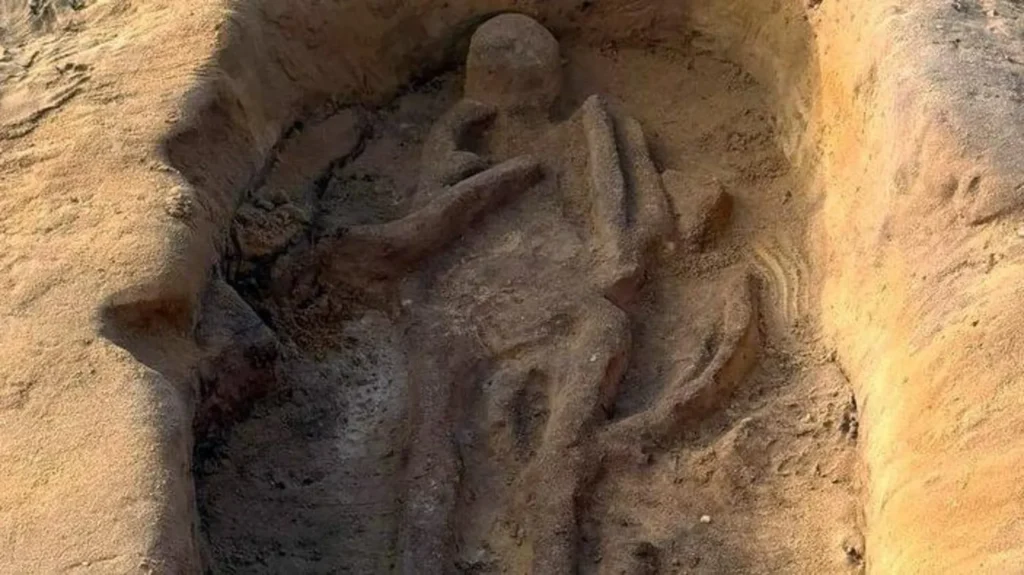
Silver and copper bowls and glass beads recovered from the excavation, alongside detailed sand silhouettes revealing an adult and child buried together. Credit: Oxford Cotswold Archaeology

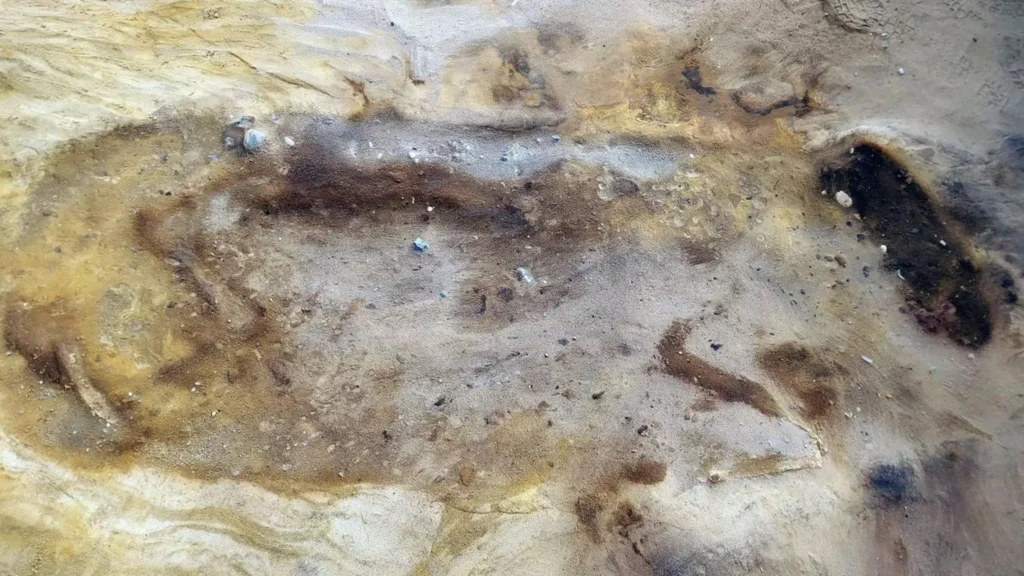
Although the acidic, sandy soil has prevented the survival of human bone, archaeologists uncovered striking “sand silhouettes” that preserve the outlines of bodies, grave goods, and the horse in remarkable detail. These traces have allowed specialists to reconstruct burial positions, grave furnishings, and ritual practices with a high degree of accuracy.


📣 Our WhatsApp channel is now LIVE! Stay up-to-date with the latest news and updates, just click here to follow us on WhatsApp and never miss a thing!!


The finds provide valuable insight into Anglo-Saxon belief systems, where burial rituals were closely tied to ideas of identity, ancestry, and power. During this period, grave goods such as weapons, jewelry, and vessels symbolized social rank and may also have reflected beliefs about the afterlife. The inclusion of a horse suggests not only wealth, but also the symbolic importance of mobility, warfare, and leadership in Anglo-Saxon culture.

The Anglo-Saxons were a collection of Germanic-speaking groups who settled in England from the 5th century onwards, forming kingdoms such as East Anglia, Wessex, and Mercia. East Anglia, where the Sizewell site is located, emerged as a major center of power during the 7th century. Its coastal position facilitated trade and cultural connections with Scandinavia and continental Europe, which is often reflected in elite burial practices.

Beyond the Anglo-Saxon cemetery, the Sizewell C project has revealed an extraordinary archaeological record spanning tens of thousands of years. Across more than 70 excavation sites covering nearly two million square metres, over 200 archaeologists are documenting evidence ranging from Neanderthal activity to Second World War coastal defenses. Notable discoveries include a rare Iron Age oak ladder, Roman pottery kilns, Bronze Age cremation urns, and early Neolithic settlement remains.

Archaeologists believe this medieval pilgrim badge was likely dropped by a visitor to Leiston Abbey, uncovered during excavations linked to the Sizewell C project. Credit: Oxford Cotswold Archaeology

In 2023, archaeologists also uncovered a hoard of over 300 silver coins dating to the 11th century, believed to have been buried during a period of political instability in late Anglo-Saxon England. Nicknamed “the pasty” due to its shape, the hoard is thought to represent a personal savings cache and has since been donated to Suffolk County Council for curation and research.

Some of the most important discoveries from the Sizewell excavations will be featured on BBC Two’s Digging for Britain, helping to bring public attention to the archaeological importance of the site. Community open days and exhibitions are also planned to ensure the finds are shared with local residents and the wider public.

Nigel Cann, Chief Executive Officer of Sizewell C, said the discoveries demonstrate how major infrastructure projects can contribute positively to heritage research. Archaeologists and developers have worked closely to ensure all remains are carefully recorded and preserved for future generations.

As construction continues, the Sizewell C excavations are offering an unparalleled window into the deep history of the Suffolk coast. The elite Anglo-Saxon burial ground, in particular, is reshaping understanding of early medieval society, revealing how power, belief, and identity were expressed in one of England’s most influential early kingdoms.

Cover Image Credit: The remains of an Anglo-Saxon pony, about 1.4m (4ft 6in)-tall, was found buried alongside the shadow skeletons of two people. Oxford Cotswold Archaeology

Related Articles

8,000-year-old Female Figurine Discovered in Ulucak Höyük in Western Türkiye

15 August 2024

15 August 2024

One of the most prominent and oldest Neolithic sites found in what is now Turkey has yielded yet another interesting...

Visit Baalbek’s Famous Temples with a Free 3d Virtual Tour

10 April 2021

10 April 2021

Baalbek, which has traces of settlement since 9000 BC, was one of the cornerstones of ancient civilizations. The famous Baalbek temple...

2000-year-old anchor discovered at the bottom of the North Sea

26 September 2022

26 September 2022

A possible Iron Age anchor made from wrought iron was found at the bottom of the southern North Sea during...

Rich Votive Deposit Discovered in the Valley of the Temples of Agrigento

10 August 2023

10 August 2023

At least sixty terracotta figurines, female protomes, and busts, oil lamps, and small vases, a rich votive deposit of bronze...

In Moravia, archaeologists discover divine thrones, thousands of artifacts and a new settlement

13 August 2021

13 August 2021

During a four-year dig in the Moravian city (Czech Republic) of Perov, rare gems, mysterious burial places, and divine thrones...

Unearthing the Epic: New Finds Bolster Links to Legendary Trojan War

8 July 2025

8 July 2025

The legendary Trojan War, long enshrined in myth and Homeric epic, may be moving closer to historical validation as archaeologists...

Marvelous Marble Floor Of Sunken Roman Villa Restored in Bacoli

19 July 2024

19 July 2024

In Bacoli, Italy, an underwater restoration project has uncovered the marvelous marble floor of a submerged Roman villa. This remarkable...

Terracotta Figurines of the ancient cult of the goddess Cybele discovered in Pompeii Domus

26 December 2023

26 December 2023

Archaeologists unearthed 13 terracotta figurines during recent excavations in the Domus adjacent to the “House of Leda and the Swan”...

Celtic Traditions Endured Long After Roman Conquest: Archaeological Research in Saarland Reveals a Hybrid Past

20 September 2025

20 September 2025

Excavations in Oberlöstern uncover burial mounds, villas, and monuments that blend Celtic and Roman traditions—tracing the roots of European identity....

A Medieval Barbican and a Network of Passages Uncovered in Western Slovakia’s town of Trenčín

5 December 2024

5 December 2024

A medieval barbican (fortified outpost or fortified gateway), and a network of passages that acted as a sewerage system have...

Bosphorus Was Frozen, People Crossed By Walking

14 February 2021

14 February 2021

The calendars showed the year 1954. Istanbul was experiencing an extremely freezing winter after many years. Heavy snowfall, hard enough...

New study says earliest recorded kiss occurred 4500 years ago in Mesopotamia

18 May 2023

18 May 2023

The University of Copenhagen according to researchers, humanity’s earliest recorded kiss occurred around 4,500 years ago in the ancient Middle...

Archaeologists discover a “Seleucid satrap tomb” in the ancient Greek (Seleucids) city of Nahavand in Iran

16 May 2022

16 May 2022

Archaeologists announced on Saturday that they discovered a tomb believed to be the tomb of a Seleucid satrap or general...

A 2,000-Year-Old Roman Inkwell Found in Portugal Contains a Technological Recipe That Shouldn’t Exist

17 November 2025

17 November 2025

A 2,000-year-old Roman inkwell found in Conimbriga reveals an advanced mixed-ink formula, challenging what we know about ancient writing technology...

Rare Langsax fighting blade with Viking origins discovered in Poland

20 August 2021

20 August 2021

Archaeologists working in the Wdecki Landscape Park in Poland’s Kujawsko-Pomorskie Voivodeship have discovered a rare langsax long knife with potential...