
11 November 2025 The Future is the Product of the Past

Sixth-Century Sword Unearthed in Anglo-Saxon Cemetery near Canterbury, England

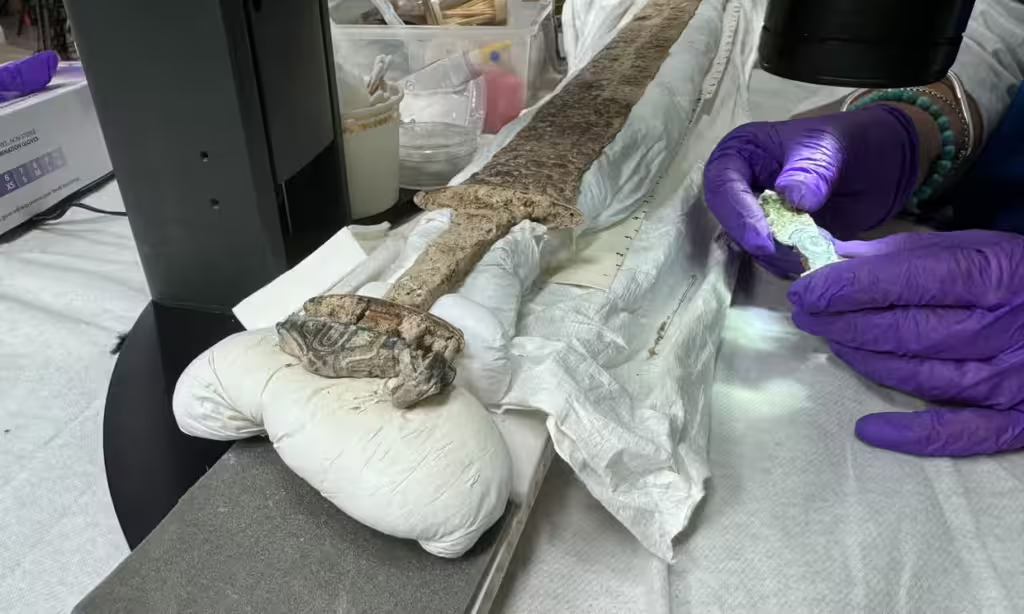
A spectacular sixth-century sword has been unearthed in an Anglo-Saxon cemetery in southeast England, and archaeologists say it is in an exceptional state of preservation and is similar to the sword found at Sutton Hoo, an Anglo-Saxon cemetery in Suffolk.

The find was made in a rural area close to Canterbury, but the exact location is being kept a secret by experts because they have discovered so many valuable artifacts.

The sword bears a silver-and-gilt hilt and runic inscriptions along the blade. According to archaeologists, the prominent feature on the sword is a ring attached to its pommel, indicating an oath to a king or person of high status. Traces of the leather and wood scabbard lined with beaver fur were also recovered. The grave also contained a gold pendant inscribed with a serpent or a dragon.

“It’s really incredible, in the top echelons of swords, an elite object in every way, which is wonderful. It rivals the swords from Dover and from Sutton Hoo,” stated Duncan Sayer, the lead archaeologist and Professor of Archaeology at the University of Central Lancashire in an interview with The Guardian.

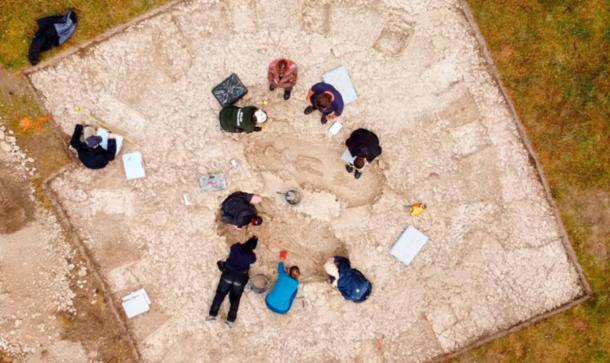
Some 12 burial patches in the early medieval cemetery site have so far been explored with up to 200 more still waiting to be examined.


📣 Our WhatsApp channel is now LIVE! Stay up-to-date with the latest news and updates, just click here to follow us on WhatsApp and never miss a thing!!


Aerial image of the Anglo-Saxon graveyard under excavation, to be revealed on Digging for Britain in January. Credit: Production/BBC/Rare TV

The gold pendants with a snake or dragon have been worn by high-status women or thought to have been treasured keepsake from a female relative or ancestor

The differences between the findings in the graves of men and women are even more fascinating. Swords, spears, and shields were discovered inside the men’s graves. Knives, buckles, brooches, and other artifacts were discovered in the women’s graves.

Scandinavian and Frankish origin artifacts were found in other graves at the Anglo-Saxon cemetery; the Scandinavian items belonged to a woman who lived in the late fifth century.

Historian and TV presenter Professor Alice Roberts will reveal more details about the discoveries in an upcoming BBC show – the six-part Digging for Britain – which starts in early January.

Professor Alice Roberts, stated: “I’ve never seen one that’s so beautifully preserved. It’s an extraordinary Anglo-Saxon cemetery, with really beautifully furnished graves, a lot of weapon burials where you find things like iron spear points and seaxes, which are Anglo-Saxon knives – and then there’s this astonishing sword.”

The items found will undergo a thorough examination before going on display at Folkestone Museum.

Cover Image Credit: Prof Alice Roberts/BBC/Rare TV

Related Articles

Rare African Script Offers Clues to the Evolution of Writing Systems

4 February 2022

4 February 2022

The world’s very first invention of writing took place over 5000 years ago in the Middle East, before it was...

Monumental Roman complex discovered in France

19 March 2023

19 March 2023

In the city of Reims in northeastern France, archaeologists have discovered an ancient Roman-era monumental complex dating from the 2nd...

City swallowed by sea now center of boat tours

10 September 2023

10 September 2023

The Kekova region, or Sunken City, which has remained under the sea after two major earthquakes in the sixth century...

Prehistoric Masterpiece Discovered in Northern Sweden: White Quartzite Arrowhead

12 July 2025

12 July 2025

A bifacially crafted arrowhead made of white quartzite has become the most remarkable discovery at an archaeological excavation in northern...

A Polish-Croatian team discovered Ancient Roman Temple under a Croatian 18th Century church

24 November 2022

24 November 2022

Under an 18th-century church, the Church of St. Daniel in Danilo near Sibenik, Croatia, the foundations of an ancient Roman...

Israeli Archaeologists discover two shipwrecks filled with treasure

22 December 2021

22 December 2021

Israeli archaeologists have been discovered ancient artifacts and treasures amid the wrecks of two ships on the seafloor off the...

Earliest Known Stone Mold for Coin Production in Roman Hispania Unearthed

27 March 2025

27 March 2025

Researchers from the University of Jaén have made a groundbreaking discovery at the archaeological site of Obulco, modern-day Porcuna, revealing...

A Ribat Mosque shares space with the Roman sanctuary dedicated to Sun and Ocean was discovered in Portugal

2 November 2023

2 November 2023

The ruins of a second Islamic ‘ribat’ mosque dating back to the 11th and 12th centuries have been discovered at...

6,500-Year-Old Neolithic Circular Enclosures Discovered in Rechnitz, Austria

10 September 2025

10 September 2025

Rechnitz, Burgenland (southeastern Austria, near the Hungarian border) – Archaeologists have uncovered extraordinary traces of Neolithic life dating back more...

Archaeologists may have uncovered a 13th-century castle in Shropshire

7 August 2021

7 August 2021

Archaeologists have been working on a mound of land in Wem, Shropshire, that belongs to Soulton Hall, Elizabethan mansion and...

5000-year-old fingerprint found in Orkney pottery

23 April 2021

23 April 2021

Fingerprints were found on a pottery dating back 5,000 years in the Orkney archipelago, located in the northern region of...

3,000-Year-Old Eyeliner Innovative Formula Discovered in Iran: A Unique Iron Age Kohl Without Lead

17 July 2025

17 July 2025

Ancient black eyeliner found in Iron Age graves reveals a previously unknown cosmetic recipe using graphite and manganese oxide, predating...

The 3,000-Year-Old Ancient City is Under Danger

8 February 2021

8 February 2021

For the port planned to be built in Izmir’s Aliağa district, a part of the 3,000-year-old ancient city is in...

Rare Beetle Ornament Found in 2,500-Year-Old Hallstatt Period Child’s Burial

9 September 2025

9 September 2025

Archaeologists working in south-west Poland have made a remarkable discovery: a funerary ornament crafted from beetle parts, buried with a...

15 new sculptures discovered in Turkey’s sculpture paradise Yesemek

8 December 2021

8 December 2021

Archaeologists discovered 15 new sculptures during recent digs around the Yesemek Open Air Museum and Sculpture Workshop in the Islahiye...