
12 June 2026 The Future is the Product of the Past

7,000-Year-Old Temple at Risk: Urgent Calls to Save Santa Verna Archaeological Site in Gozo

Archaeologists and heritage conservationists are sounding the alarm over continued development near the Santa Verna archaeological site, a prehistoric temple complex deemed one of Malta’s most invaluable cultural landmarks. Despite decades of discoveries that highlight the site’s profound historical importance, construction projects persist in its immediate surroundings—sparking outrage and urgent pleas for intervention.

The Santa Verna Temple, located in the village of Xagħra on the island of Gozo, boasts a timeline that stretches back to circa 5000 BCE, spanning all phases of the Maltese prehistoric era. Initially excavated in 1908 and again in 1911, the site revealed a trefoil-shaped temple layout, along with two remarkably preserved human skeletons, suggesting the area held ritualistic or burial significance.

Subsequent excavations, including major efforts in 1961 and comprehensive surveys between 1987 and 2015, further confirmed Santa Verna’s status as a five-apsed megalithic temple. Findings included substantial in-situ stone structures, lime concrete floors, undisturbed stratigraphic soil layers, and rare artefacts like snail figurines and globigerina limestone polygonal paving.

“This is not just a local heritage site — Santa Verna holds clues to understanding the evolution of temple architecture, early agrarian life, and spiritual practices in the Neolithic Mediterranean,” said a spokesperson from Flimkien Għall-Ambjent Aħjar (FAA), a leading Maltese environmental NGO.

In 2015, a pivotal excavation unearthed ceramic fragments, animal bones, and environmental samples dating back to the Għar Dalam and Skorba periods (5000–4100 BCE), suggesting the temple was built on an even earlier settlement. These finds demonstrate the site’s dynamic history, from early habitation to its transformation into a ceremonial complex.


📣 Our WhatsApp channel is now LIVE! Stay up-to-date with the latest news and updates, just click here to follow us on WhatsApp and never miss a thing!!


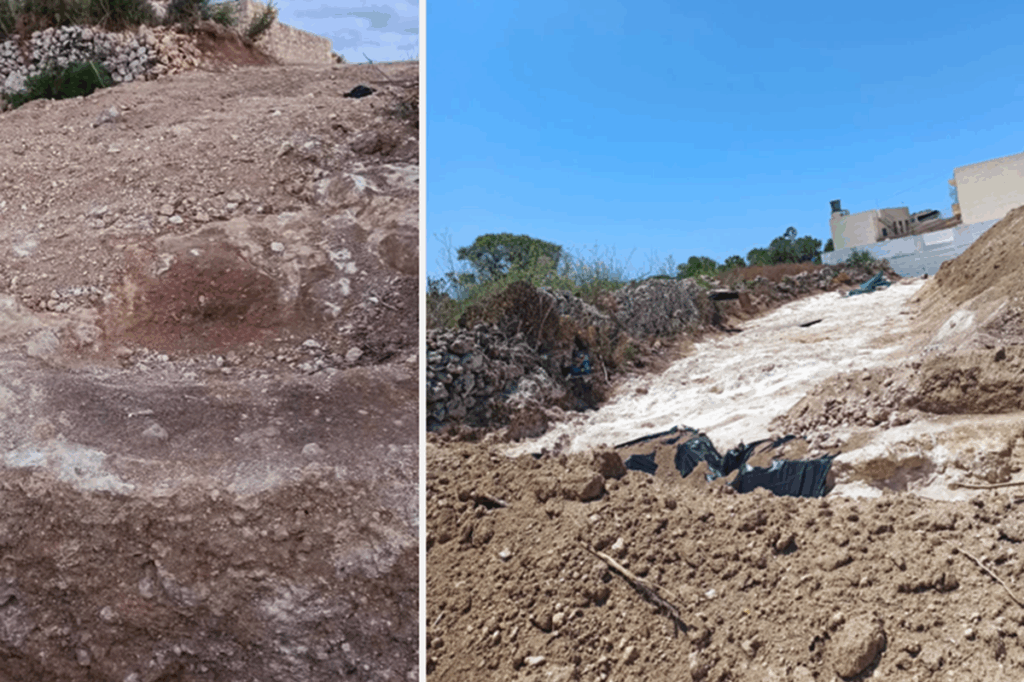
Works near the archaeological site in Xagħra, Gozo. Credit:   Flimkien Għall-Ambjent Aħjar (FAA)
Works near the archaeological site in Xagħra, Gozo. Credit: Flimkien Għall-Ambjent Aħjar (FAA)

Heritage at Risk: Calls for Protection Ignored

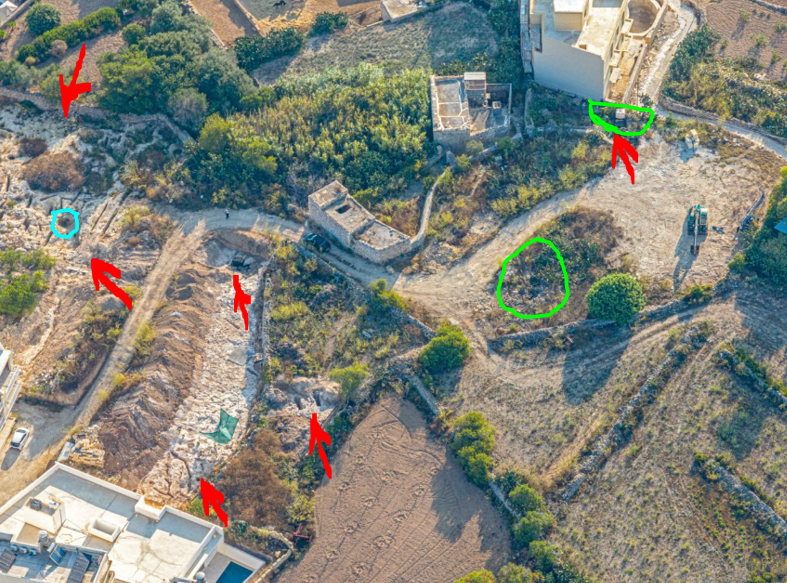
Despite this extensive body of evidence, the Superintendence of Cultural Heritage (SCH) initially claimed that no archaeological features were present in the zones earmarked for development—a claim later contradicted by the discovery of human skulls reported by concerned residents. FAA has condemned what it describes as “systemic negligence” in the handling of heritage preservation and is demanding an immediate moratorium on all nearby construction activity.

“Using heavy machinery on or near archaeological deposits, discarding unearthed human remains, and the absence of scientific monitoring are signs of cultural vandalism, not progress,” FAA stated.

Why Santa Verna Deserves World Attention

Unlike the more widely recognized Ġgantija and Ħaġar Qim temples, Santa Verna remains largely uncelebrated in global discourse, despite its equally significant archaeological footprint. Its continuous occupation through different prehistoric phases offers unmatched insight into early Maltese civilization.

The site’s distinct architectural features, such as its polygonal paving and multi-phase temple modifications, challenge conventional understanding of Neolithic construction techniques. Additionally, the presence of rare items like snail-shaped figurines and the scientific precision of recent excavations, including geophysical surveys conducted by the FRAGSUS Project, reveal the site’s untapped research potential.
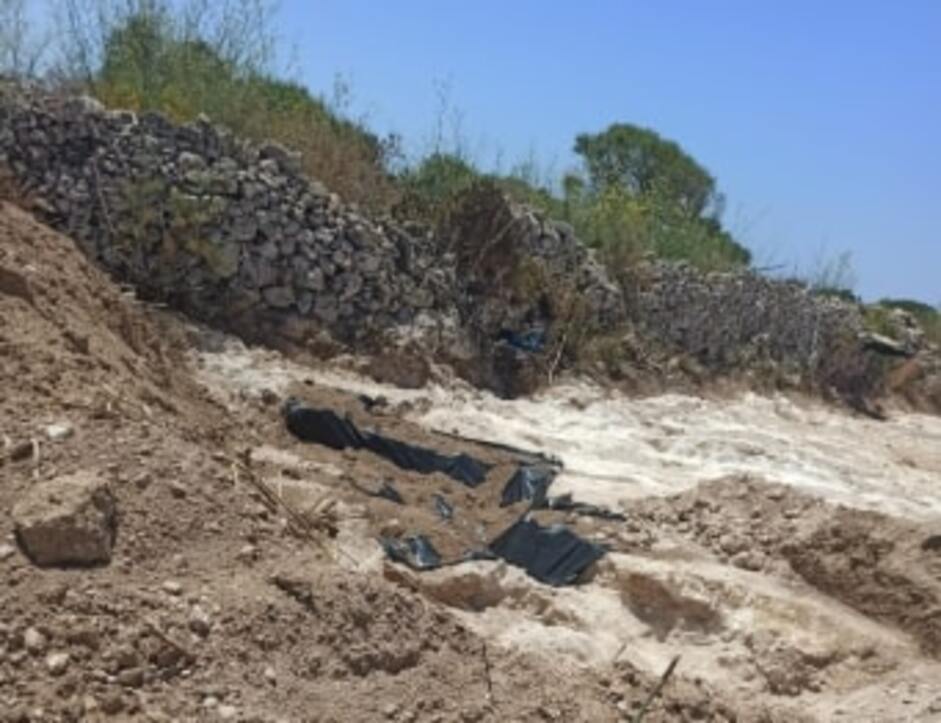
Flimkien għal Ambjent Aħjar demands immediate halt to construction near Santa Verna temple. Credit:   Flimkien Għall-Ambjent Aħjar (FAA)
Flimkien għal Ambjent Aħjar demands immediate halt to construction near Santa Verna temple. Credit: Flimkien Għall-Ambjent Aħjar (FAA)

Urgent Need for Protection and International Support

FAA and other experts argue that Santa Verna should be included in UNESCO’s tentative list of World Heritage Sites, alongside its neighboring Ġgantija complex. They also stress the need for updated national policies on development near archaeologically sensitive zones and for public awareness campaigns to foster respect for Malta’s prehistoric legacy.

Conclusion

The case of Santa Verna is more than a local issue—it is a cautionary tale for how modern development, when left unchecked, can irreversibly damage our connection to the ancient world. With mounting evidence of its cultural and scientific importance, the time to act is now.

Cover Image Credit: Sta Verna Temple in Xagħra, Gozo.

Related Articles

Two more Giants discovered at Mont’e Prama in Sardinia, Italy

7 May 2022

7 May 2022

Two more Giants have emerged from the Mont’e Prama excavations in Sardinia: both of the new statues have been described...

Iron Age Fortification Unearthed on the Trave: A Forgotten Stronghold of the Roman Imperial Period

26 September 2025

26 September 2025

Archaeologists investigating the Stülper Huk, a headland on the River Trave located in the German federal state of Schleswig-Holstein, have...

Sacred Seduction: Kamasutra Feminism and the Legacy of Ancient Erotic Temples

8 April 2025

8 April 2025

For many, the Kamasutra is merely a name linked to condom brands and erotic chocolates, often dismissed as just a...

Only Known Iberian Wolf Ceramic Unearthed in Cunit Archaeological Site

24 March 2026

24 March 2026

A remarkable archaeological focus has emerged from the coastal region of northeastern Spain, where recent attention on the Corral del...

Minoan civilization may have used celestial navigation techniques

3 March 2023

3 March 2023

According to a study done by an American researcher at the University of Wales, ancient civilizations may have used celestial...

Laodikeia’s Roman Asopos Bridge Carries Water Again After 1,300 Years

2 March 2026

2 March 2026

After more than a millennium of silence, water is once again flowing beneath the monumental arches of the Laodikeia Asopos...

The 2800-year-old Urartians Lake, which is an engineering masterpiece of its time, is drying

13 July 2023

13 July 2023

Keşiş Lake in Van, in eastern Turkey, which was built by the Urartu King Rusa 2,800 years ago, was negatively...

Discovery in Georgia Reveals How Bronze Age Smelters Sparked the Iron Age

1 October 2025

1 October 2025

A groundbreaking study from Georgia’s Kvemo Bolnisi site reveals that Bronze Age metallurgists were experimenting with iron oxides long before...

Celtic gold rainbow cup coin discovered in Bavaria

12 September 2023

12 September 2023

An extremely rare “rainbow cup” Celtic coin dated to the second or first century B.C. has been discovered next to...

3,200-Year-Old Temple Mural of Spider God in Peru

25 March 2021

25 March 2021

Archaeologists in northern Peru have discovered a 3200-year-old mural. The mural was painted on the side of an ancient adobe...

New Elymaean Rock Carving in Iran Shows Possible Parallels with the Hercules–Hydra Motif Known from 325 BC Greek Coinage

21 December 2025

21 December 2025

A newly discovered Elymaean rock carving in southwest Iran is drawing significant scholarly attention for its unusual iconography and its...

New Churches Discovered in Türkiye’s “Thousand and One Churches” Reveal Lost Byzantine Pilgrimage Center

11 April 2026

11 April 2026

A series of fresh archaeological findings in central Anatolia is reshaping what scholars know about one of the region’s most...

Exciting Discovery of oldest English coin in Canada

16 November 2022

16 November 2022

A gold coin found on the south coast of Newfoundland, Canada’s easternmost province, may be the oldest known English coin...

New Huge Viking-age boat grave discovered by Radar in Norway

12 April 2022

12 April 2022

Archaeologists have located a boat grave from the Viking Age near Øyesletta in Norway during a ground-penetrating radar (GPR) survey....

Researchers use AI to read words on ancient Herculaneum scroll burned by Vesuvius

13 October 2023

13 October 2023

Researchers used artificial intelligence to extract the first word from one of the first texts in a charred scroll from...