
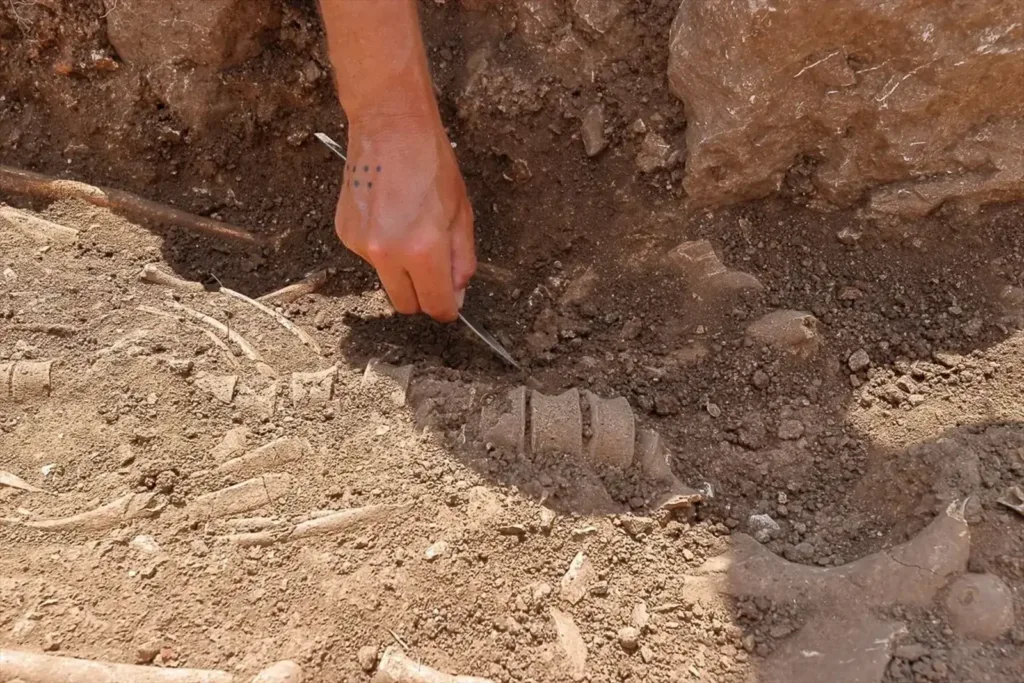
Archaeologists have uncovered a new set of tombs dating back roughly 2,300 years at Hattusa, the ancient capital of the Hittite Empire in central Türkiye, shedding fresh light on burial customs from a lesser-known chapter of the site’s long history.
Located in the Boğazkale district of Çorum province, Hattusa was once the political and cultural heart of the Hittites, one of the earliest civilizations of Anatolia, serving as their capital for around 450 years. The ancient city spans two square kilometers and is still ringed by roughly seven kilometers of fortification walls. Excavations at the site — recognized by UNESCO as both a World Heritage Site and part of the Memory of the World program- have been ongoing since 1906, gradually revealing traces of human settlement stretching back some 8,000 years, including layers from the Chalcolithic period, the pre-Hittite era, the Hittite period itself, the Iron Age, and later Galatian, Byzantine, and Roman occupation.
The current excavation season, led by Prof. Dr. Andreas Schachner of the German Archaeological Institute, is being carried out at five separate points across the site. It was on the city’s Northwest Slope that the team came across the newest discovery: a previously unknown cemetery containing three tombs, believed to date to the Early Hellenistic and Galatian periods.
One grave in particular stood out to the excavation team. Its stone architecture was unusually well preserved, and the skeleton inside was found completely intact — a rarity among burials of this kind. Beside the skeleton’s right shoulder, archaeologists found a knife, its function still undetermined. Researchers are now trying to establish whether it was placed there as a burial offering or whether it belonged to the deceased and was buried alongside them.
The tomb itself was encircled by a stone wall roughly seven meters in diameter, with a second, inner stone boundary sized to hold a single adult. Experts say the structure could offer valuable insight into the burial rituals practiced in the region during this period.
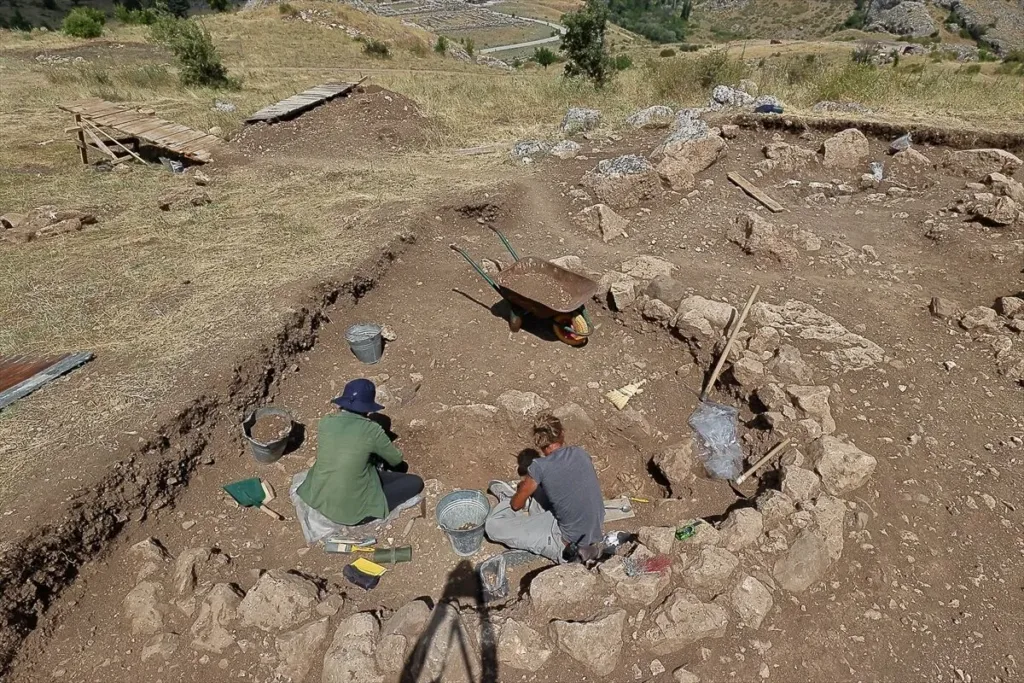
A well-preserved stone-ringed tomb uncovered on Hattusa’s Northwest Slope, dating to the Early Hellenistic and Galatian periods. Credit: AA
“We found the best-preserved example yet”
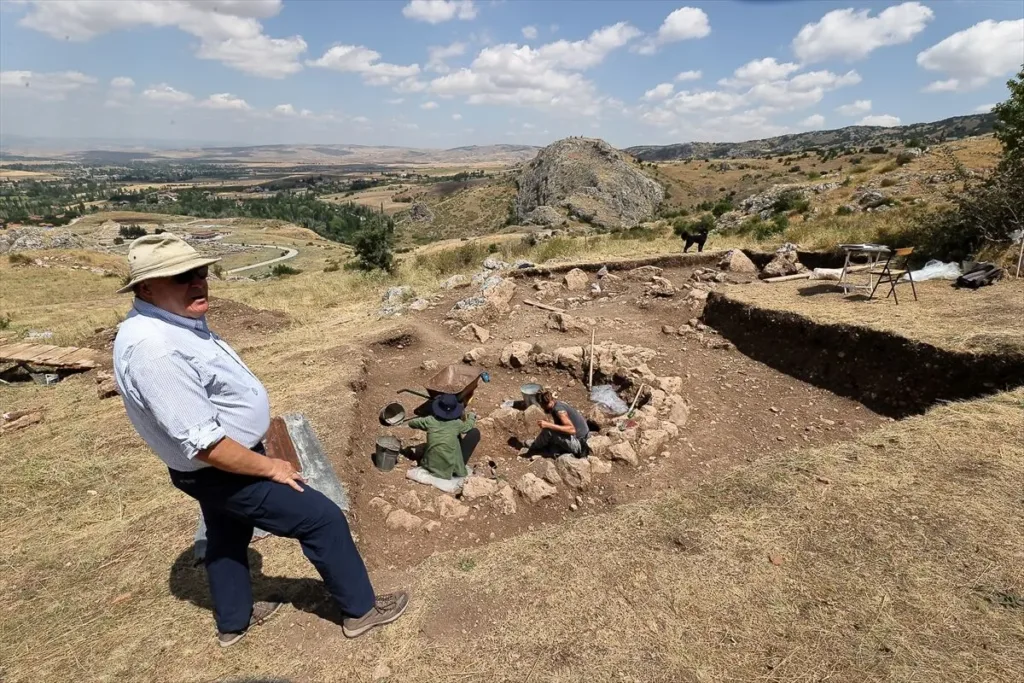
Speaking to Anadolu Agency, excavation director Schachner said the cemetery was discovered while the team was working to clear the area around a storage structure. He explained that during last year’s excavations, five tombs — three of them belonging to women — were found in the same area, and that this year’s work added three more.
“This isn’t a densely packed cemetery — it’s a sparse one, with tombs scattered around. They belong to the Early Hellenistic and Galatian periods, so we can date them to the late 4th century BC through the 3rd century BC,” Schachner said.
He described the newly found tomb as the best-preserved of its type discovered so far at the site. “A circular stone ring around them characterizes these tombs, and in this new one, that ring has survived remarkably well. It’s a stone cist grave, a type very common in this region. Other tombs nearby have yielded items like coins and cosmetic sets. In this one, a knife was resting on the individual’s right shoulder. We don’t yet know its full significance — it could be a grave offering or something buried with the body. We can’t say for certain until the whole tomb is opened. This may be a male individual, whereas the tombs we’ve excavated before were mostly women,” he said.
Seventeen tombs now known from the same period
Schachner noted that burials from many different eras have been uncovered across Hattusa over the years. “In this area, we’ve found eight tombs total — five last year and three this year. To the west of this area, nine more tombs from the same period were found in previous seasons, bringing the total to 17 tombs from that era. Across the wider Boğazköy site, hundreds of tombs from various periods have been documented — nearly 200 from the Roman period alone. This gives us insight into a period we actually know relatively little about,” he said.
Once excavation and documentation work on the tombs is complete, the team plans to restore them and open the area to visitors.
