
Sometime around 1486 BCE, one of the most powerful men in Egypt simply disappeared. No death record. No burial. His two tombs — one of them decorated with the oldest star map ever found in Egypt- were abandoned mid-construction, tools still scattered on the floor. Soon after, someone took a chisel to his name and smashed his statues to pieces.
For centuries, Egyptology filed this away as one of its stranger unsolved mysteries. But a growing line of biblical researchers is asking a bolder question: what if this vanishing act is actually the missing chapter of a much more famous story: the flight of Moses from Egypt?
From Nobody to “Ruler of Egypt”
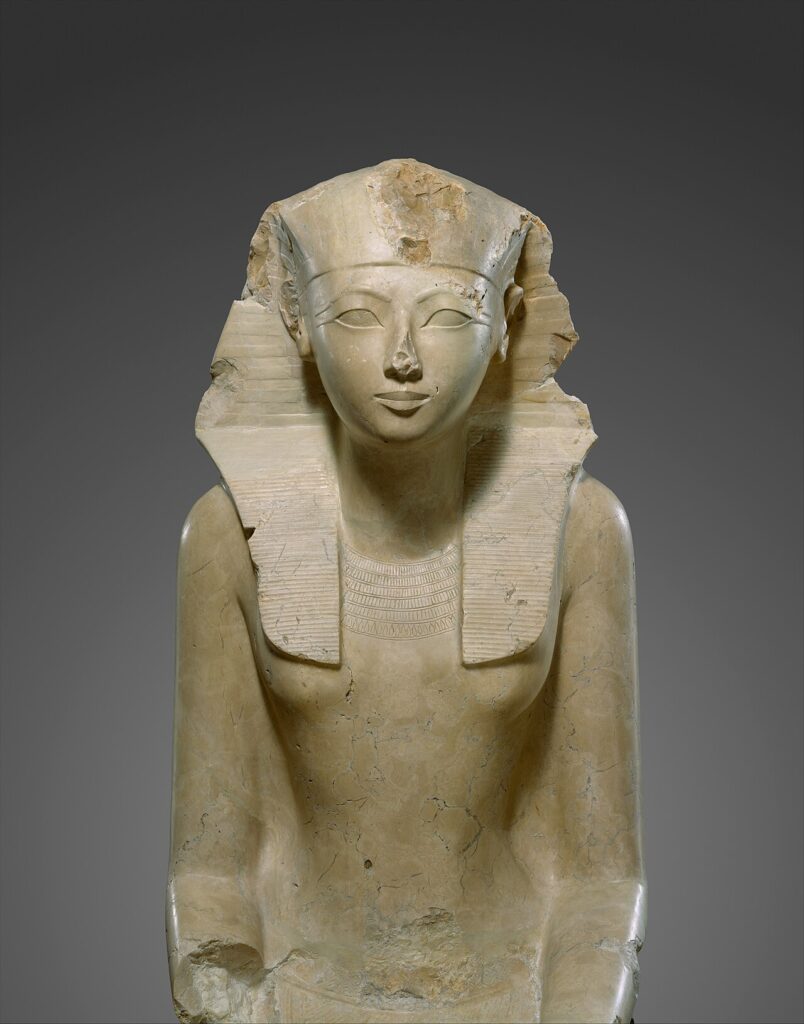
The man at the center of the theory is Senenmut, chief steward and closest confidant of Hatshepsut, the woman who defied convention to rule Egypt as pharaoh. He was born to parents with no titles, no land, no standing: and yet, under Hatshepsut, he was showered with nearly 90 offices: Royal Vizier, Chief Royal Architect, Overseer of the Granary of Amun, and tutor to the pharaoh’s own daughter. Egyptologist Joyce Tyldesley has called him the “Greatest of the Great” in Hatshepsut’s court: “effectively,” she writes, “Senenmut was ruler of Egypt.”
That kind of ascent, from commoner to the second most powerful person in the kingdom, has no clean parallel in Egyptian history. Author Scott Alan Roberts, who has spent years building the case, puts it bluntly: Senenmut, he argues, “is the very same man we know as Moses.”
The Math That Refuses to Be a Coincidence
Skip the theology for a moment and just look at the dates. Using the chronology most conservative biblical scholars accept, Moses would have been born around 1526 BCE — which lands squarely in the reign of Pharaoh Thutmose I, Hatshepsut’s father. That makes Hatshepsut a girl of roughly 10 to 15 years old at the time Exodus says “Pharaoh’s daughter” pulled a Hebrew infant from the Nile: young, unmarried, and, according to her own temple inscriptions, a woman whose “heart” was “full of love” and whose “spirits inclined toward foreign people.”
Forty years later, corresponding to the age at which the biblical account places Moses’ killing of an Egyptian overseer and subsequent flight into the desert, Senenmut’s last dated appearance in the Egyptian record occurs around the same period. This appearance is associated with year 16 of Hatshepsut’s reign, conventionally dated to approximately 1486 BCE. Thereafter, Senenmut disappears from the surviving historical record; no contemporary death record has been identified, and his tomb appears to have remained unfinished.
A Man Erased on Purpose
What makes researchers suspicious isn’t just that Senenmut vanished: it’s how thoroughly someone tried to make him disappear twice. Long after his fall, both of his tombs were vandalized, his name hacked out of inscriptions, his sarcophagus smashed into fragments. Historians have traditionally blamed Thutmose III for the purge. But newer analysis points instead to his son, Amenhotep II: the same pharaoh many biblical chronologists identify as the pharaoh of the Exodus, and the same ruler who ordered Hatshepsut’s own monuments defaced.
If a bitter, foreign-fearing successor wanted to erase every trace of a rival who’d escaped Egypt’s grip and led a slave revolt against it, this is roughly what the wreckage would look like.
Even the Name Fits — If You Read It Right
Skeptics have long pointed out that “Moses” sounds Egyptian — plenty of pharaohs carried names ending in “-mose.” But Egyptologist Kenneth Kitchen has argued on strict linguistic grounds that the sound patterns don’t actually match, and that “Moses” was likely a Hebrew name given by his own mother, meaning roughly “one drawn out” — not an Egyptian court name at all. That tracks with the ancient historian Manetho’s claim that Moses used an entirely different name inside Pharaoh’s palace, and was called “Moses” only by his own people.
That leaves an opening for “Senenmut,” which translates roughly to “mother’s brother”: an odd, almost ceremonial title, not a typical Egyptian birth name. Researchers argue it reads like exactly the kind of name a royal woman might bestow on an adopted foreign son she was elevating to equal status with herself.
So, Why Not?
No inscription anywhere says “Senenmut was a Hebrew slave.” The theory remains circumstantial, and mainstream Egyptology has largely rejected it — a detailed 2024 academic paper devoted to the question concluded the identification doesn’t hold up, and even its most prominent champion has admitted the story “borders on being far too romanticized.”
But strip away the romance and what’s left is a stack of coincidences that refuses to thin out: a commoner raised to the edge of the throne by a pharaoh’s daughter, a disappearance timed almost exactly to the age scripture assigns to Moses’ flight, and a deliberate campaign to erase his name from history afterward. Any one of those, on its own, is a curiosity. All of them, together, are why researchers keep returning to the same stubborn question — why not Senenmut?
