

16 January 2026 The Future is the Product of the Past

Have We Found Moses’ Signature? Ancient Inscriptions in Egypt May Hold the First Written Link to the Bible

Mysterious Proto-Sinaitic inscriptions may point to Moses and Joseph as historical figures, sparking global scholarly controversy.

A groundbreaking proto-thesis by independent scholar Michael S. Bar-Ron suggests exactly that. After eight years of rigorous epigraphic analysis, Bar-Ron argues that two inscriptions found at Serabit el-Khadim, an ancient turquoise mining site on Egypt’s Sinai Peninsula, contain the Semitic phrase “This is from MŠ” — a possible early rendering of the name Moses (Moshe).

The inscriptions, dated to Egypt’s late 12th Dynasty during the reign of Pharaoh Amenemhat III, are written in Proto-Sinaitic, considered one of the world’s earliest alphabetic scripts. According to Bar-Ron, this writing system reflects an early Northwest Semitic dialect remarkably close to Biblical Hebrew, but with traces of Aramaic structure.

“If correct, this could be the first inscriptional evidence of Moses as a historical individual,” Bar-Ron states. “And the implications for our understanding of the Exodus traditions are enormous.”
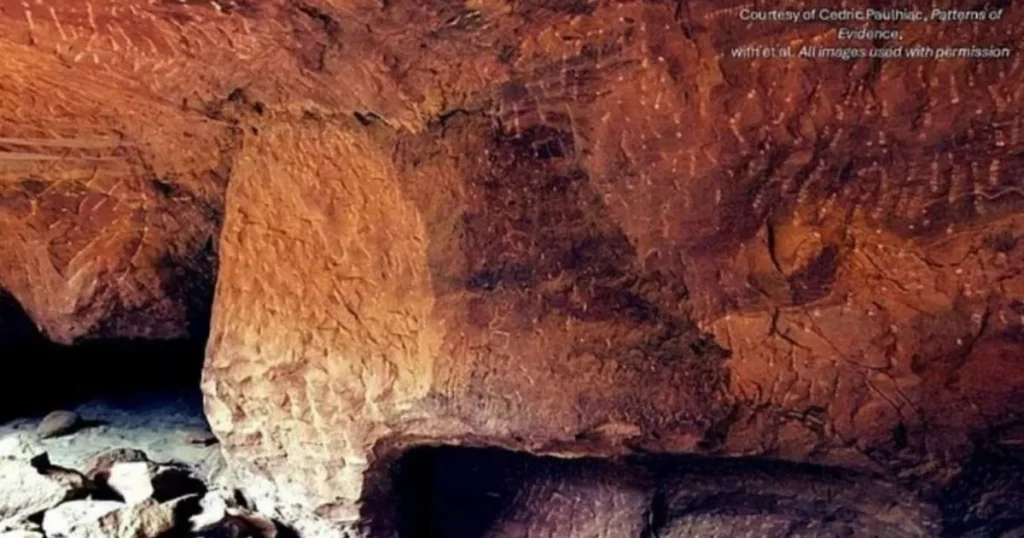
The cave markings were first found in the early 1900s. Credit: Johannes Gutenberg University Mainz

A Message from Moses?

Two inscriptions — Sinai 357 and 361 — bear the characters M-Š in configurations that Bar-Ron interprets as personal authorship marks: “ZT MMŠ” (This is from MŠ) and “NʾUM MŠ” (A saying of MŠ). These inscriptions, he claims, appear alongside others that share linguistic style, personal tone, and even poetic structure — all pointing to a single Semitic scribe with elite Egyptian training, consistent with the biblical tradition of Moses being raised in Pharaoh’s palace.


📣 Our WhatsApp channel is now LIVE! Stay up-to-date with the latest news and updates, just click here to follow us on WhatsApp and never miss a thing!!


High-resolution photographs, 3D scans, and direct study of casts at Harvard’s Museum of the Ancient Near East were used to substantiate the claim. Epigraphic features like the letter mem (מ) and certain unique formations were tracked across multiple inscriptions to support the idea of a single authorial hand.
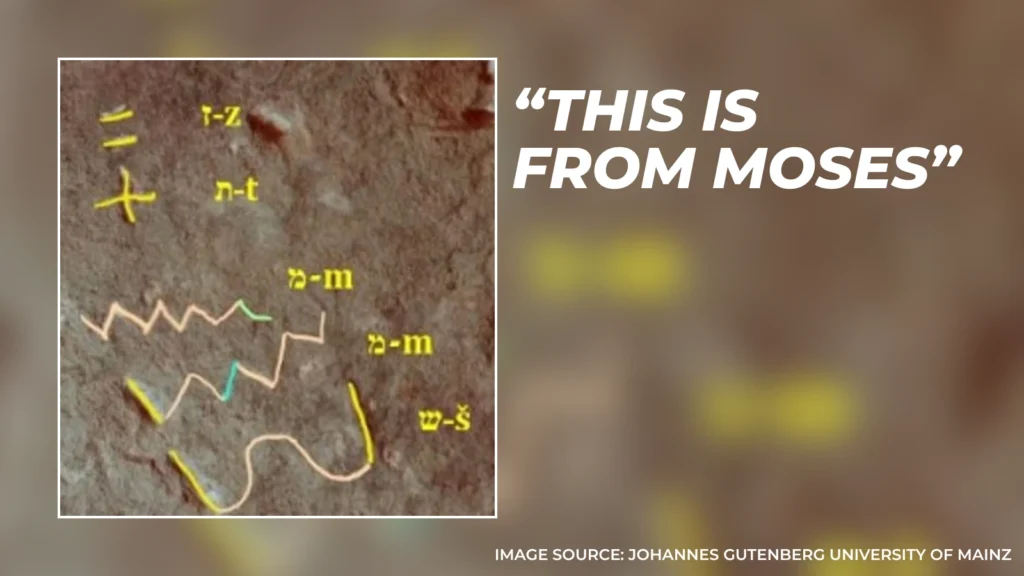

Michael Bar-Ron suggests these texts could provide the first-ever archaeological evidence of Moses himself. Credit: Johannes Gutenberg University Mainz

The Joseph Connection

In addition to Moses, Bar-Ron puts forward another startling theory: that the Egyptian vizier Ankhu, known from other archaeological records, could be the historical basis for the biblical Joseph.

One key inscription, Sinai 350, bears a hybrid Egyptian-Semitic cartouche and references to the deity El, associated with early Hebrew worship. Its refined execution suggests the author was not a slave, but rather a Semitic official in high standing, possibly working under Amenemhat III. This scenario fits closely with the Joseph narrative in the Book of Genesis.

Bar-Ron’s thesis proposes that a Semitic elite class, possibly including Joseph, rose to influence during this era, only to be later enslaved — a transformation echoed in Exodus.
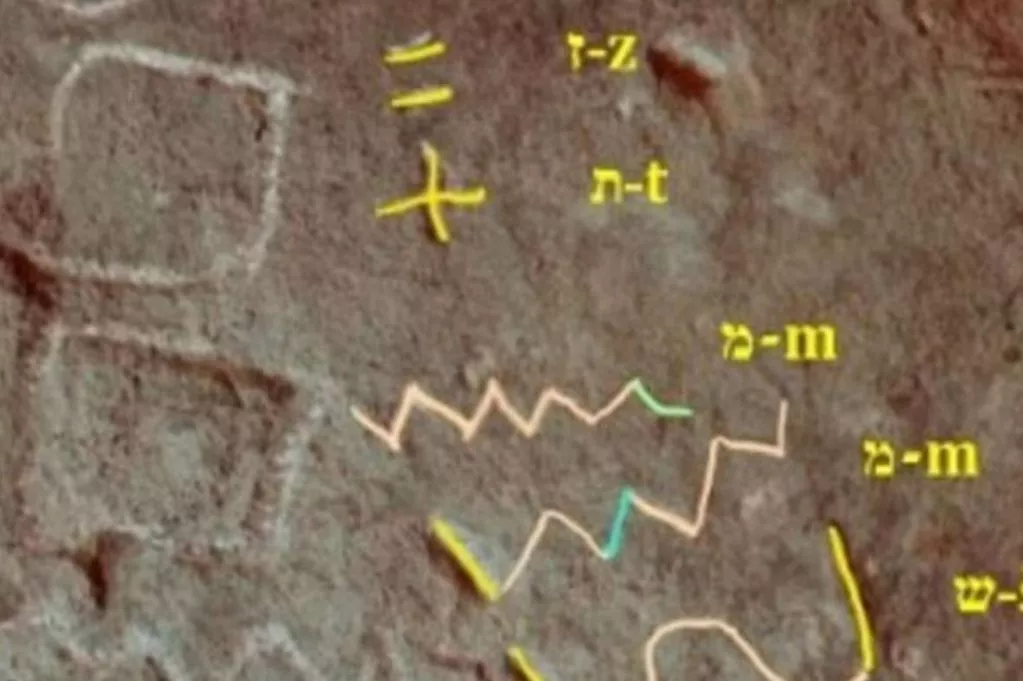
Michael Bar-Ron suggests these texts could provide the first-ever archaeological evidence of Moses himself. Credit: Johannes Gutenberg University Mainz

Religious Conflict in Stone

More than a linguistic puzzle, the inscriptions also tell a story of religious strife. Bar-Ron categorizes the 22 inscriptions into five clades, with some praising Baʿalat (the Canaanite goddess linked to Hathor), and others showing signs of deliberate defacement — often by later scribes loyal to El, the god of the Hebrews.

“We see worshipful inscriptions lauding Baʿalat, only to have later scribes hack them — scratching out cultic fish symbols and replacing them with praises to El,” Bar-Ron told Patterns of Evidence. “This is ground zero for theological rebellion.”

The remains of a burnt temple to Baʿalat at Serabit el-Khadim align with Bar-Ron’s theory of a violent religious purge, potentially led by followers of El — perhaps even Moses himself. Combined with phrases like nimosh (“let us depart”), these writings suggest a proto-Exodus narrative recorded in real-time.
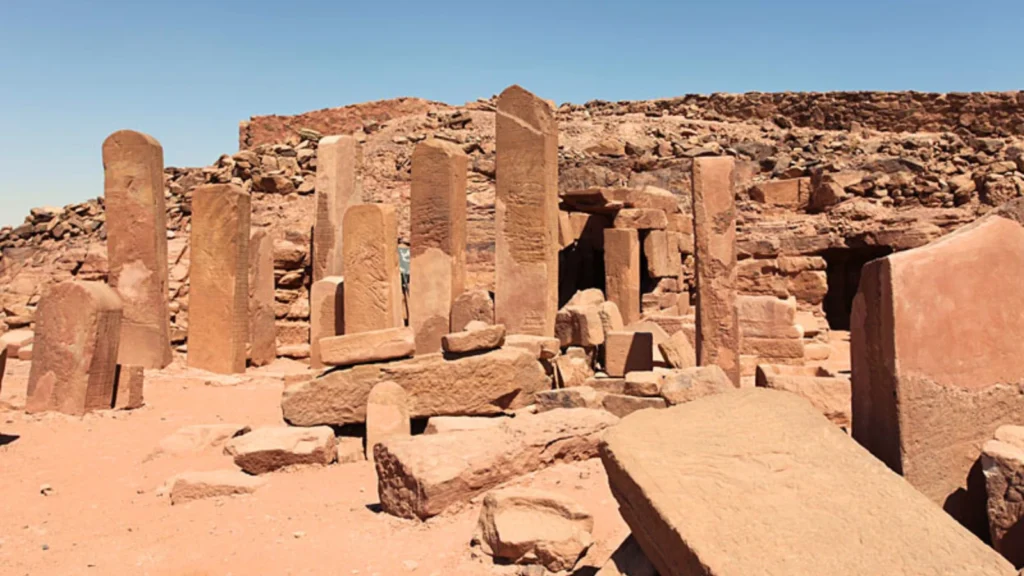
 The find was discovered at Serabit el-Khadim on Egypt's Sinai Peninsula. Credit: Wikipedia
The find was discovered at Serabit el-Khadim on Egypt’s Sinai Peninsula. Credit: Wikipedia

Controversy and Skepticism

Not all academics are convinced. Dr. Thomas Schneider, Egyptologist at the University of British Columbia, labeled the claims “completely unproven and misleading,” criticizing what he sees as arbitrary letter identifications and theological bias.

Nonetheless, the inscriptions — first unearthed in the early 1900s and long considered undecipherable — are receiving renewed attention. Even skeptics acknowledge that they provide a unique glimpse into the cultural, linguistic, and religious world of Semitic laborers in ancient Egypt.

A History Waiting to Be Rewritten?

If Bar-Ron’s interpretations hold under further academic scrutiny, it could mark a turning point in biblical archaeology, offering tangible evidence that the Exodus narrative may have roots in real history.

As debate swirls in scholarly circles, one thing is clear: the mystery of Serabit el-Khadim has not yet given up all its secrets.

Bar-Ron, M. S. (2025). Presenting critical readings of 22 complex P-S inscriptions across five proposed clades, the Stele of Reniseneb, a seal of an Asiatic Egyptian high official and their implications for early Biblical traditions: A proto-thesis summarizing eight years of critical Proto-Sinaitic research (Unpublished proto-thesis). Johannes Gutenberg University of Mainz.

Related Articles

Oldest prayer beads made from salmon vertebrae found on England’s Holy island

28 June 2022

28 June 2022

On the island of Lindisfarne, just off the coast of Northumberland, known in England as the “Holy Island“, archaeologists have...

11,000-Year-Old LSU Campus Mounds Are Oldest Known Human-Made Structures In North America

23 August 2022

23 August 2022

According to new research published in the American Journal of Science, two six-meter (20-foot) high mounds on the campus of...

On the eastern shore of the Marmara Sea, off the coast of Yalova, a 1700-year-old Shipwreck was discovered

23 August 2023

23 August 2023

A 1700-year-old shipwreck was discovered during maritime police training dives in the province of Yalova, located on the east coast...

Archaeologists Unearth First-Ever Assyrian Inscription in Jerusalem — A 2,700-Year-Old Message Between Kings

23 October 2025

23 October 2025

Archaeologists in Jerusalem have uncovered a discovery of extraordinary significance: a tiny, 2,700-year-old pottery fragment inscribed in Assyrian cuneiform —...

The 2000-year-old origin mystery of the Etruscans solved

25 September 2021

25 September 2021

A genetic analysis of DNA taken from ancient skeletons appears to have answered a conundrum that has captivated researchers for...

Archaeologists found a noble woman buried beside her ‘husband’ 1,000 years ago with the top of her face hollowed out

4 November 2023

4 November 2023

Archaeologists unearthed the 1,000-year-old remains of a woman with her face and head hollowed out buried next to her husband...

409 silver coins, found in the Mleiha area of Sharjah, were inspired by Alexander the Great and the Seleucid dynasty

17 July 2021

17 July 2021

409 silver coins dating to the 3rd century have been found in the Mleiha area of Sharjah in the United...

New discoveries announced at Sanxingdui Ruins

20 March 2021

20 March 2021

Chinese archaeologists announced on Saturday that some new major discoveries have been made at the legendary Sanxingdui site in southwestern...

The Anahita Temple in western Iran is Being Restored

11 June 2021

11 June 2021

A restoration project has been commenced on the ancient temple of Anahita, which is located in the city of Kangavar,...

An extraordinary medieval belt loop found near Kamień Pomorski in Poland

18 March 2024

18 March 2024

A late medieval belt loop for hanging keys or a bag was found near the town of Kamień Pomorski in...

2,400-year-old Battlefield of Alexander the Great’s First Persian Victory found in Türkiye

27 December 2024

27 December 2024

After 20 years of research, archaeologists in Türkiye have pinpointed the exact location of the legendary Battle of Granicus, where...

The circular-shaped structure unearthed in Uşaklı mound may point to the holy Hittite city of Zippalanda

27 December 2022

27 December 2022

Italian-Turkish team of archaeologists led by the University of Pisa unearthed a mysterious circle-shaped structure from the Hittite era at...

A stone bathtub, which is considered to be the first example of ‘water birth’, was found in Ani Ruins

7 September 2022

7 September 2022

A stone tub was found in the large bath, whose birth was mentioned in a work by the Turkish scholar...

Many Ancient Artifacts Discovered in Vietnam’s Rice Fields

28 December 2025

28 December 2025

In Vietnam’s central Ha Tinh province, archaeologists have uncovered a remarkable concentration of ancient artifacts beneath rice fields in the...

Archaeologists Found Seal Impressions That Could Change Hittite History in Kayalıpınar

15 September 2023

15 September 2023

A seal impression belonging to Hattusili III was found during the excavations carried out near the village of Kayalıpınar in...