
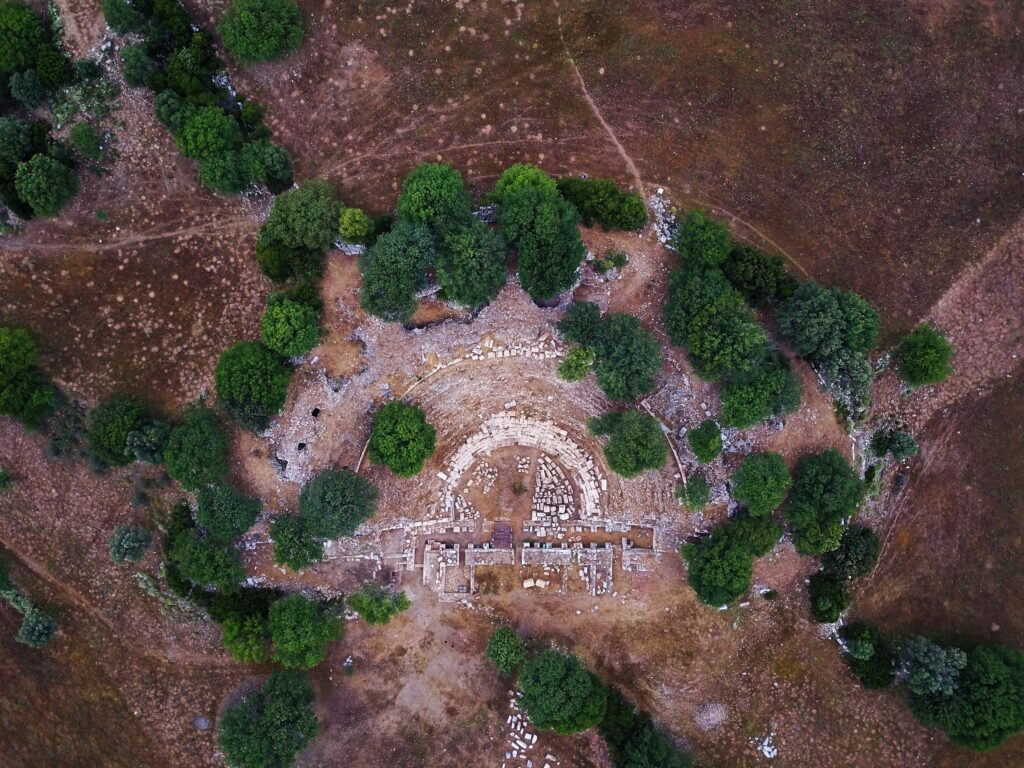
Before the actors crossed the stage and the audience filled the stone seats, the Theatre of Teos had already done something remarkable. It had organized people.
A new archaeological study argues that the ancient theatre at Teos, on Türkiye’s Aegean coast, was not only a place of performance but also a carefully engineered machine for moving large audiences through space. The research, written by archaeologist Ceyda Eroğlu and published in Arkeoloji Dergisi, shows that the building’s circulation system changed across two major construction phases, revealing how Greek architectural traditions and Roman engineering met in one of Ionia’s important coastal cities.
Teos lies near modern Sığacık in Seferihisar, İzmir, on the southern side of the Urla-Çeşme peninsula. In antiquity, the city was closely associated with Dionysos, theatre, wine, and artistic life. Its theatre stood on the southern slope of Kocakır Hill, facing toward the South Harbour and positioned near the Sanctuary of Dionysos and the bouleuterion.
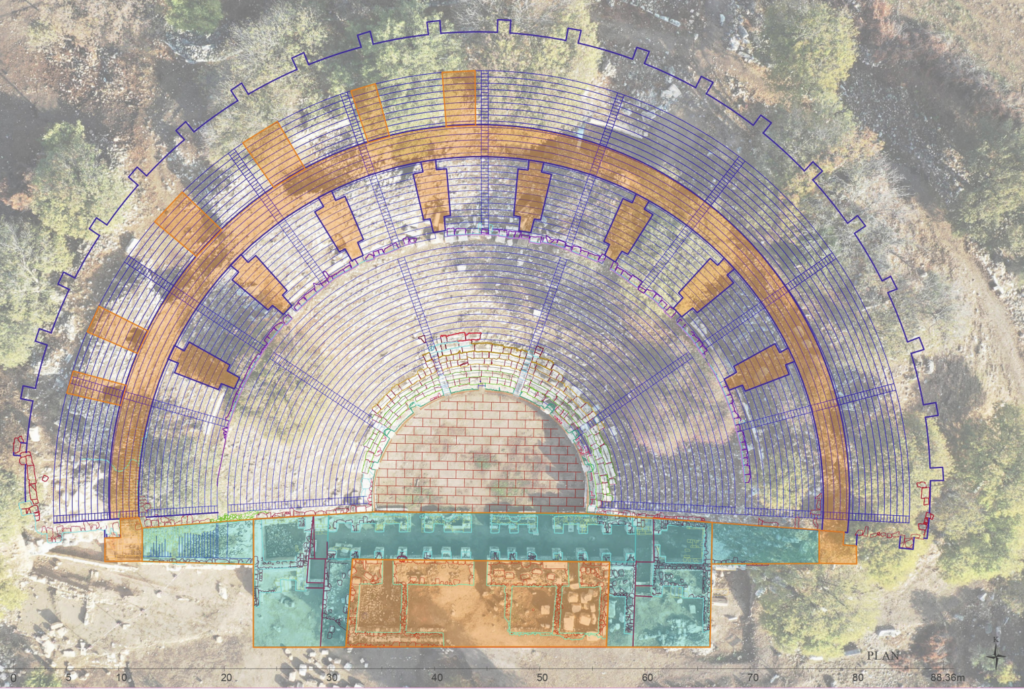
The Teos Theatre had a cavea, or seating area, measuring 84.60 meters in diameter. Its plan slightly exceeded a semicircle on both sides, creating a horseshoe-like form. The lower seating rested against the natural slope, while the upper seating required an artificial vaulted substructure. This gave the builders a chance to solve a difficult problem. How could crowds be brought into the theatre without forcing everyone through the same lower entrances?
A theatre designed around movement
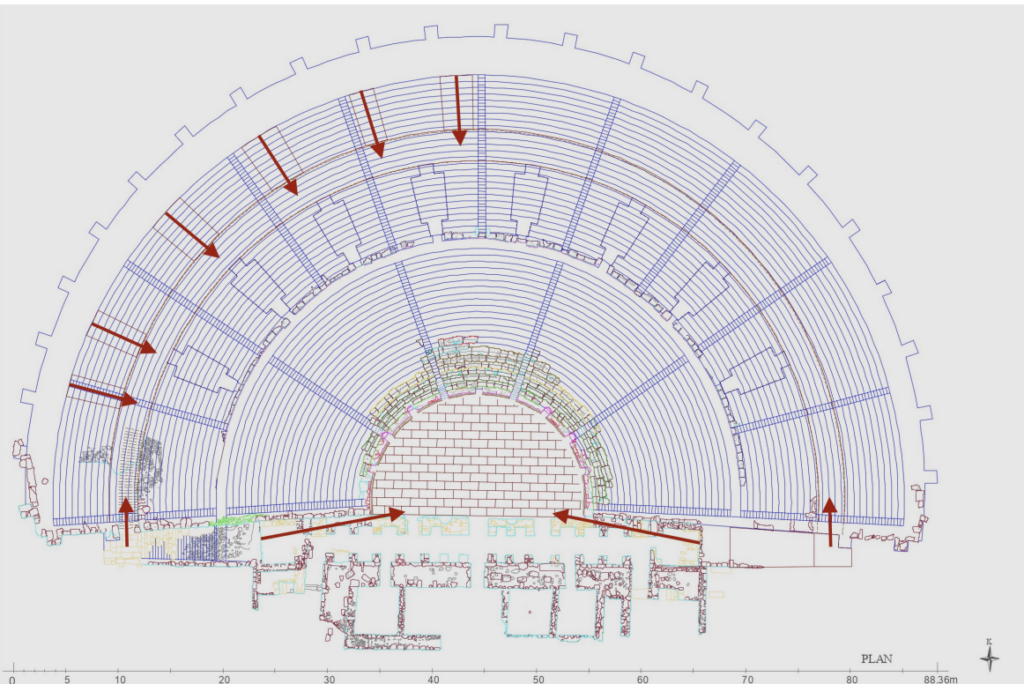
In the first major phase, which Eroğlu links to the Augustan period, access was arranged through multiple routes. Spectators could move through the parodoi, the diagonal side entrances leading toward the orchestra. Others could enter through routes connected with the analemmata, the retaining walls at the sides of the cavea. A third system worked from the outer wall of the cavea, where arched openings led into an ambulacrum, a vaulted passage behind the seating.
From there, eight vomitoria opened toward the praecinctio, the horizontal passage dividing the lower and upper seating zones. Teos did not rely on a single entrance logic. It distributed movement vertically and horizontally, easing pressure on the orchestra and allowing the audience to spread through the theatre in a more controlled way.
That is why the study treats the theatre’s circulation system as evidence of planning, not just construction. The builders were thinking about the behavior of crowds.
A Roman transformation changed the audience experience
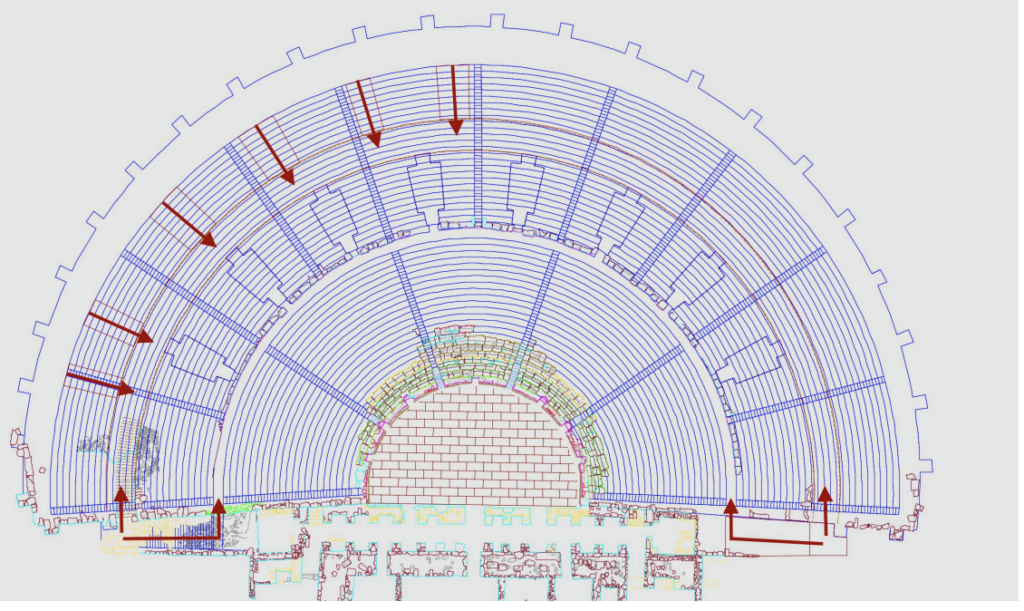
The second phase changed the experience of the building. In the late Flavian period, around the end of the 1st century CE and the beginning of the 2nd century CE, the stage building was expanded from about 25 meters to roughly 30 meters. The pulpitum was pushed toward the orchestra, the scaena became more enclosed, and parascaenium structures rose on either side. As a result, the parodoi appear to have lost their role as mass access points.
This was a major architectural shift. The theatre no longer functioned with the same open Greek-style relationship between side entrance, orchestra, and seating. Instead, movement was reorganized through the analemmata and the cavea enclosure wall. On the west side, fourteen surviving steps in front of the analemma show how access was redirected toward the praecinctio. The audience now moved through a more Romanized system, one that separated performance space from spectator circulation more sharply.
Teos stands out among the Asia Minor theatres
The study also places Teos within a wider map of theatre architecture in Asia Minor. Eroğlu compares 56 theatres from 55 ancient cities and identifies three main access systems: parodoi or aditus maximi, analemmata, and cavea enclosure walls. Parodoi were by far the most common, appearing in 54 theatres. Circulation through analemmata was found in 17, while cavea enclosure-wall access appeared in 30.
Teos stands out because its early phase combined all three systems. That makes it part of a more advanced circulation type usually associated with larger or later monumental theatres. Yet at Teos, this arrangement seems to have been present from the first phase, suggesting that the city adopted a sophisticated approach early in the Roman Imperial period.
Comparisons with Ephesos, Miletos, Patara, Kaunos, Myra, Nicaea, and Stratonikeia show how widespread these problems were. As theatres grew, and as Roman performance culture reshaped older Greek spaces, architects had to rethink how bodies moved. Some cities transformed parodoi into monumental gates. Others added vaulted corridors, stairways, terraces, and upper-level entrances.
Teos followed a different path. It appears to have planned its multi-layered system from the beginning, then adapted it when the stage became more enclosed. Its surviving steps, arches, passages, and blocked routes show that Roman-era architecture was not only about spectacle. It was also about flow, visibility, and control.
At Teos, the crowd was part of the design.
Eroğlu, C. (2026). Teos Tiyatrosu Seyirci Sirkülasyonu. Arkeoloji Dergisi, 36, 153-173. https://doi.org/10.51493/egearkeoloji.1830329
Cover Image Credit: Public Domain
