
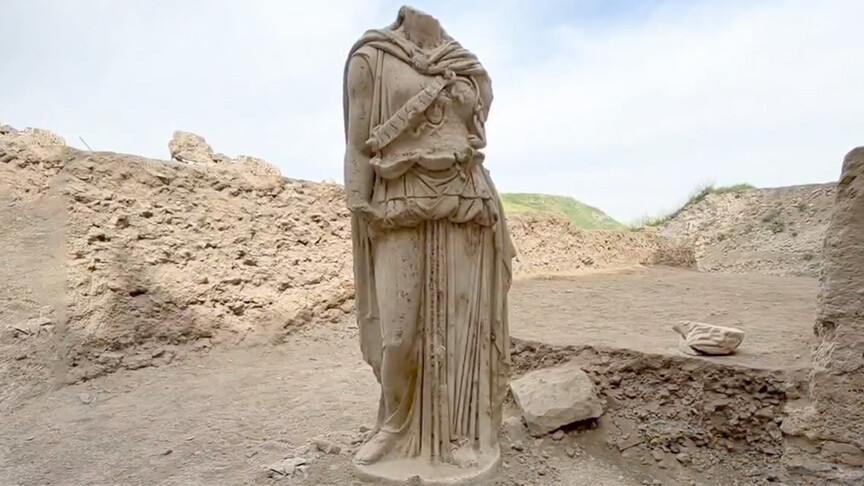
A remarkable archaeological discovery has emerged from the ancient city of Laodicea in southwestern Türkiye, where excavations have revealed a striking 2-meter-tall marble statue of the Greek goddess Athena. The find, announced by Türkiye’s Minister of Culture and Tourism Mehmet Nuri Ersoy, is already being hailed as a significant contribution to the understanding of the region’s cultural and artistic heritage.
The statue was uncovered during ongoing excavation and restoration work at the West Theater of Laodicea, a site known for its rich historical layers and monumental architecture. According to official statements, the sculpture was found within the stage building—specifically in the outer wall of the structure known as the postscaenium—buried among rubble and lying face down. Although the head of the statue has not yet been recovered, the remaining structure is largely intact and offers valuable insights into ancient craftsmanship.
A Window into the Ancient World
Laodicea, located near modern-day Denizli, has long been recognized as one of the most important archaeological sites in Anatolia. Known in antiquity as a thriving center of trade, culture, and textile production, the city continues to yield discoveries that shed light on daily life and artistic expression in the ancient world.
The West Theater, where the Athena statue was found, dates back to the 2nd century BCE and features a grand three-story stage building supported by rows of columns. Historical evidence suggests that this space was not only used for theatrical performances but also served as a platform for cultural storytelling. Sculptural programs placed between the columns depicted mythological scenes, deities, and even episodes from Homer’s epics.
Recent excavations conducted between 2024 and 2025 have already brought to light numerous sculptures illustrating legendary narratives such as Odysseus’ journey, including encounters with the Laestrygonians, the Cyclops Polyphemus, and the sea monster Scylla. The newly discovered Athena statue adds another layer to this narrative-rich environment.
Artistic Excellence and Unique Features
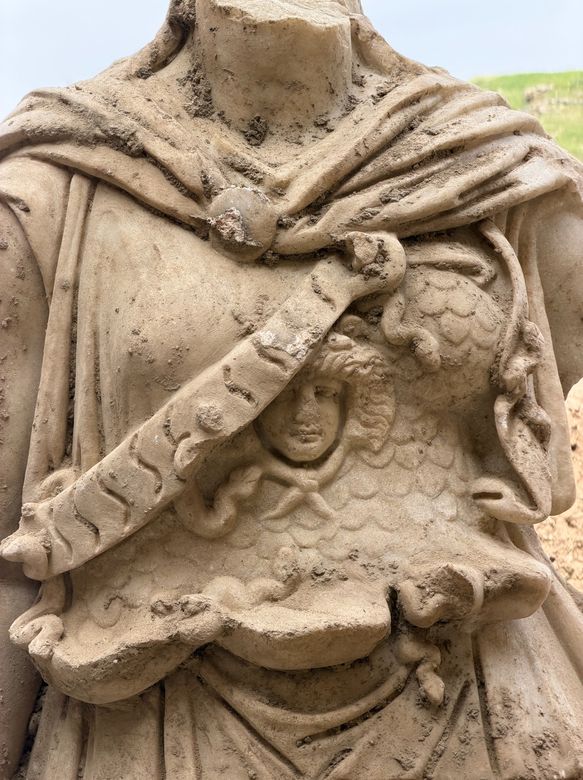
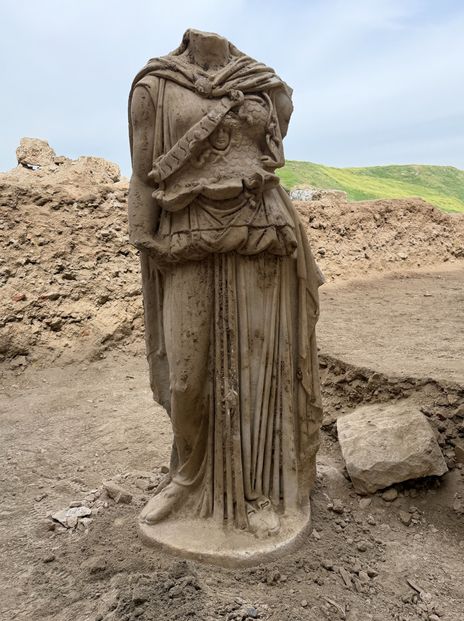
Crafted from white marble, the statue stands approximately 2 meters tall and depicts Athena in a standing position on a circular base. Despite the missing head, the sculpture showcases exceptional artistic detail. The goddess is portrayed wearing a finely textured sleeveless peplos (a traditional Greek garment), complemented by a cloak draped around her neck.
One of the most striking features is the depiction of the aegis on her chest—an ornamental element traditionally associated with Athena—featuring the head of Medusa surrounded by serpents. The intricate carving of the garment’s folds and the naturalistic rendering of fabric demonstrate a high level of craftsmanship, suggesting the work of a master sculptor.
Experts have also noted the statue’s unique typology, particularly the presence of a cloak around the neck, which is rarely seen in similar representations. Additionally, the back of the sculpture appears roughly finished, indicating it was originally positioned within a niche or between columns, where only the front would be visible to viewers.
Echoes of the Augustan Age
Stylistic analysis suggests that the statue reflects the classical artistic traditions of the Augustan period (27 BCE – 14 CE), a time marked by a revival of classical Greek aesthetics under Roman rule. This “first classical style” is characterized by balanced proportions, refined details, and an emphasis on idealized forms.
Interestingly, while Athena is widely known as a goddess of wisdom and warfare, her representation in Laodicea appears to emphasize a different aspect of her identity. Historical records indicate that the city was a major center for textile production in antiquity, and inscriptions suggest that festivals were held in honor of Athena in connection with weaving and craftsmanship. This local interpretation highlights the adaptability of mythological figures within different cultural contexts.
Preserving Heritage for the Future
Minister Ersoy emphasized that the discovery aligns with Türkiye’s broader “Heritage for the Future” initiative, which aims to protect and promote the country’s rich archaeological legacy. “Our work in Laodicea continues to bring the traces of the past to light,” he stated, underscoring the importance of ongoing excavation and restoration efforts.
Work at the West Theater has continued since early 2026, focusing on both structural restoration and the recovery of artifacts. Each new find contributes to a more comprehensive understanding of the site and enhances its value as a cultural and historical landmark.
A Discovery That Resonates Beyond Borders
The unearthing of the Athena statue is more than just an isolated archaeological event—it is a reminder of the enduring legacy of ancient civilizations and their influence on modern culture. As researchers continue to study the sculpture and its context, it is expected to provide further insights into artistic practices, religious beliefs, and social life in ancient Laodicea.
For now, the statue stands as a powerful symbol of the past resurfacing in the present—an embodiment of history, artistry, and cultural continuity that continues to captivate both scholars and the public alike.
Cover Image Credit: Türkiye’s Minister of Culture and Tourism Mehmet Nuri Ersoy via X
