
23 January 2026 The Future is the Product of the Past

Grace of Ancient Art Emerges in Laodikeia: Hermes Sculpture Head Discovered in Ongoing Excavations

Discover the newly unearthed Hermes sculpture head in Laodikeia Ancient City, revealing the artistic elegance and cultural richness of the Roman Imperial period in Türkiye.

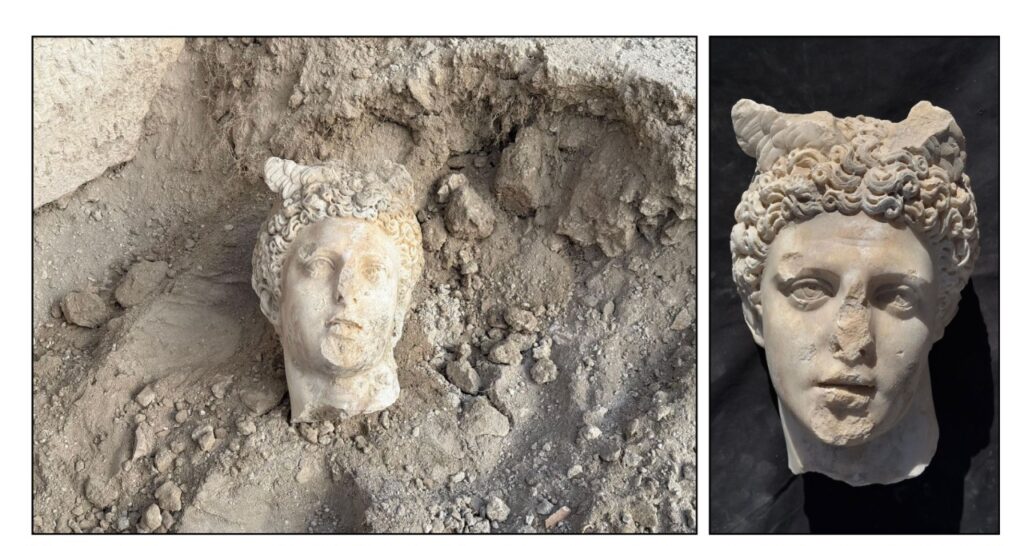
Under the patronage of the Ministry of Culture and Tourism as part of the Geleceğe Miras (Heritage for the Future) Project, a remarkable archaeological discovery has come to light in the ancient city of Laodikeia, located near modern-day Denizli in southwestern Türkiye. Excavations conducted in the Bouleuterion (Council House) and Prytaneion complexes have revealed a finely crafted marble head of the god Hermes, offering fresh insight into the city’s artistic sophistication during the Roman Imperial Period.

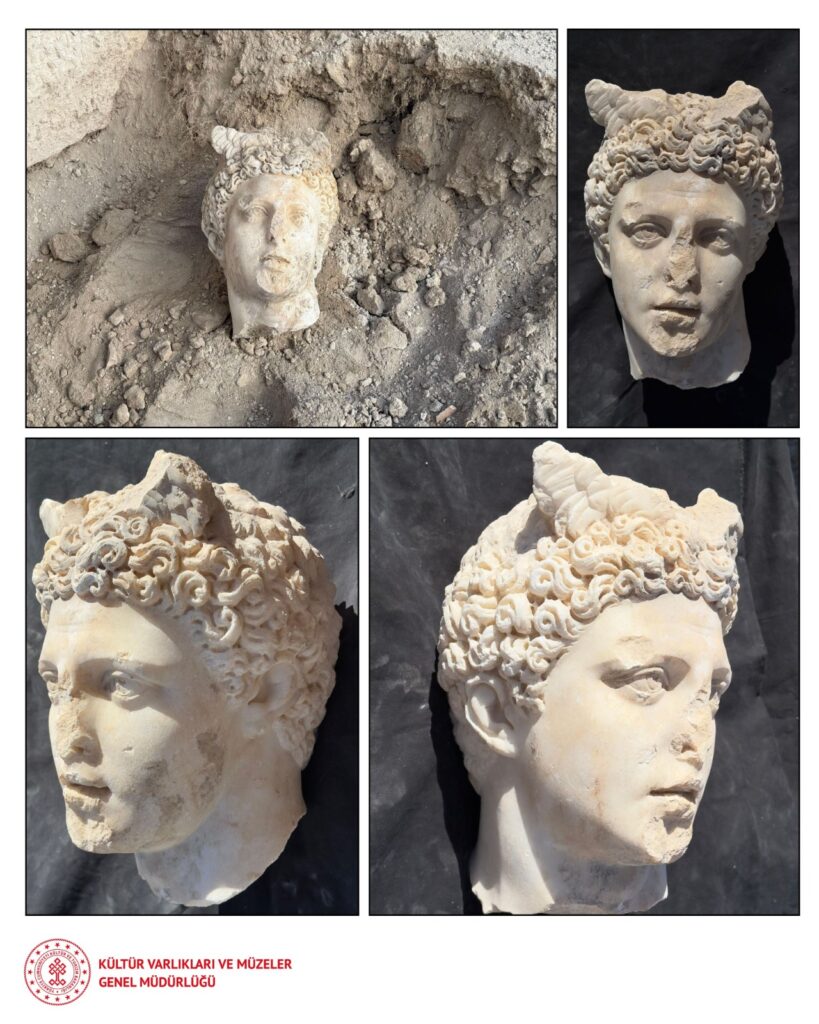
The newly uncovered sculpture head was found in the eastern entrance corridor of the Bouleuterion and is carved from high-quality white Dokimeion (İscehisar) marble, a material prized in antiquity for its purity and durability. Preliminary analysis dates the work to the mid-2nd century CE. The delicate facial features, carefully rendered eyes and irises, and elegantly curled locks—topped with the emblematic wing motif—reflect the stylistic legacy of the renowned classical sculptor Praxiteles. Experts identify the piece as an outstanding example of the “Hermes Andros” type, a sculptural tradition admired across the Mediterranean world for its balance, naturalism, and poise.
Credit: General Directorate of Cultural Assets and Museums of Türkiye

A Window Into Laodikeia’s Prosperity and Cultural Identity

The discovery highlights the economic strength and refined aesthetic sensibility that characterized Laodikeia in antiquity. Situated at the crossroads of major trade routes in the Lycus Valley, the city flourished as a hub of textile production, agriculture, and commerce. Its wealth funded ambitious civic projects—monumental theaters, colonnaded streets, temples, and council buildings—demonstrating both political influence and cultural ambition. Finds such as the Hermes sculpture help document how this prosperity was translated into patronage of the arts, confirming Laodikeia’s role as a vibrant urban center in the Roman world.

Beyond its economic significance, Laodikeia carries deep historical and cultural resonance. The city was one of the Seven Churches of Asia mentioned in early Christian tradition, yet it also preserved strong ties to classical religion and philosophy. Public buildings like the Bouleuterion and Prytaneion were not only administrative spaces but also symbols of civic pride, where art and architecture communicated the identity and values of the community.


📣 Our WhatsApp channel is now LIVE! Stay up-to-date with the latest news and updates, just click here to follow us on WhatsApp and never miss a thing!!


The Enduring Symbolism of Hermes

In ancient Greek and Roman mythology, Hermes—known as Mercury in Latin tradition—was the messenger of the gods, patron of travelers, commerce, eloquence, and transitions. His imagery often accompanied spaces associated with movement, communication, and civic life, making his presence in a council building both meaningful and contextually appropriate. The iconography seen in the Laodikeia sculpture—youthful features, dynamic hair, and small wings—embodies Hermes’ attributes of speed, intelligence, and mediation. Such artworks were not merely decorative; they carried symbolic messages about prosperity, diplomacy, and the orderly flow of public affairs.

Credit: General Directorate of Cultural Assets and Museums of Türkiye

Preservation, Documentation, and Future Research

Following the discovery, conservation and documentation procedures are being completed to ensure the integrity and long-term protection of the artifact and its architectural context. Excavations at Laodikeia continue uninterrupted within the scope of the Geleceğe Miras Project, which prioritizes sustainable heritage management and the responsible sharing of archaeological knowledge with the public.

The Hermes sculpture head stands as a significant scholarly gain, enriching our understanding of artistic production in Roman-period Anatolia and reaffirming Laodikeia’s place among the region’s most culturally expressive cities. As ongoing research reveals further connections between art, economy, and civic identity, Laodikeia once again demonstrates how the elegance of ancient craftsmanship can illuminate the stories of the past—and bring them gracefully into the present.

General Directorate of Cultural Assets and Museums of Türkiye

Cover Image Credit: General Directorate of Cultural Assets and Museums of Türkiye

Related Articles

Earthquake Unearthed Lost Roman Odeon in Croatia

28 May 2025

28 May 2025

An extraordinary archaeological discovery emerged in Croatia after renovation work began on Sisak’s City Hall, damaged by a 6.4-magnitude earthquake...

3,500-year-old perfectly preserved ancient frozen bear found in Siberian

28 February 2023

28 February 2023

As the permafrost on Bolshoy Lyakhovsky Island in eastern Siberia melted, a mummified brown bear that lived more than three...

10 Ancient Shipwrecks and Finds from Prehistoric to Ottoman Periods Discovered οff Kasos Island in Greece

14 March 2024

14 March 2024

The research team of the National Hellenic Research Foundation, in collaboration with the Ministry of Culture, has identified ten shipwrecks...

Before the Hittites: 8,000-Year-Old Rock Art Discovered in Kayseri, Türkiye

6 November 2025

6 November 2025

An extraordinary archaeological discovery in Kayseri’s Develi district has revealed 8,000-year-old rock art engravings, offering new insight into how early...

Archaeologists Uncover Roman London’s First Basilica Beneath an Office Basement

13 February 2025

13 February 2025

Archaeologists have made a groundbreaking discovery beneath an office building in London, unearthing a substantial section of the ancient city’s...

2900-Year-Old Erzin Stele: A Key to Understanding the Hittite to Greek Mythological Transition

5 April 2025

5 April 2025

In a significant archaeological discovery, a basalt stele was unearthed in 1987 by O. Günay while plowing his field at...

Well-Preserved Wooden Houses Over 2,000 Years Old Discovered in Zhejiang, China

15 March 2025

15 March 2025

In a remarkable archaeological find, researchers in Shaoxing, Zhejiang Province, China, have uncovered exceptionally well-preserved wooden houses dating back over...

The 8,000-year-old Aslantepe in Turkey has been added to the UNESCO World Heritage List

26 July 2021

26 July 2021

The Turkish Foreign Ministry said Monday that a rich, 30-meter-high archaeological mound going back 8,000 years in southern Turkey has...

Ancient city “Germanicia” lost in 73 years

8 July 2021

8 July 2021

The presence of the ancient city of Germanicia, discovered during an illegal excavation in the southeast Turkish province of Kahramanmaraş...

From Destruction to Discovery: Ancient Greek Tombstone Discovered in Libya After Storm ‘Daniel’

2 March 2025

2 March 2025

The Libyan Antiquities Authority has officially confirmed that an ancient artifact uncovered in the torrents caused by Storm “Daniel” in...

In the Mediterranean Oldest Hand-Sewn Boat is Preparing for its Next Journey

25 January 2024

25 January 2024

The oldest hand-sewn boat in the Mediterranean was discovered in the Bay of Zambratija near Umag on Croatia’s Istrian peninsula....

2000-year-old ancient Roman Road, described as the most important in Scottish history, has been discovered

3 November 2023

3 November 2023

A 2000-year-old ancient Roman road was unearthed in Old Inn Cottage’s garden near Stirling, Scotland. The site is located a...

5,700-Year-old Ancient “Chewing Gum” Gives Information About People and Bacteria of the Past

4 April 2021

4 April 2021

Researchers at the University of Copenhagen have successfully extracted the complete human genome from “chewing gum” thousands of years ago....

Saudi shipwreck excavation reveals hundreds of 18th-century artifacts on sunken ship in the north Red Sea

25 February 2022

25 February 2022

Divers from Saudi Arabia’s Heritage Authority have discovered a shipwreck in the Red Sea from the 18th century filled with...

Unique and very well-preserved prehistoric engravings found in southwestern Catalonia

23 March 2023

23 March 2023

Significant prehistoric rock art has been discovered in La Febro, in southwestern Catalonia. The team that discovered the art inside...