
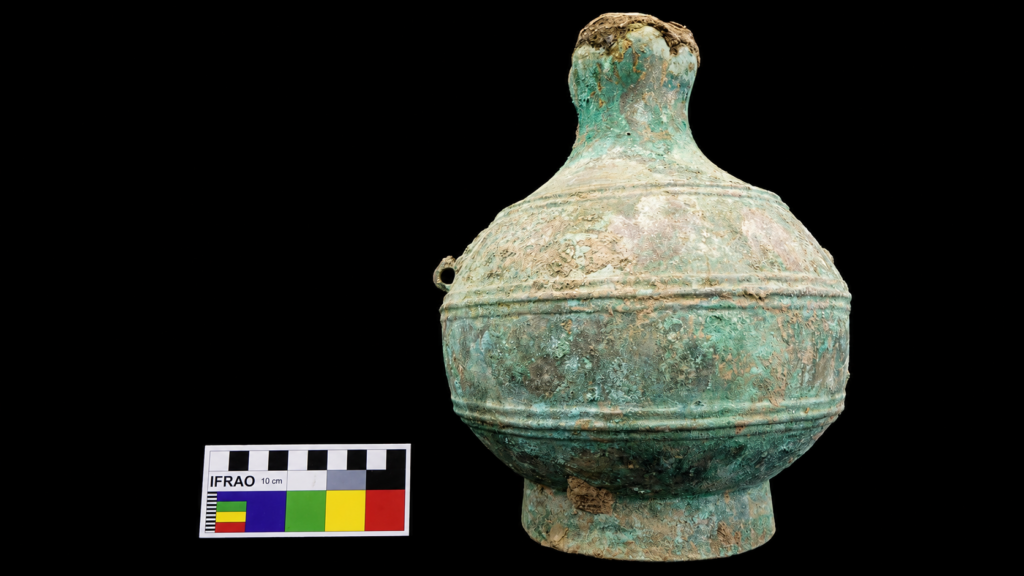
A sealed bronze bottle placed in a tomb in northwestern China more than 2,000 years ago has yielded something archaeologists rarely encounter: not a stain or microscopic residue, but 3.74 liters of surviving liquid.
The pale blue-green fluid came from Tomb M39 at the Shanjiabao cemetery in Guyuan, Ningxia Hui Autonomous Region. Laboratory analysis identified it as a cereal-based alcoholic beverage produced by people of the Qin state during the Warring States period, before China was unified under the Qin dynasty in 221 BC.
Calling the drink “beer” is convenient, but only up to a point. It was fermented from cereals and yeast, yet it was not a hopped, modern-style beer. Its chemistry and production method belong instead to China’s long tradition of grain-based fermented drinks, including beverages produced with microbial fermentation starters known as qu.
Nearly a gallon survived inside the tomb
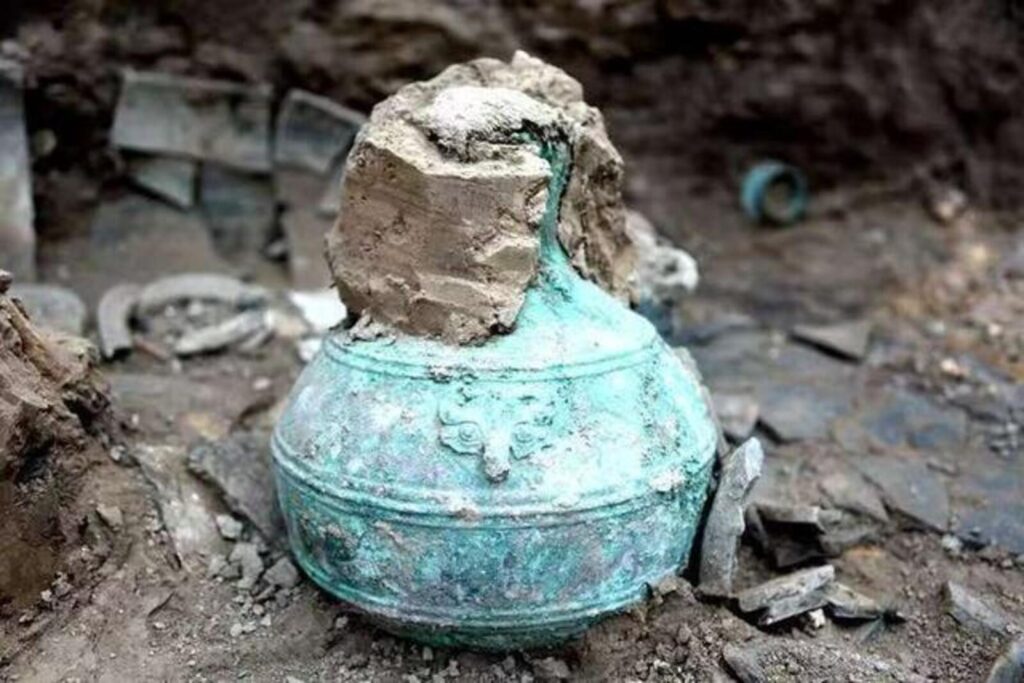
Shanjiabao lies close to a section of the Warring States-era Qin Great Wall. Archaeologists excavated 183 tombs at the cemetery, 179 of them associated with Qin people. Inside one burial, they found a bronze vessel with a distinctive garlic-shaped mouth, a form closely associated with Qin culture and the storage of alcoholic beverages.
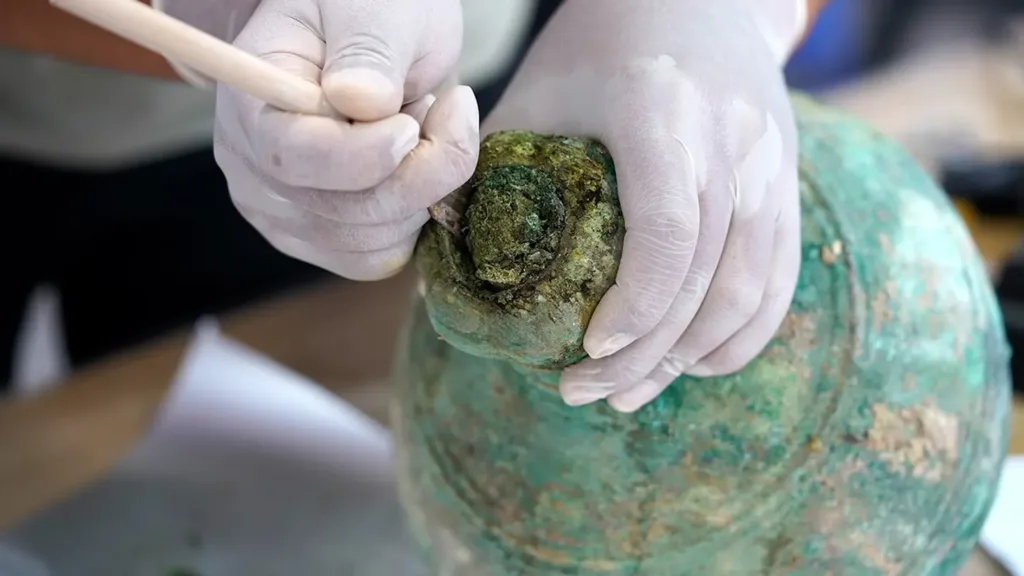
What made the vessel exceptional was its seal. Textile had been packed inside the opening, while an organic-tempered daub covered the exterior. Together, the two layers appear to have sharply limited evaporation and outside contamination.
When researchers opened the vessel under controlled conditions, they recovered about 3,740 milliliters of clear, light blue-green, odorless liquid, together with a small amount of sediment. Chinese researchers describe it as the most completely preserved and information-rich alcoholic liquid yet publicly reported from the Qin state of the Warring States period.
The contents were subjected to infrared spectroscopy, ultra-high-performance liquid chromatography coupled with mass spectrometry, and microscopic examination of starch grains, phytoliths and yeast.
The results made it difficult to explain the liquid as groundwater that had simply seeped into the bottle. Researchers detected high concentrations of lactic and oxalic acids but little tartaric acid, pointing toward a cereal-based drink rather than fruit wine. Its organic-acid pattern was also comparable to artificially aged huangjiu, a traditional Chinese fermented grain beverage.
More than 2,400 organic compounds were detected. Microscopic analysis revealed over 100,000 starch grains along with more than 8,500 yeast cells, preserving an unusually detailed chemical and biological record of the drink.
A Qin recipe hidden in the sediment
The starch grains offered clues to what went into the bottle.
Around 92 percent of those identified came from broomcorn millet, while the remainder belonged to Triticeae, the cereal group that includes wheat and barley. Damage observed on some of the grains indicated that they had probably been ground and heated during preparation.
Researchers believe the drink was probably produced using qu, a fermentation starter made from grains colonized by microorganisms. This method allows saccharification — the conversion of starch into fermentable sugars — and fermentation to occur together. Chinese researchers say the evidence shows Qin brewers had already mastered this process more than two millennia ago.
That makes the discovery more significant than simply showing that Qin communities drank alcohol. The bottle preserves evidence of the technological process behind producing it.
The study by Ruru Chen, Hongying Zhang, Xiaoyang Wang, Wei Ge, Xuekai Qi, Nan Xiao and Rui Wen, published in the Journal of Archaeological Science: Reports, provides rare direct evidence for cereal selection, fermentation and sealing technology in the Qin state.
Beer is far older than the Qin state
The Shanjiabao bottle belongs to a far deeper history of humans deliberately fermenting plants.
At Raqefet Cave in present-day Israel, residues preserved in stone mortars dating to roughly 13,000 years ago have been interpreted as evidence for beer production by Natufian hunter-gatherers, probably connected with ritual feasting.
China has an exceptionally long brewing record of its own. Recent research at the Shangshan site in Zhejiang identified evidence for rice-based beer dating back roughly 10,000 years, produced using rice, fungi and other plant ingredients. Researchers described it as the earliest known alcohol-fermentation technique in East Asia.
By about 5,000 years ago, people at Mijiaya near Xi’an were brewing another complex drink from broomcorn millet, barley, Job’s tears and tubers.
Such discoveries explain why “beer” becomes a flexible term when pushed deep into prehistory. Ancient brews did not follow a single recipe. Different communities used different cereals, plants and microbial processes, many of which bear little resemblance to modern brewing.
The Shanjiabao drink add s a later but remarkably detailed chapter. By the Warring States period, Qin brewers appear to have combined selected cereals, microbial starters and sophisticated sealing techniques within an established fermentation tradition.
Why was it placed in a grave?
The bottle’s funerary context raises a question chemistry cannot answer on its own.
Alcohol played social and ritual roles in ancient China, and food and drink could accompany the dead. The 3.74 liters at Shanjiabao may therefore have been a funerary offering, provisions intended for the deceased, or part of ceremonies surrounding the burial.
Whatever its exact purpose, the archaeological value lies in what survived together: the liquid, sediment, plant microfossils, yeast, and sealed bronze container.
Most research into ancient alcohol begins with minute residues left on vessel walls. Shanjiabao instead preserves something much rarer — a chemical snapshot of what people of the Qin state were brewing, sealing and ultimately burying around 2,300 years ago.
