
8 June 2026 The Future is the Product of the Past

3,000-Year-Old Conical Axe Believed to Have Fallen from the Sky: Possibly Made from Meteorite

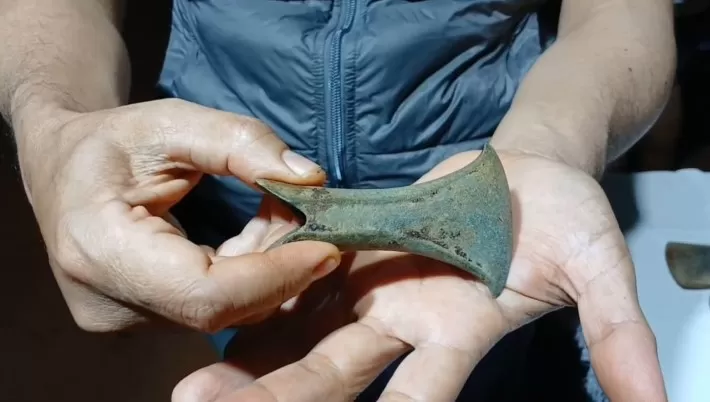
A rare Bronze Age conical axe, over 3,000 years old and possibly crafted from meteorite metal, has been recently discovered in Indonesia, stunning archaeologists and historians alike.

Believed to be the first of its kind in the region, this extraordinary artifact offers new insights into the advanced metalworking techniques and social practices of ancient Borneo communities, highlighting the rich heritage of even remote parts of the island.

The axe emerged from the collection of a local villager, who had preserved it alongside other artifacts found while panning for gold. Among these items were ancient beads from the Dayak tribe and traditional stone axes, but the conical axe immediately captured the attention of experts for its unique shape, intricate craftsmanship, and possible meteorite origin.

Young archaeologist Ida Bagus Putu Prajna Yogi was among the first to examine the find. “In all my years studying Kalimantan’s archaeology, I have never seen a conical axe like this,” she said. Her observation underscores the rarity and significance of the discovery.

Hartatik, a member of the Banjar Regency Cultural Heritage Expert Team (TACB), explained that the conical axe—locally known as “Gigi Petir” or Untu Gledek—carries both cultural and historical importance. While local legends suggest such objects appear where lightning strikes, scientists propose that it may have been crafted using advanced metalworking techniques, possibly even from melted meteorite material.



📣 Our WhatsApp channel is now LIVE! Stay up-to-date with the latest news and updates, just click here to follow us on WhatsApp and never miss a thing!!


The conical axe, suspected to be a Bronze Age relic, was discovered by a resident of Paau Village, Aranio District, Banjar Regency. Credit: MADA FOR RADAR BANJARMASIN

Unlike ordinary stone axes, the conical axe was likely not intended for chopping or cutting. Its small size and artistic design suggest that it served as a symbol of social status or a trade item. “It represents both artistry and social hierarchy, reflecting the culture of Bronze Age communities in Kalimantan,” Hartatik noted.

Experts stress that verifying the artifact’s authenticity is critical. Understanding the context of its discovery—including when and how it was found and whether it was inherited or directly uncovered—is essential to ensure historical accuracy and guard against forgery.

The appearance of this rare axe provides compelling evidence that ancient Kalimantan communities had moved beyond the Stone Age, employing sophisticated metalworking skills for symbolic, social, and possibly ceremonial purposes. The discovery also emphasizes the importance of preserving local heritage, showing how even isolated areas can hold invaluable insights into Indonesia’s past.

TACB and the National Research and Innovation Agency (BRIN) are coordinating with authorities to conduct further analysis and authentication. If confirmed, this discovery will position the find as a landmark in the study of Bronze Age Indonesia, with potential to redefine understanding of early Borneo societies and their technological capabilities.

This exceptional find not only captivates archaeologists but also highlights the enduring mysteries of Indonesia’s rich cultural landscape. As studies continue, the Bronze Age conical axe may reveal even more about the ingenuity, artistry, and social complexity of ancient communities in Borneo.

Cover Image Credit: MADA FOR RADAR BANJARMASIN

Related Articles

Pictish ring believed to be more than 1,000-years-old found during Burghead fort dig in Scotland

5 September 2024

5 September 2024

A “remarkable” Pictish ring thought to be more than 1,000 years old has been unearthed by an amateur archaeologist on...

In Moravia, archaeologists discover divine thrones, thousands of artifacts and a new settlement

13 August 2021

13 August 2021

During a four-year dig in the Moravian city (Czech Republic) of Perov, rare gems, mysterious burial places, and divine thrones...

Archaeologists Uncover Extensive Ancient Irrigation Network in Eridu, the World’s First City

8 March 2025

8 March 2025

Recent research by a multidisciplinary team of archaeologists and geologists has revealed that the Eridu region of southern Mesopotamia, inhabited...

Hebrew University Archaeologists have Unveiled 7,000-year-old Seal İmpressions

10 June 2021

10 June 2021

Israeli archaeologists unveiled a 7,000-year-old clay seal impression used for commerce and protection of property, the Hebrew University of Jerusalem...

DNA Confirms Northern Britain’s Oldest Human Remains Belong to an 11,000-Year-Old Girl -Ossick Lass

15 February 2026

15 February 2026

An 11,000-year-old burial discovered in a small limestone cave in Cumbria has now been identified as a young girl, making...

Ancient Stone Slabs with Hunting Scenes Discovered in Burial Mounds of Khakassia

2 March 2026

2 March 2026

Archaeologists from the Institute for the History of Material Culture have uncovered remarkable stone slabs engraved with hunting scenes and...

The Jinn of Girnavaz Mound

6 February 2021

6 February 2021

Girnavaz mound is in the north of Nusaybin district of Mardin province and Nusaybin 4 km is away. It is...

Hunting tools Dating Back 1900 Years Found inside a Cave in Querétaro, Mexico

27 January 2024

27 January 2024

Archaeologists from the National Institute of Anthropology and History (INAH) found hunting weapons dating back approximately 1,900 years in a...

The first Dutch Neanderthal’s ‘Krijn’ face was reconstructed

7 September 2021

7 September 2021

World-renowned “paleo-artists” Kennis brothers have reconstructed the face of the first Neanderthal in the Netherlands. After more than 50,000 years,...

Hidden Byzantine Treasure Uncovered: 7th-Century Gold Coin Hoard Reveals Secrets of a Turbulent Empire

10 April 2026

10 April 2026

A remarkable collection of Byzantine gold coins, known as the “Sivas Hoard,” is shedding new light on one of the...

Medieval subterranean corridors found by accident in northeast Iran

1 October 2022

1 October 2022

The workers working on a routine road construction project near Shahr-e Belqeys (City of Belqeys) in northeast Iran made an...

Iron Age stone altar and gold-plated ceremonial sword discovered in Kazakhstan

14 August 2021

14 August 2021

A stone altar and a gold-plated ceremonial sword used in the early Iron Age were discovered during excavations along the...

New study reveals the Milky Way’s hidden role in ancient Egyptian mythology

11 April 2024

11 April 2024

The ancient Egyptians were keen observers of the night sky. They incorporated their astronomical observations into their religion, mythology, and...

Archaeologists uncovered a kurgan tomb from a previously unknown culture

8 January 2023

8 January 2023

Archaeologists from the Siberian Federal University have unearthed a kurgan tomb and numerous bronze tools and artifacts from a previously...

Roman Handprints, Preserved Textiles and Possible DNA Found in Rare Gypsum Burial in England

22 December 2025

22 December 2025

Archaeologists in England have uncovered extraordinary evidence of intimate Roman burial practices after re-examining a rare gypsum-filled stone sarcophagus discovered...