
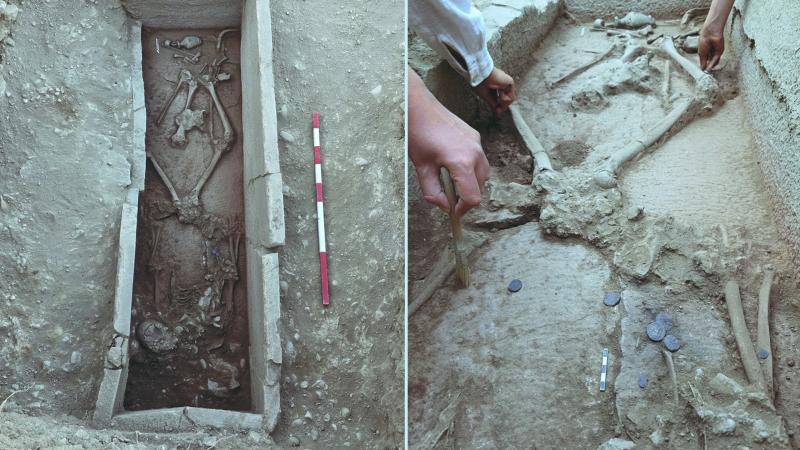
Archaeologists excavating at Aspendos Ancient City in southern Türkiye have uncovered a chest-type tomb dating to the last quarter of the 5th century BCE through the 4th century BCE, in a section of the site never before documented.
The discovery was announced by Türkiye’s Minister of Culture and Tourism, Mehmet Nuri Ersoy, marking what officials describe as a significant addition to understanding of the city’s Classical Period.
The tomb was found within the Eastern Necropolis, an area whose existence at Aspendos had not been identified prior to this excavation season. Its discovery expands the known boundaries of the ancient city’s burial landscape and opens a new avenue of research into how the site’s population lived, died, and was commemorated more than two millennia ago.
Coins Point to a Life in Sport
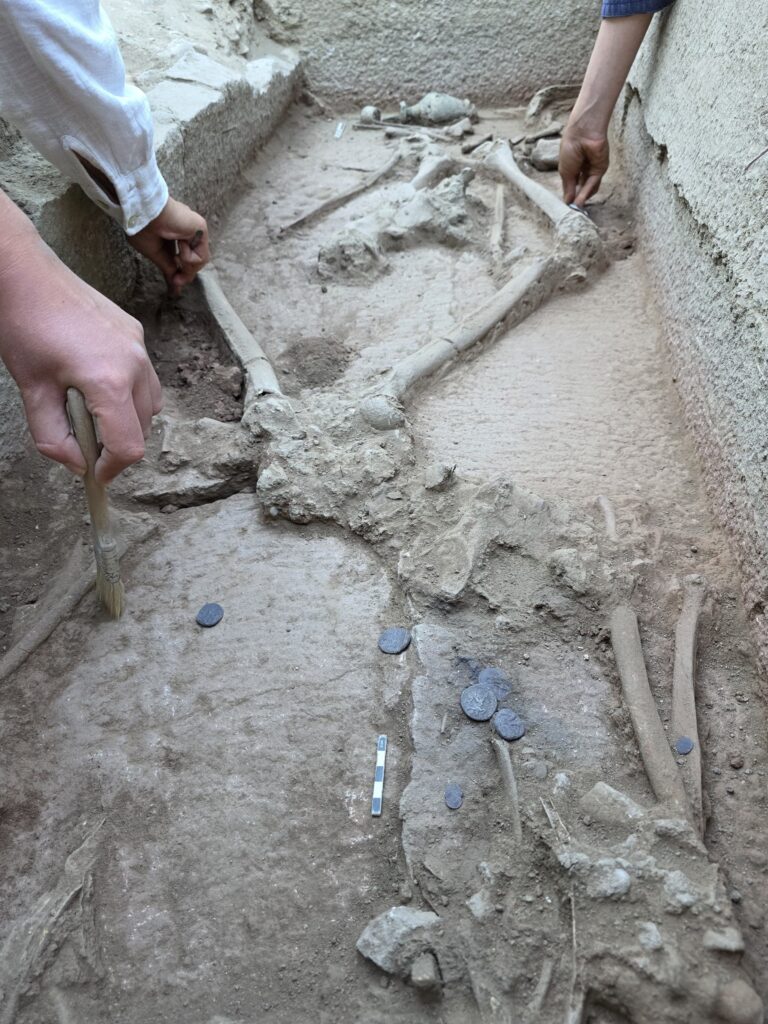
Among the grave goods recovered from the tomb were Aspendos coins bearing depictions of wrestlers, alongside additional finds that support the theory the deceased had ties to athletics. Researchers say the combination of evidence suggests the person buried in the tomb may have been an Aspendos wrestler, a detail that offers a rare, tangible link between the city’s Classical-era inhabitants and the athletic culture associated with the ancient Greek world at the time.
Minister’s Statement
Sharing the discovery on his X (Twitter) and NSosyal accounts, Minister Mehmet Nuri Ersoy said:
“In the excavations we are conducting at Aspendos Ancient City, we have reached a very important discovery that sheds light on the city’s Classical Period history. In the Eastern Necropolis, whose existence within the city was detected for the first time, we have brought to light a chest-type tomb dated to the last quarter of the 5th century BCE and the 4th century BCE. The Aspendos coins found in the tomb, featuring depictions of wrestlers, along with other finds, indicate that the person buried here was connected to sports, and possibly even an Aspendos wrestler. I wholeheartedly congratulate our General Directorate of Cultural Assets and Museums, our excavation team, and all our scientists for their contributions to this valuable discovery. With each new find from Aspendos, we will continue to complete the missing pages of our history and to protect our cultural heritage through scientific studies, carrying it forward to the future.”
What the Findings Reveal
According to the Ministry of Culture and Tourism, the newly recovered finds provide important data on daily life, burial customs, and the social structure of Aspendos during the Classical Period.
Officials noted that this era of the city’s history has so far been documented only through limited archaeological evidence, meaning the tomb and its contents meaningfully enrich the existing body of knowledge. The Ministry added that the findings are expected to inform further scientific research into the ancient city’s past.
About Aspendos
Aspendos, located near the modern town of Serik in Türkiye’s Antalya province, is one of the best-preserved ancient cities of Pamphylia and is world-renowned for its remarkably intact Roman theater, still used for performances today.
Beyond the theater, the site preserves the remains of an aqueduct, basilica, agora, and stadium, reflecting centuries of continuous habitation from the Classical period through Roman and Byzantine times. Ongoing excavations at
Aspendos continue to reveal new layers of the city’s history, from its monumental Roman architecture to, now, evidence of its earlier Classical Period communities and their connections to sport and civic life.
Looking Ahead
Excavation teams and the General Directorate of Cultural Assets and Museums are expected to continue work in the Eastern Necropolis in search of further tombs and artifacts that could clarify the identity of the deceased and provide a fuller picture of burial practices at Aspendos during the Classical era.
As Minister Ersoy noted, each new discovery at the site contributes to filling in previously missing chapters of the region’s ancient history.
