
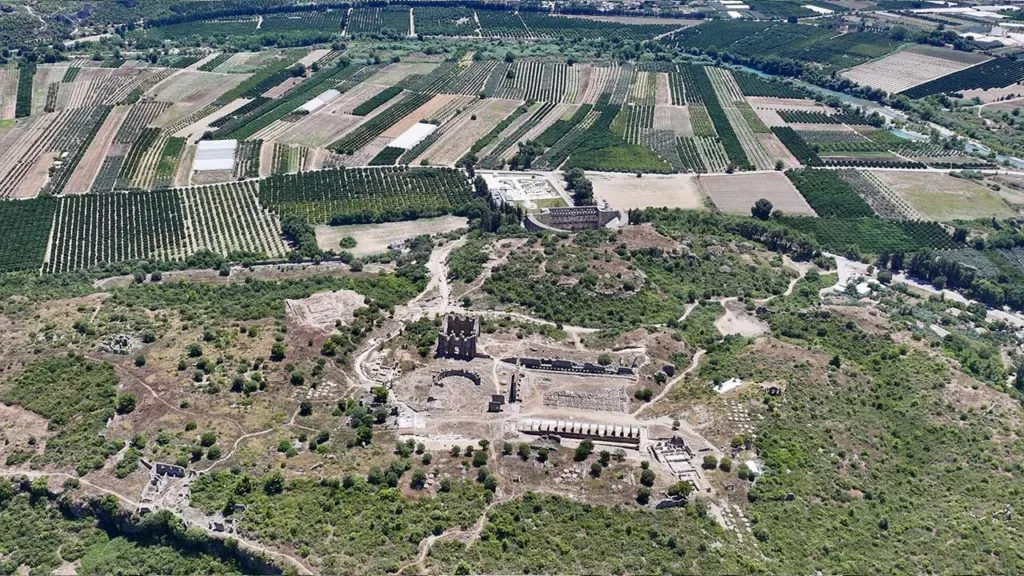
A 2,000-year-old main street in Aspendos has been uncovered along the route once used to travel between the city’s celebrated Roman theater and its hilltop acropolis. The discovery is revealing a side of the ancient city that remained largely hidden behind its best-known monuments.
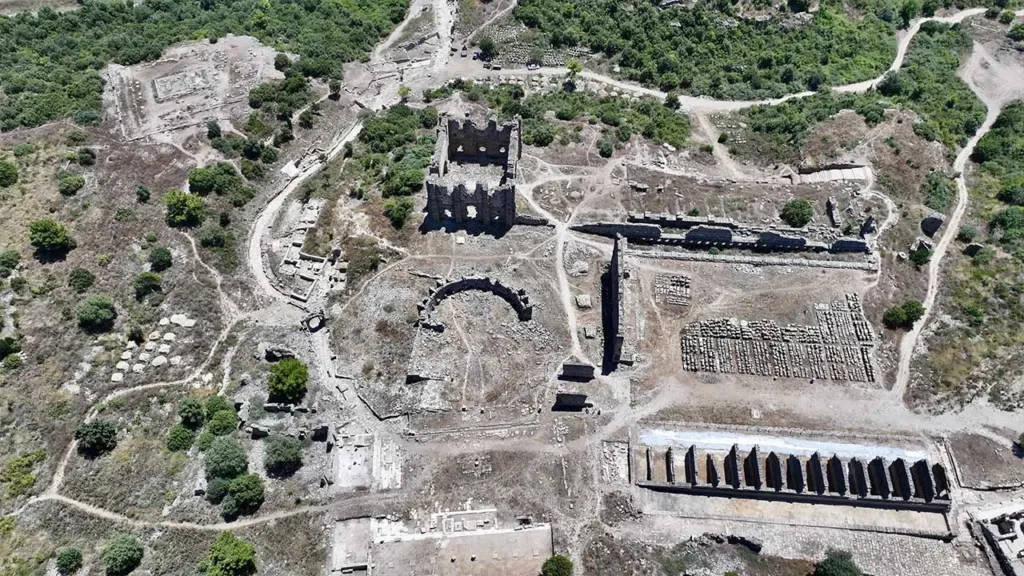
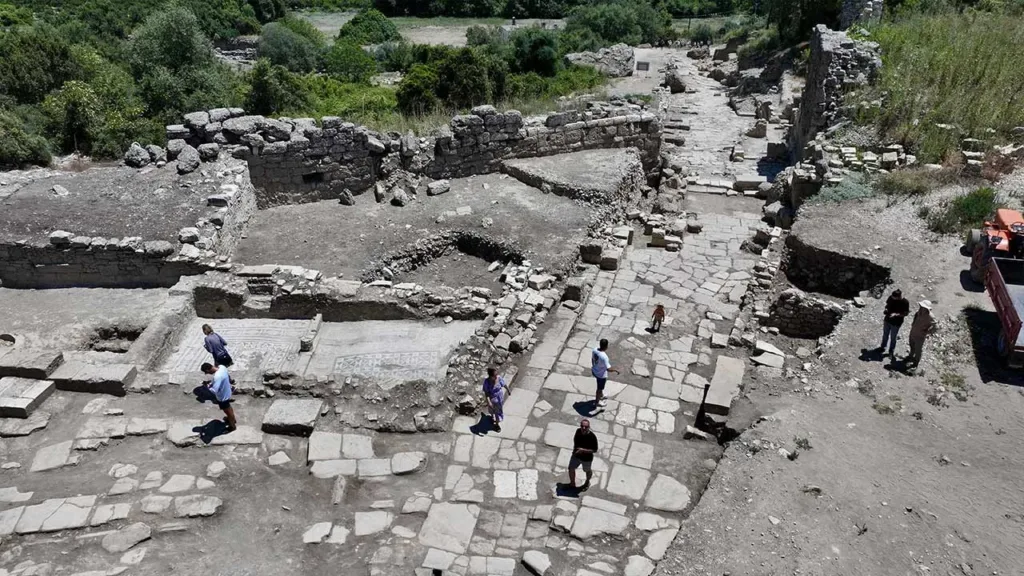
Archaeologists have exposed approximately 300 meters of the paved road, known as Theater Street, during excavations in Antalya, on Türkiye’s Mediterranean coast. Public buildings, houses, two-story shops, a covered colonnade, a monumental gateway and an exceptionally well-preserved bakery have also emerged along the route.
The excavations have been led since 2022 by Assoc. Prof. Mustafa Bilgin of Afyon Kocatepe University and are continuing under the Turkish Ministry of Culture and Tourism’s Heritage for the Future Project.
A major artery leading to the acropolis
Theater Street connected the monumental theater at the foot of the settlement with the acropolis rising above it. Measuring between three and five meters wide, the road appears to have been one of the busiest transportation routes in ancient Aspendos.
Bilgin said the excavation of the street is approaching completion after two years of work. Once the route is prepared for visitors, people will be able to follow the same path once used by the inhabitants of the ancient city as they moved between its residential, commercial and administrative districts.
The discovery is particularly important because most modern visitors have experienced Aspendos through its theater and aqueducts. The restored route will instead lead them into the wider urban landscape, including the monumental structures preserved on the acropolis.
Located about 60 meters above the surrounding plain, the acropolis contains the remains of a basilica, market building, monumental fountain and other public structures. Its elevated position also overlooked the Eurymedon River, now known as Köprüçay, which connected Aspendos with the Mediterranean and helped support the city’s commercial prosperity.
Roman engineering survived centuries of earthquakes
The excavations have also revealed the infrastructure beneath Theater Street. Approximately one meter below the road lies a sewage channel designed to carry wastewater away from the densely occupied urban area.
According to Bilgin, the paving stones were carefully arranged in accordance with the natural slope. This construction technique prevented major displacement even when the city was affected by earthquakes.
The drainage system adds Theater Street to a wider network of ambitious engineering projects at Aspendos. The city’s Roman aqueduct, parts of which extend for roughly one kilometer, transported water from springs in the northern hills. Its surviving towers and pressure-based siphon system are regarded as rare examples of ancient hydraulic engineering.
The theater and aqueducts of Aspendos have been included on UNESCO’s World Heritage Tentative List since 2015. Although these monuments established the city’s international reputation, the latest excavations are beginning to reconstruct the streets, workshops and neighborhoods that connected them.
Shops reveal links with the Eastern Mediterranean
Two-story shops and a stoa, or covered walkway, uncovered beside the road have produced evidence of Aspendos’ commercial activity. Finds include a Phoenician coin and glass perfume bottles believed to have been manufactured locally.
The excavation team associates these objects with the city’s connections to Eastern Mediterranean trading networks, including regions corresponding to ancient Syria and Palestine. The location of Aspendos near a navigable river would have allowed goods arriving from the Mediterranean coast to move inland.
Aspendos was one of the principal cities of Pamphylia, a region occupying the fertile coastal plain of southern Anatolia. Its access to agricultural land, river transport and Mediterranean trade routes helped it develop into an important commercial center long before the Roman period.
The unearthed bakery provides a more immediate view of life along the street. Rather than representing elite or ceremonial architecture, the structure records the daily production and sale of food within one of the city’s busiest districts.
Cemetery pushes activity back to the Classical period
Outside the eastern city gate, archaeologists identified the eastern necropolis of Aspendos. A tomb dated to the late fifth century BC indicates that the area was already being used for burials during the Classical period, centuries before the Roman structures that dominate the site today.
Excavations in the nearby Eastern Square also uncovered the remains of a mosaic-floored building. Together with the monumental gate, shops and residential structures, the discovery is helping researchers trace how the eastern entrance of Aspendos developed over different periods.
The work is gradually changing the archaeological image of Aspendos. Rather than an ancient settlement represented by a single extraordinary theater, it is emerging as a complex city shaped by long-distance trade, sophisticated infrastructure and streets crowded with shops, homes and public buildings.
