
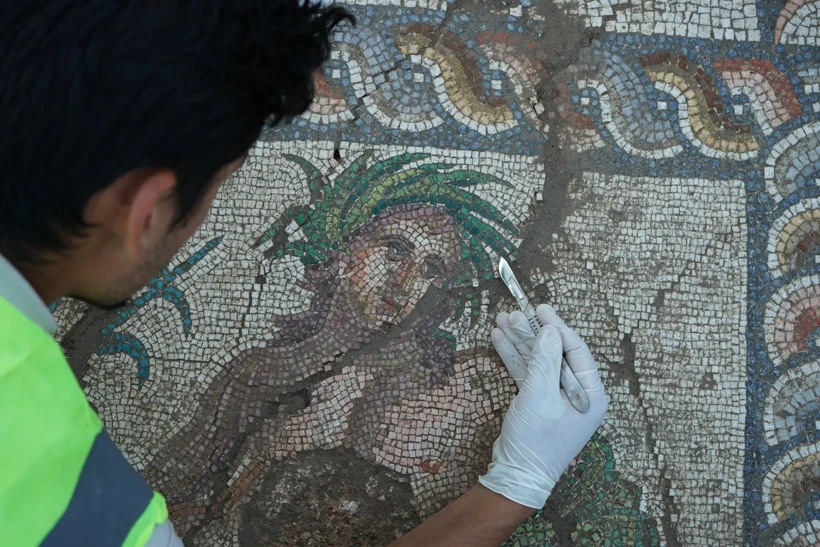
An Aspendos mosaic dating to the 3rd century AD has revealed one of the rarest images in Roman-period Anatolian mosaic art: a youthful personification of the Eurymedon River, the waterway that once helped sustain the ancient city.
The mosaic was uncovered during excavations on Theatre Street, the ancient route connecting the acropolis of Aspendos with its famous Roman theatre. According to Türkiye’s Ministry of Culture and Tourism, the newly exposed floor belongs to a mosaic-covered architectural structure in the East Square area, between the square and the eastern city walls.
At the center of the composition is a figure identified as “Young Eurymedon,” a river god representing the ancient Eurymedon, today known as the Köprüçay River. The discovery stands out not only for its preservation and craftsmanship, but also because depictions of river gods in mosaic art are not commonly found in such a local and clearly identifiable form.
A mosaic floor beside Aspendos’ Theatre Street
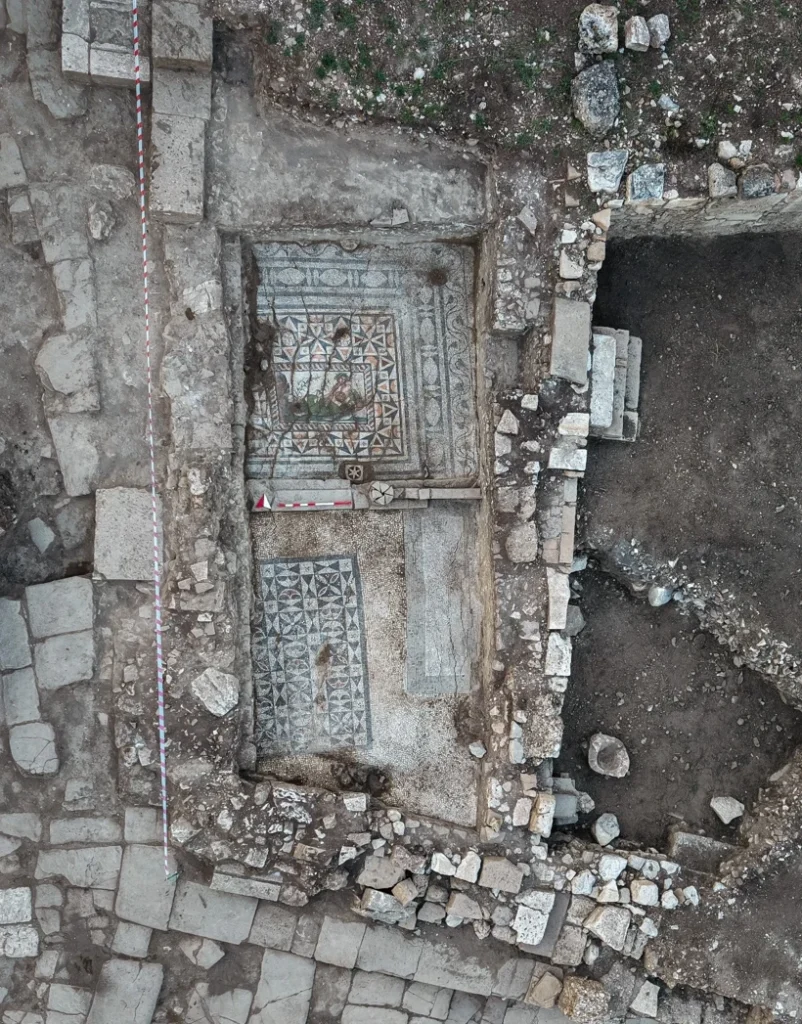
The structure uncovered in the East Square measures roughly 6 by 25 meters. So far, archaeologists have completed excavation of an area measuring about 6 by 7.5 meters, but the mosaic pavement appears to continue into still-unexcavated sections.
Initial assessments suggest that the building was first constructed as a pool or water-related structure in the early 3rd century AD. After the earthquake of AD 262, it seems to have been divided into smaller spaces by internal walls, a change that reflects how the urban fabric of Aspendos adapted after a major seismic event.
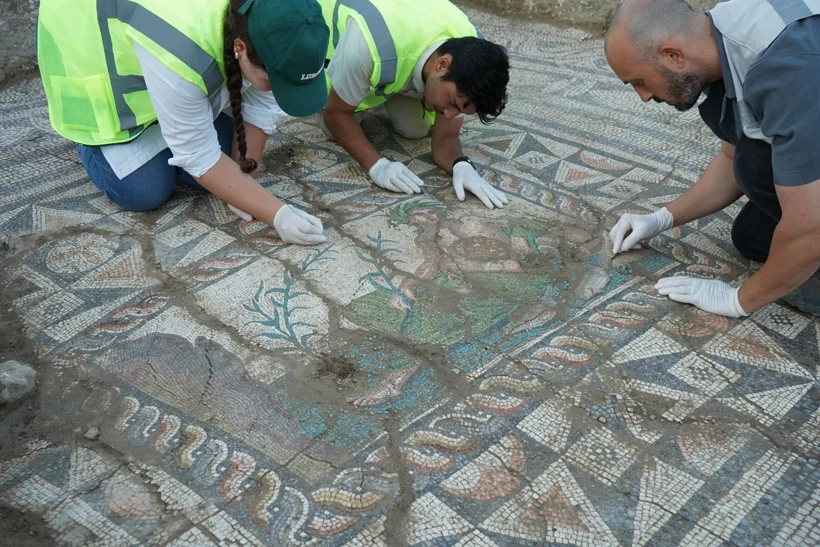
The visible mosaic floor is arranged in two main panels. One contains geometric decoration, while the other presents the figural scene that gives the find its significance. The central figure, identified through its iconography and comparison with similar examples, represents the river that gave Aspendos much of its agricultural and economic strength.
Young Eurymedon and the language of water
In Greco-Roman art, rivers were often imagined as divine beings. They could appear as reclining male figures, sometimes leaning on a vessel from which water flows, or shown with reeds, fish, aquatic plants, and other signs of fertility. The Aspendos mosaic follows this visual language, but gives it a distinctly local identity.
Young Eurymedon is shown with reed leaves on his head and in his hand. He reclines beside an amphora from which water pours, while fish swim in the river around him. The details are not decorative filler. They form a symbolic scene built around water, abundance, and life.
This matters at Aspendos more than it might elsewhere. The city’s prosperity was closely tied to water. Located in ancient Pamphylia, in today’s Antalya province of southern Türkiye, Aspendos stood near the Eurymedon River, about 16 kilometers inland from the Mediterranean. The river connected the city to trade routes, agriculture, and the wider coastal plain.
The choice to represent Eurymedon as a youthful river god may also be significant. Many river gods in classical art are shown as mature or bearded figures. A younger Eurymedon gives the scene a different tone: less monumental, more lively, and perhaps more closely connected to renewal, flow, and fertility.
Small tesserae, careful color transitions
The Ministry noted that the mosaic was made with small tesserae, allowing the artist to create refined color transitions and detailed modelling. This level of workmanship is especially visible in the figure’s proportions, the treatment of the water symbols, and the balance between the central image and surrounding decorative fields.
The find adds a new reference point for Roman-period mosaic production in Anatolia. While famous mosaic centers such as Zeugma have produced major mythological and aquatic scenes, the Aspendos discovery is important because it links a local river, a local city, and a high-quality mosaic program in a single composition.
Culture and Tourism Minister Mehmet Nuri Ersoy described the Eurymedon mosaic as a discovery of “great scientific importance,” noting that it offers valuable data for the study of Roman Anatolian mosaic art.
Aspendos beyond its famous theatre
Aspendos is best known for one of the best-preserved Roman theatres in the Mediterranean world. Built in the 2nd century AD, the theatre still dominates the site with its intact stage building and strong architectural presence. Yet the ancient city was never only a theatre.
Its aqueducts, also among the most remarkable Roman hydraulic systems in Anatolia, carried water from the mountains north of the city. The theatre and aqueducts of Aspendos have been on UNESCO’s Tentative List since 2015, underlining the site’s architectural and technological importance.
The newly discovered mosaic now broadens that picture. It brings attention to the city’s streets, squares, water structures, and urban decoration. More importantly, it restores a visual link between Aspendos and the river that shaped its life.
As excavation continues, the still-buried sections of the mosaic may reveal more of the building’s plan and decorative program. For now, the Young Eurymedon mosaic gives Aspendos something rare: a work of art in which myth, water, city identity, and Roman craftsmanship meet on the same floor.
Cover Image Credit: Minister Mehmet Nuri Ersoy via X
