
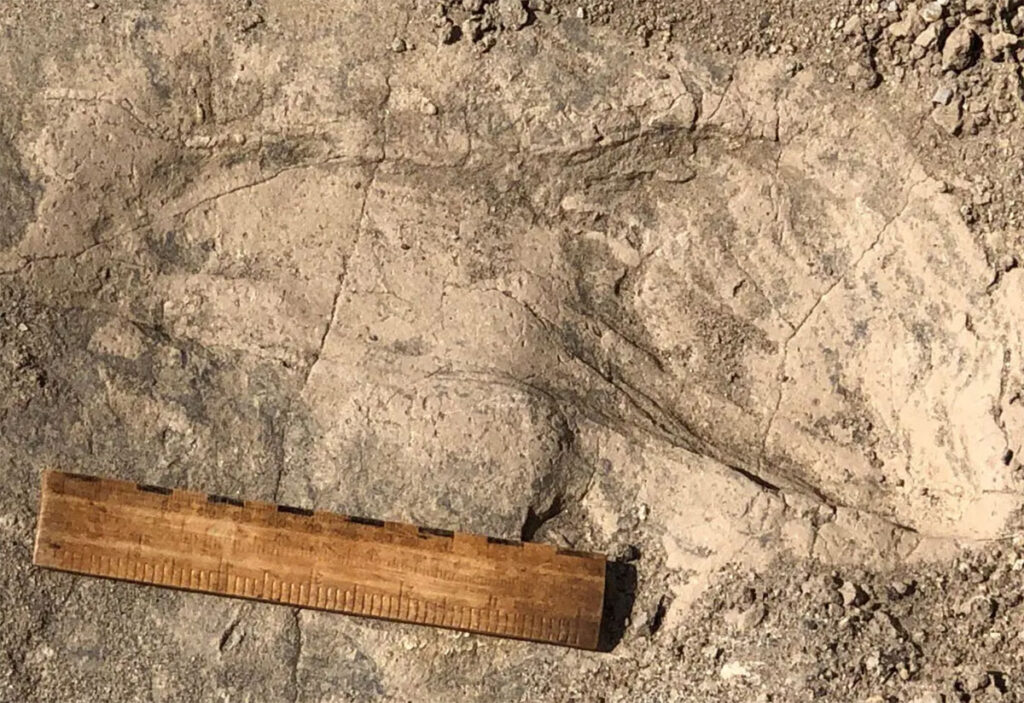
Fossil footprints preserved beside an ancient lake in northern Kenya have captured an extraordinary scene from approximately 1.43 million years ago: several large-bodied hominins walking through shallow water, possibly as part of the same social group.
The tracks, discovered at the GaJi10 site in East Turkana, provide new evidence about the anatomy, body size, movement and behavior of early human relatives. Some of the individuals may have stood close to 1.8 meters tall—far larger than previous reconstructions of Paranthropus boisei, the species the footprints most closely resemble.
The findings also raise a significant question. Were these unusually large members of P. boisei, or did the footprints belong to Homo erectus, another hominin known to have inhabited the same region?
Researchers say the balance of anatomical evidence currently favors P. boisei, but the identification remains provisional.
The study, led by Kevin Hatala of Chatham University and the Max Planck Institute for Evolutionary Anthropology, was published in the journal Proceedings of the National Academy of Sciences.
A Lakeshore Scene Frozen in Time
The GaJi10 footprint surface lies within the Koobi Fora Formation, one of the world’s most important regions for studying human evolution.
The site was first identified in 1978, but expansions of the excavation in 2016 and 2023 exposed many more footprints. Researchers have now documented 21 hominin tracks, including five continuous trackways, provisionally representing eight individuals.
Unlike bones, which may accumulate over hundreds or thousands of years, footprints are usually created within minutes and preserved over a relatively short period. They can therefore record behavior almost as it happened.
At GaJi10, most of the hominins were moving westward. One individual walked in the opposite direction. The tracks were made in fresh silt covered by an estimated two to ten centimeters of water along the shore of ancient Lake Lorenyang.
Fine sand soon filled the impressions, protecting their shape before later sediments buried the surface. A volcanic deposit approximately 40 centimeters above the tracks has been correlated with the Akait Tuff, dated to around 1.43 million years ago.
The scene was not limited to hominins. Excavations also uncovered 146 animal tracks, including footprints left by hippopotamuses, bovids, birds, and equids. The evidence reconstructs a busy lakeshore visited by both early hominins and large animals.
Feet That Moved Differently from Ours
The researchers created detailed three-dimensional models of the footprints and compared them with fossil tracks from East Africa, ancient human footprints from other regions and hundreds of experimentally produced modern human tracks.
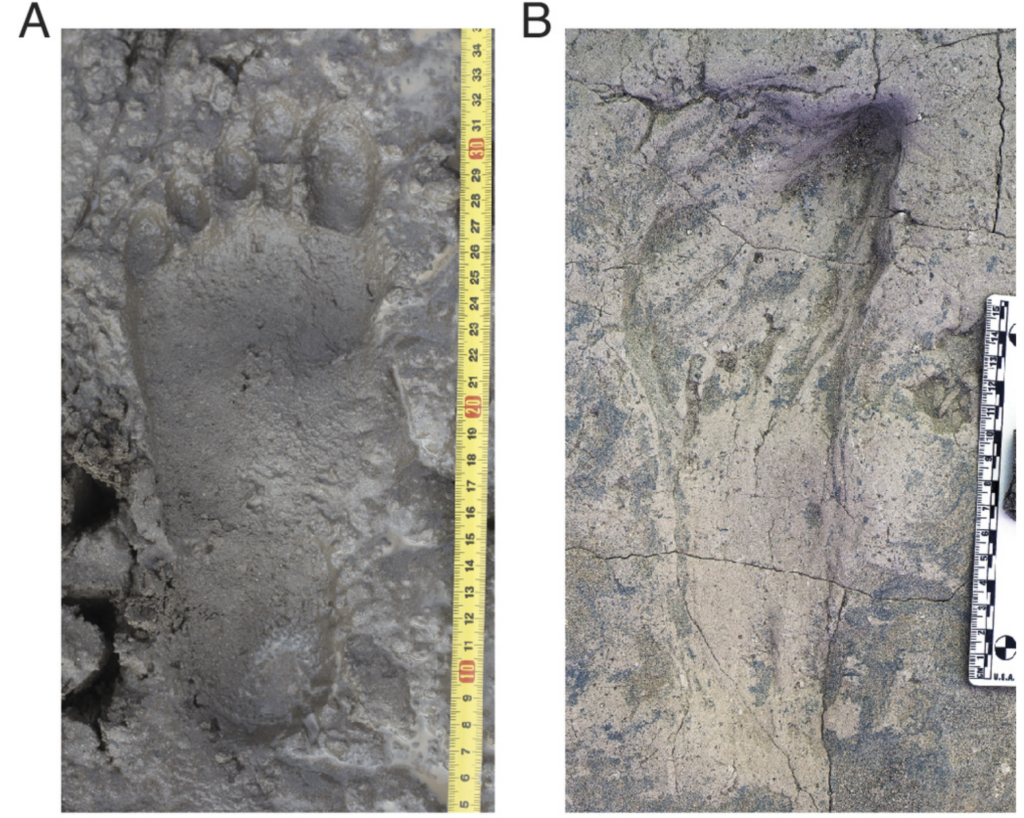
The GaJi10 footprints show a flatter arch pattern and a heel-to-toe movement that differed from that of modern humans. Their big toes were also angled farther away from the rest of the foot than is typical in people today.
In some tracks, the big-toe angle reached nearly 40 degrees.
These characteristics resemble other East Turkana footprints previously attributed to Paranthropus boisei. They also share features with the 3.66-million-year-old Laetoli footprints generally associated with Australopithecus afarensis.
By contrast, other East Turkana tracks attributed to Homo erectus display a more modern human-like pattern of foot movement.
The three GaJi10 trackways that could be used to estimate speed record slow walking, between approximately 0.32 and 0.50 meters per second. However, the researchers caution that this pace probably reflects what the individuals were doing at that particular moment rather than their usual walking speed.
The Unexpected Body-Size Evidence
The greatest surprise came from the dimensions of the footprints.
Because the species responsible has not been conclusively identified, the team calculated body size using two different models. One assumed the body proportions expected for P. boisei, while the other used proportions associated with Homo erectus.
Under the P. boisei model, the seven measurable individuals would have stood between approximately 1.31 and 1.81 meters tall and weighed between 39.8 and 74.6 kilograms.
All seven height estimates exceeded the previously published average for P. boisei. Four were also taller than the largest skeletal estimate included in the comparison. Six of the seven estimated body masses were above the highest published species average used by the researchers.
These results would mean that P. boisei was not only capable of reaching a much larger size than previously thought, but also displayed far greater variation in body size.
Using Homo erectus proportions produces estimated heights of approximately 1.55 to 1.81 meters and masses of 55 to 79.6 kilograms. Those figures are large for H. erectus, but they fall more comfortably within the range already suggested by skeletal remains.
This creates the central puzzle of the discovery: the internal anatomy of the footprints looks more like P. boisei, while their size appears more compatible with Homo erectus.
Did Several Adult Males Move Together?
The trackways may also preserve rare evidence of early hominin social behavior.
Five large individuals appear to have moved westward in broadly similar directions, travelling from shallower water toward deeper parts of the lake margin. Their footprints do not significantly overlap, suggesting they may have crossed the surface at approximately the same time.
Assuming the tracks belonged to P. boisei, their large estimated sizes suggest that several of the individuals may have been adult males.
At minimum, the footprints demonstrate that multiple large males tolerated one another in the same place at nearly the same time. They may even have belonged to a shared social group.
The researchers caution that body-size differences cannot be translated directly into a precise social system. Nevertheless, the trackways offer evidence unavailable from isolated skulls or bones: the spatial relationship between living individuals moving through the same landscape.
Why Early Hominins Returned to Lake Margins
GaJi10 is one of a growing number of Early Pleistocene footprint sites found along former shorelines in East Turkana.
These wetlands offered dependable water and a range of potential foods. Papyrus and other sedges may have been important resources for P. boisei, while shallow water could also provide shellfish, fish, and other aquatic foods.
Evidence from nearby sites suggests that Homo erectus exploited a broader range of environments and increasingly consumed animal foods. P. boisei, by contrast, may have maintained a smaller home range more closely connected to stable lakeshore vegetation.
The footprint record shows that the two hominins repeatedly used the same lake-margin environments over hundreds of thousands of years. Earlier discoveries in East Turkana have even preserved tracks attributed to both species on the same surface, demonstrating that they sometimes occupied the landscape within hours or days of one another.
An Identification That Remains Open
The researchers emphasize that the GaJi10 footprints cannot yet be assigned to a species with absolute certainty.
Foot shape and movement favor Paranthropus boisei. Body size makes Homo erectus a credible alternative. A third, currently unknown hominin species is theoretically possible, although decades of research in this geological layer have so far identified only P. boisei and H. erectus.
Whatever their final attribution, the footprints show that some Early Pleistocene hominins in northern Kenya were considerably larger than average. They also preserve an exceptionally rare moment in which several individuals moved through the same lakeshore environment.
Rather than another isolated fossil, GaJi10 offers something closer to a scene from life—a group of early hominins crossing shallow water while hippos, hoofed mammals and birds moved nearby.
The study describes the tracks as evidence of anatomy, locomotion, behavior and habitat that could not be recovered from bones alone. Together with other East Turkana footprint sites, GaJi10 is gradually turning the ancient lakeshores of northern Kenya into a record of human evolution captured one step at a time.
K.G. Hatala, N.T. Roach, J.W.K. Harris, P. Kiura, E.K. Ndiema, B. Sila, D. Kipkebut, J. Waweru, P. Kisale, A.A. Longaye, H. Sale, & A.K. Behrensmeyer, Insights into hominin body size, locomotion, and behavior from Early Pleistocene trackways in northern Kenya, Proc. Natl. Acad. Sci. U.S.A. 123 (31) e2530996123, https://doi.org/10.1073/pnas.2530996123 (2026).
