
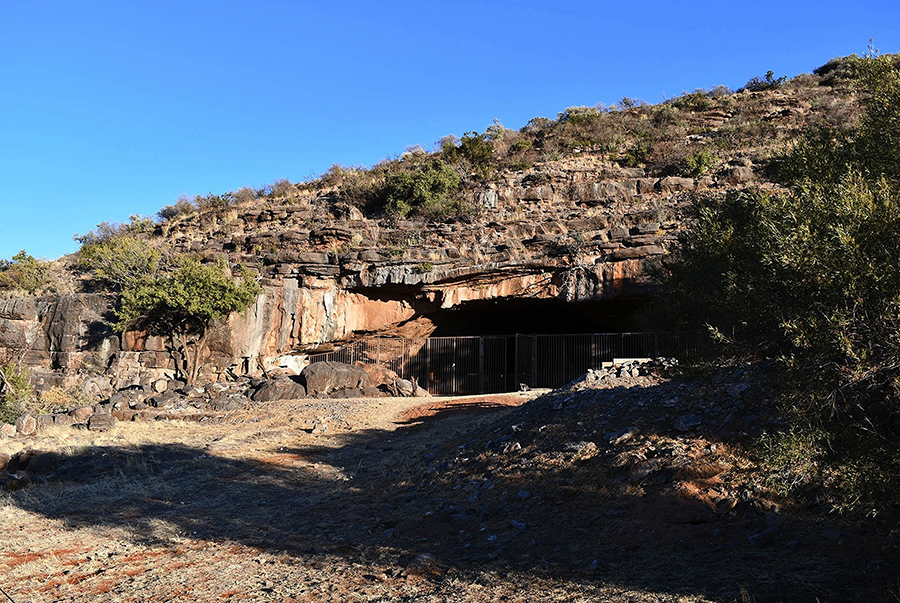
Ancient bones hidden deep inside Wonderwerk Cave in South Africa are giving researchers new evidence that early humans were using fire far earlier than many archaeological records can clearly show.
A new study published in PLOS One reports that small mammal bones from Early Pleistocene layers of the cave carry strong traces of burning. The results suggest that early Acheulean hominins, most likely Homo erectus, brought fire into the cave more than once between 1.79 million and 1.07 million years ago. That does not mean they had fully mastered fire-making. But it does point to something almost as important: they were no longer simply watching fire from a distance.
Fire Traces Deep Inside Wonderwerk Cave
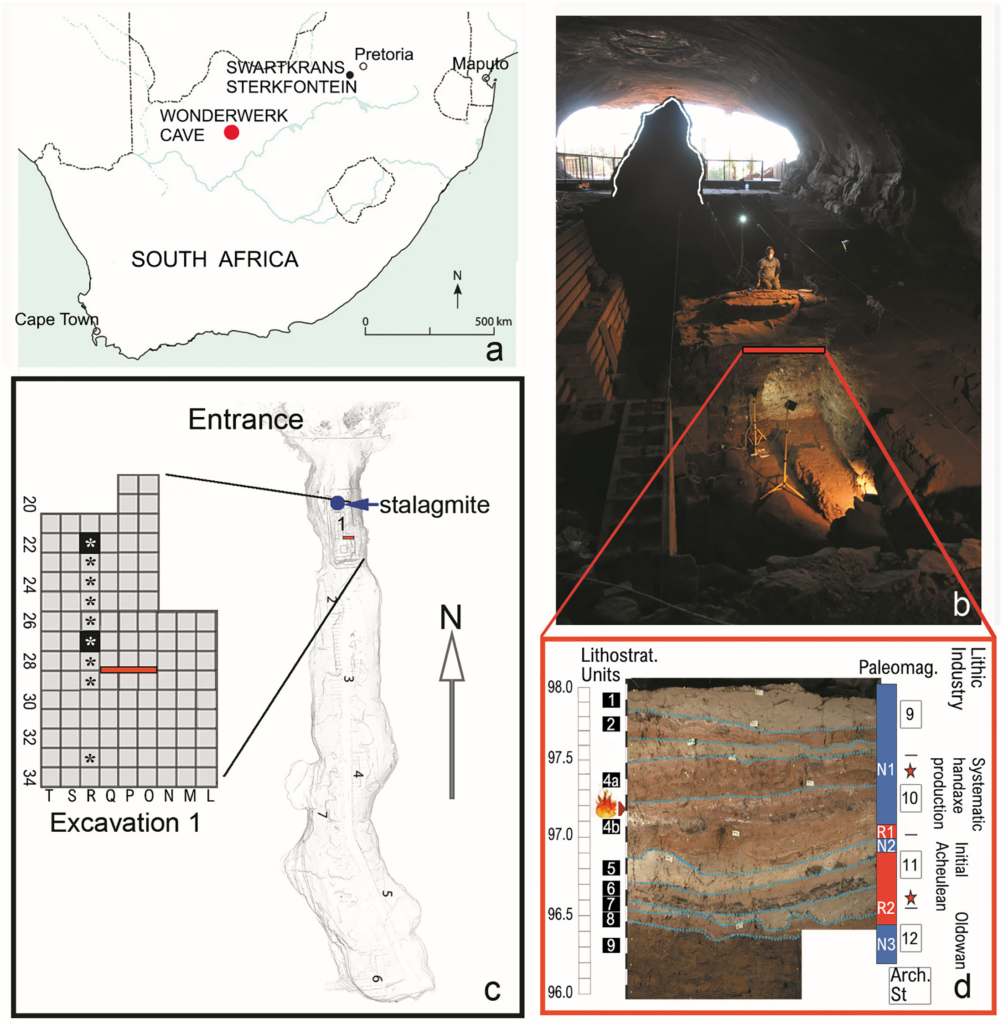
Wonderwerk Cave lies in South Africa’s Northern Cape Province, about 60 kilometers south of Kuruman. It is one of the most important deep-time archaeological sites in Africa, preserving nearly two million years of human occupation.
Earlier research had already identified evidence of fire in Stratum 10 of the cave, dated to around 1 million years ago. That evidence included burnt bone, heated stone tools, burnt sediment, and traces of ash. The new study adds a deeper layer, Stratum 11, where researchers found burned microfauna in deposits associated with the early Acheulean.
The location matters. At the time these bones accumulated, the excavation area was at least 30 meters from the cave entrance. Natural wildfires outside the cave are unlikely to have reached that far inside. For the researchers, this strengthens the case that fire was introduced into the cave by hominins rather than produced by natural burning.
Bones That Glow Under Blue Light
The study’s most striking detail is methodological. Researchers tested a rapid, non-invasive technique based on bone luminescence. When certain burned bones were exposed to blue light at 455 nanometers and viewed through a red long-pass filter, they emitted a reddish glow. Unburned bones did not show the same reaction.
The team then compared the luminescence results with Fourier Transform Infrared spectroscopy, or FTIR, a widely used method for detecting heat-related changes in archaeological materials. FTIR can identify transformations in bone mineral caused by high temperatures, especially above about 537°C.
The match between the two methods was especially strong in Stratum 11. All 32 white and grey small mammal bones tested from that layer were identified as burned by both FTIR and luminescence. In Stratum 10, the results also confirmed earlier evidence of burning, while helping distinguish true heat alteration from fossilization effects such as fluoridation.
Owl Pellets Became an Unexpected Fire Record
The burned bones were not remains of meals. Many belonged to small mammals brought into the cave by barn owls. Over long periods, owl pellets accumulated across the cave floor. These pellets contained hair, feathers, and small bones, creating a layer of organic material that could burn after fire was brought into the cave.
That makes the evidence unusually useful. Because the small mammals were not food waste, they provide an independent record of burning events inside the cave. In Stratum 11, burned bones were not spread evenly. They appeared in patterned concentrations, including two excavation squares about five meters apart. This distribution supports the idea of repeated or spatially limited burning rather than one random event.
Not Cooking Yet, But Something Important
The study does not claim that early humans at Wonderwerk Cave were cooking food nearly 1.8 million years ago. The authors are careful on that point. The evidence is better understood as opportunistic fire use.
Early hominins may have collected fire from natural wildfires outside the cave, carried it into the shelter, and kept it burning until it went out. That is still a major behavioral step. Fire could provide warmth, light, protection from predators, and a way to modify food or animal remains, even before the regular control and production of fire became part of human life.
Wonderwerk Cave therefore sits at a key point in the story of human pyrotechnology. It does not show the full domestication of fire. But it suggests that early humans were already experimenting with fire inside protected spaces, far earlier than securely identified hearths appear in the archaeological record.
A New Tool for Finding Ancient Fire
The luminescence method may also reshape how archaeologists search for early fire use. Unlike some laboratory techniques, it is fast, non-destructive, and can be applied to large numbers of bone fragments. That is important because early fire evidence is often faint, fragmentary, and easy to confuse with natural chemical changes.
At Wonderwerk Cave, the combination of luminescence and FTIR produced converging evidence from two separate Early Pleistocene layers. For researchers studying the origins of fire use, that matters. It offers not only a stronger case for early hominin fire use in South Africa, but also a practical method for detecting similar traces at other ancient sites.
In the long history of human evolution, fire did not begin as a neat hearth. It may have started as something more uncertain: borrowed flame, carried into darkness, kept alive for a while, and lost again. The bones of Wonderwerk Cave now preserve a rare trace of that early encounter.
Marin-Monfort, M. D., Shaw, C. L., Natalio, F., Grossman, L., Andrews, P., Campos, J., García-Morato, S., Pereira, J. M., Pons, A., Chazan, M., Kolska Horwitz, L., & Fernández-Jalvo, Y. (2026). New evidence for Early Pleistocene use of fire at Wonderwerk Cave (South Africa). PLOS ONE, 21(6), e0347480. https://doi.org/10.1371/journal.pone.0347480
Cover Image Credit: Michael Chazan
