
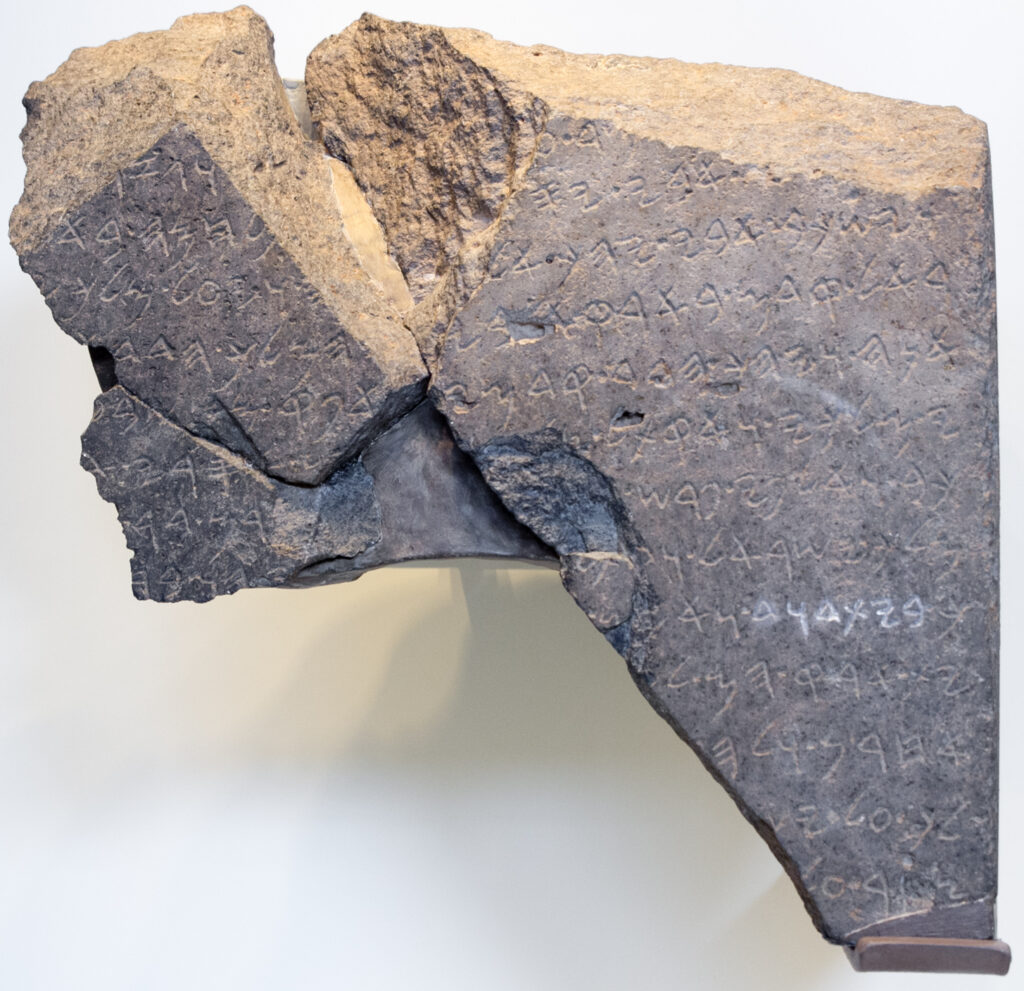
On a July afternoon in 1993, archaeologist and surveyor Gila Cook was completing measurements beside an ancient gateway at Tel Dan in northern Israel. Nothing about the dark basalt stone beneath her suggested that it had once carried the words of a victorious king.
Then the sunlight struck its surface.
Shallow lines appeared across the stone. Cook looked closer and recognized letters carved into the basalt. When the fragment was turned toward the sun, the inscription became clearer. Words separated by small dots began to emerge from a text that had been buried, broken, and forgotten for nearly three millennia.
The discovery would become known as the Tel Dan Stele, one of the most consequential archaeological finds connected with the Hebrew Bible.
A royal monument reused as building stone
The first fragment was discovered on July 21, 1993, during excavations directed by archaeologist Avraham Biran and the Nelson Glueck School of Biblical Archaeology at Hebrew Union College.
It was not standing upright in its original position. The monument had been deliberately smashed in antiquity, and part of it had later been reused in the paved entrance area of the city’s outer gate. The surviving piece measured only about 32 centimeters high and 22 centimeters across, although researchers estimated that the original basalt monument may have stood approximately one meter tall.
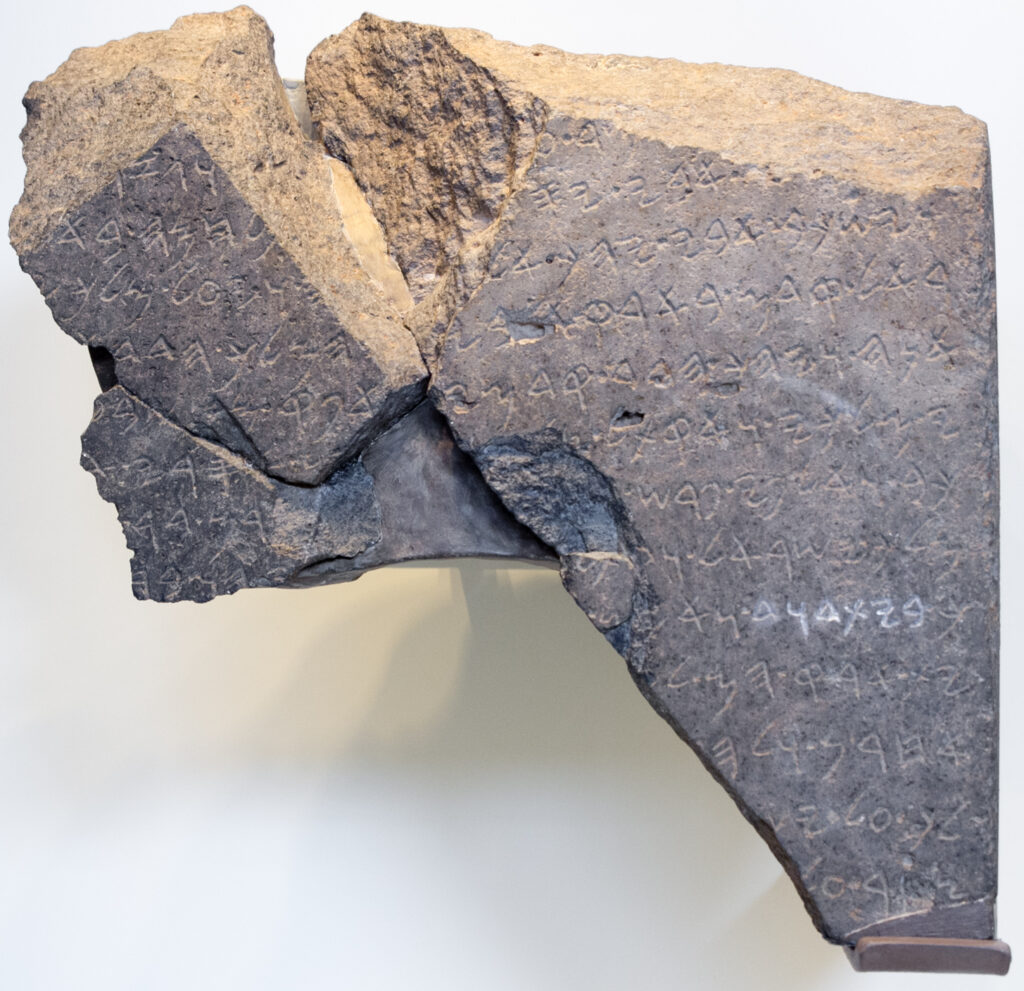
Two additional fragments were recovered during the 1994 excavation season. One appeared in a debris layer near the gateway, while another was found beside a wall bordering the stone pavement. Together, the pieces preserved parts of an Aramaic victory inscription dating to the ninth century BCE.
The monument had probably been erected by Hazael, king of Aram-Damascus, or under his authority, following military victories over the neighboring kingdoms of Israel and Judah. The Israel Museum, where the fragments are now held, identifies it as a monumental slab commemorating Hazael’s campaigns.
What does the Tel Dan inscription say?
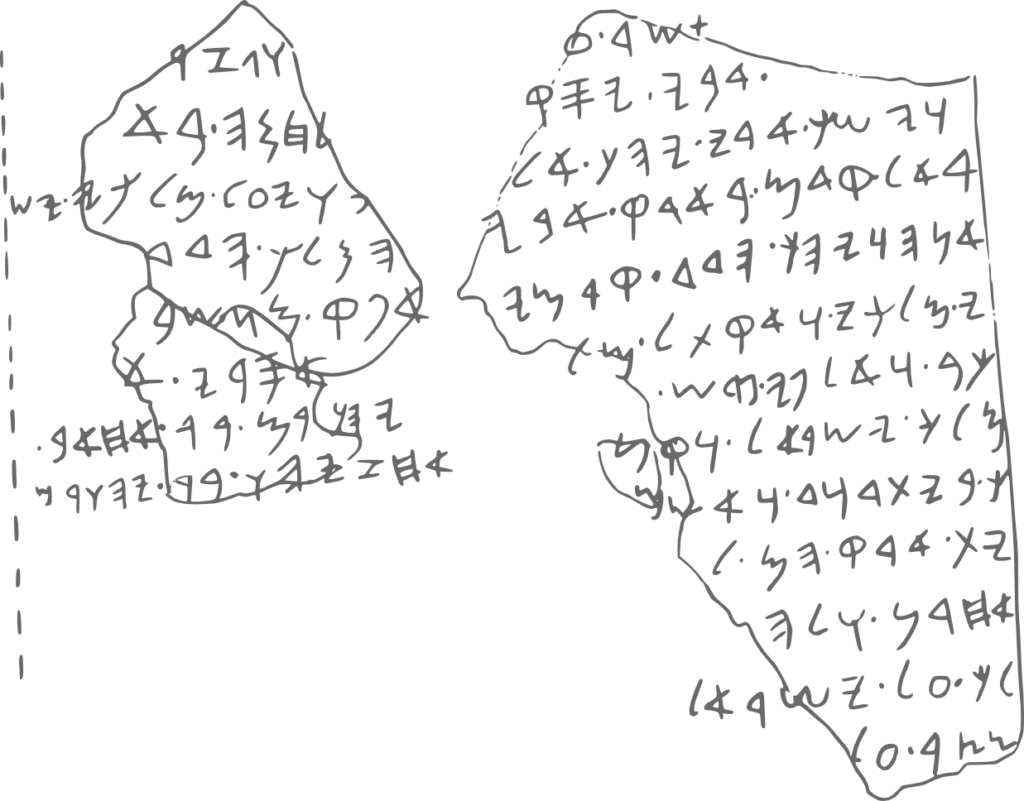
Much of the inscription is missing, leaving only broken sentences from a longer royal declaration. The surviving lines describe warfare, defeated kings and territory taken by an Aramean ruler who believed the storm god Hadad had granted him victory.
Scholars generally reconstruct the text as referring to the deaths or defeat of Joram, king of Israel, and Ahaziah, king of Judah. These rulers also appear in the biblical Books of Kings as participants in the violent struggles between Israel, Judah and Aram-Damascus during the ninth century BCE.
Yet one short phrase transformed the inscription from an important royal monument into an archaeological sensation:
BYTDWD — “House of David.”
In ancient Near Eastern political language, a “house” could mean a ruling dynasty founded by a particular ancestor. The expression therefore appears to identify the kingdom of Judah—or its ruling family—as the dynasty of David.
It remains the earliest widely accepted reference to the House of David outside the Hebrew Bible.
Why three words caused such an enormous reaction
Before the Tel Dan discovery, no undisputed inscription from the ancient Near East clearly referred to David or a Davidic dynasty.
David was central to the biblical account: a warrior who became king, captured Jerusalem and established a royal line that continued to rule Judah. But the lack of contemporary external evidence had left historians divided over how much of that account represented recoverable history.
Some scholars viewed David as a historical ruler whose achievements had been enlarged by later writers. Others questioned whether he had ruled more than a small highland territory. The most skeptical interpretations treated him largely as a literary or dynastic figure created by writers centuries after the period in which he was supposed to have lived.
The Tel Dan Stele did not settle all of those arguments. What it changed was the starting point.
An enemy ruler writing in Aramaic during the ninth century BCE—roughly a century after David’s traditional lifetime—apparently recognized Judah’s rulers as belonging to the “House of David.” The phrase indicated that David was already remembered as the founder of a political dynasty, not merely as a character appearing in much later religious literature.
The discovery shifted much of the debate away from the simple question of whether a Davidic dynasty existed. Attention increasingly turned toward more difficult questions: How large was David’s kingdom? How centralized was it? How much of the biblical narrative preserves historical memory, and how much reflects later political and theological interpretation?
The stele does not simply “prove the Bible”
The Tel Dan inscription is frequently presented as archaeological proof of the biblical account of King David. Its real significance is more precise—and more interesting.
The stone does not describe David’s life. It says nothing about his battle with Goliath, his capture of Jerusalem, the size of his army or the extent of his territory. It was carved generations after David’s presumed reign and refers to the dynasty associated with his name rather than to David directly.
The inscription also does not perfectly reproduce the biblical narrative.
The Aramean author appears to take credit for the deaths or defeat of the kings of Israel and Judah. The Book of Kings, however, attributes their killings to the Israelite commander Jehu during his seizure of power. Scholars have proposed several explanations: Hazael may have claimed ultimate responsibility for events initiated by his military pressure, he may have supported Jehu, or the royal inscription may simply contain the kind of deliberate exaggeration commonly found in ancient victory monuments.
Rather than acting as a stone copy of the Bible, the stele preserves a rival political voice. It shows how an Aramean king wanted the conflict remembered.
Debate continued after the discovery
The reading “House of David” quickly generated intense discussion. Alternative interpretations were proposed, partly because ancient inscriptions often omit vowels and because no word divider appears inside the sequence BYTDWD.
Despite these objections, “House of David” became the prevailing interpretation among epigraphers and historians. The dynastic construction also fits expressions used elsewhere in the ancient Near East, where kingdoms could be named after their founders.
Research into the monument has nevertheless continued. A 2024 study using Reflectance Transformation Imaging and digital analysis found systematic differences between the lettering on the first fragment and the two pieces discovered in 1994. Researcher Michael Langlois argued that the fragments may have been carved by two engravers—or by one engraver whose technique changed—and that their traditional physical arrangement should be reconsidered.
The study did not remove the words “House of David” from the stone. It demonstrated instead that even one of biblical archaeology’s most famous objects remains open to new examination.
A broken monument that changed the historical question
The Tel Dan Stele survived because someone destroyed it. Its shattered pieces were carried away, placed among ordinary construction stones, and eventually covered by the remains of the ancient city.
Nearly 3,000 years later, a few letters caught the afternoon sun.
Those letters did not prove every story told about King David. They did something historically more defensible: they showed that, by the ninth century BCE, Judah’s ruling line was known beyond its own borders as the House of David.
The stone did not bring the entire biblical David into history. But after its discovery, the historical debate could no longer ignore the dynasty that carried his name.
Sources: Avraham Biran & Joseph Naveh — “An Aramaic Stele Fragment from Tel Dan”, Israel Exploration Journal, Vol. 43, No. 2–3, 1993, s. 81–98.
Avraham Biran & Joseph Naveh — “The Tel Dan Inscription: A New Fragment”, Israel Exploration Journal, Vol. 45, No. 1, 1995, s. 1–18.
The Israel Museum — “‘House of David’ Inscribed on a Victory Stele”
