
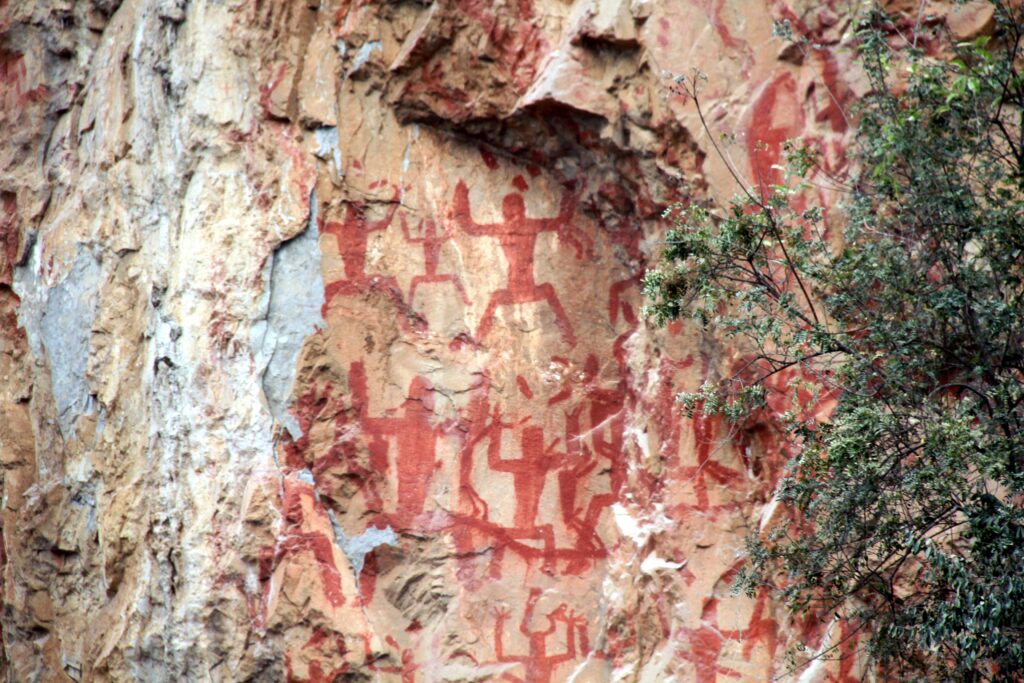
Ancient artists in southern China may have used a remarkable mixture of lime, red clay and blood to create rock paintings capable of surviving more than 2,000 years of torrential rain, intense heat and repeated typhoons.
A new study of the Huashan rock art in Guangxi has identified human and animal blood proteins inside the microscopic mortar holding the red pigment to limestone cliffs. Researchers believe the proteins helped produce a mineral bond so durable that the paintings effectively became part of the rock itself.
Even more remarkably, some of the detected proteins led the team to propose that part of the human blood may have been collected from women during childbirth or the postpartum period. The researchers suggest that its inclusion could have carried ritual meaning connected with fertility and motherhood.
The childbirth interpretation remains a hypothesis rather than a proven fact. Nevertheless, the chemical evidence for blood in the paintings offers an unexpected explanation for one of Asia’s great archaeological preservation mysteries.
Monumental Images Above the Zuojiang River
The Zuojiang Huashan Rock Art Cultural Landscape extends through the karst landscape of the Guangxi Zhuang Autonomous Region in southern China.
More than 80 painted locations have been documented across a rock art belt running approximately 260 kilometers along the Zuojiang River and its tributaries. Thirty-eight of the best-preserved sites were added to the UNESCO World Heritage List in 2016.
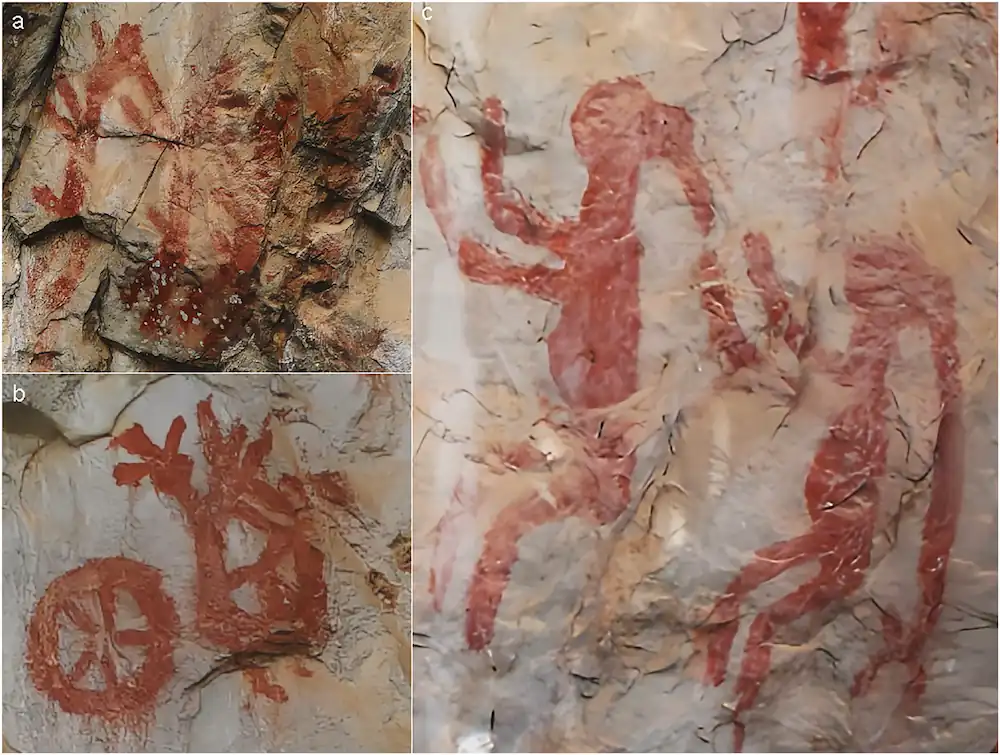
The paintings, generally attributed to the ancient Luoyue people, depict human figures, animals, boats, weapons, bells and bronze drums. Many figures stand or squat with their arms extended, apparently participating in ceremonies associated with southern China’s ancient bronze-drum culture.
UNESCO dates the cultural landscape from approximately the fifth century BCE to the second century CE. Earlier scientific dating produced similar results. Radiocarbon measurements placed some paintings between roughly 2,370 and 2,115 years ago, while a later uranium-thorium study suggested that activity at the main Huashan panel may have continued for more than a century.
The scale of the main site is extraordinary. Research published in Quaternary Research described the Mt. Huashan panel as containing about 1,900 identifiable figures across approximately 8,000 square meters, potentially making it one of the world’s largest individual rock art panels.
Why Did the Paintings Not Wash Away?
The survival of the Huashan rock art has long puzzled archaeologists and conservation scientists.
The images were placed directly on exposed limestone cliffs, sometimes dozens of meters above the river. They have endured a subtropical monsoon climate characterized by extreme summer heat, high humidity, heavy seasonal rainfall and recurring tropical storms.
Ordinary organic binders, including plant gums, animal glue or untreated proteins, would normally deteriorate rapidly under such conditions.
A 2012 study proposed that the artists may have used plant sap containing oxalic acid. The acid could have reacted with calcium in the limestone to produce calcium oxalate, forming a protective coating over the pigment.
The new research, published in the Journal of Archaeological Science, presents a different explanation. Instead of merely mixing red pigment with an organic adhesive, the artists appear to have prepared a sophisticated lime-based mortar.
Ancient Paint Made Like a Composite Material
Researchers collected fallen fragments from the Gaoshan, Daningshan and Tunpingshan rock art sites. This allowed them to examine genuine painted surfaces without removing material from images still attached to the cliffs.
The samples were studied using Raman spectroscopy, scanning electron microscopy with energy-dispersive spectroscopy, Fourier-transform infrared spectroscopy and proteomic analysis.
The results revealed a layered structure consisting of limestone, a thin artificial mortar and red pigment.
The color came from local red clay containing extremely small hematite particles. Some of the iron-rich particles measured only a few hundred nanometers, producing the paintings’ characteristic red tone.
The binding layer was more complex. It contained calcium carbonate, calcium phosphate and blood proteins. According to the study, the artists probably mixed slaked lime, phosphate-rich material and blood into an emulsion before applying it to the limestone.
Red clay pigment was then placed over the mortar while it was still partly wet.
As the lime absorbed carbon dioxide from the air, it hardened into calcium carbonate. Blood proteins guided the formation of densely packed mineral crystals, a process known as biomineralization.
These crystals surrounded the hematite particles and locked them against the limestone. The result was not simply dried paint but an integrated organic-inorganic composite resembling a microscopic mineral cement.
In the best-preserved samples, the painted layer was bonded so firmly that researchers needed an electric drill to separate it from the underlying rock during laboratory preparation.
Was Blood Collected During Childbirth?
Proteomic analysis detected serum proteins associated with blood, including albumin, fibrinogen, and immunoglobulins.
Both human and animal proteins were present. Human proteins dominated several samples from Gaoshan, while bovine and other animal proteins appeared in different proportions at other locations. This indicates that the artists did not necessarily follow a single standardized recipe throughout the Huashan rock art belt.
The most provocative evidence came from two proteins associated by the researchers with pregnancy, breastfeeding and female reproductive biology: prolactin-inducible protein and lactotransferrin.
The samples did not contain casein, the principal protein expected if milk had been added directly. The authors therefore proposed that the material could have been blood lost during childbirth or postpartum bleeding rather than breast milk.
This conclusion must be treated cautiously. The proteins are not an archaeological identification tag unique to women in labor, and attempts to extract ancient DNA from the mortar were unsuccessful. The highly alkaline lime mixture may have destroyed any surviving genetic material.
The evidence therefore supports the presence of human blood, but the identity and circumstances of the donors cannot be established with certainty.
Blood May Have Carried Ritual Meaning
The researchers connect the possible use of childbirth blood with the social and ritual world of the Luoyue, the community generally credited with creating the paintings.
Historical Chinese texts have been interpreted as describing Luoyue society as matrilineal, although such accounts were written by outsiders and should not be treated as neutral ethnographic descriptions.
The paintings themselves are widely interpreted as ceremonial compositions. Groups of human figures appear beside bronze drums and other prestige objects, suggesting collective rites rather than scenes of ordinary daily life.
Under the researchers’ interpretation, blood connected with childbirth may have been valued not simply as a technical ingredient but as a substance associated with fertility, ancestry and social continuity.
The blood would therefore have served two functions: chemically, it helped control mineral crystallization; symbolically, it may have linked the painted ceremonies to birth and regeneration.
Prehistoric Artists as Materials Engineers
The Huashan paintings were once understood primarily as a monumental achievement requiring large numbers of workers to reach and decorate the cliffs.
The new study shifts attention from manpower to technical knowledge.
The creators needed to burn limestone to produce lime, obtain phosphate from sources such as bone or guano, collect and preserve blood, select fine hematite-rich clay, and apply the different layers in the correct sequence.
All of the raw materials could have been obtained locally, but transforming them into a durable composite required experience and precise control.
The researchers describe the project as technically intensive rather than simply labor-intensive. The durability of the paintings came from knowledge of how natural materials reacted—not from the thickness of the paint or the size of the workforce.
More than two millennia later, that technology is still performing its original function. The blood proteins have largely disappeared as organic substances, but the mineral structure they helped create continues to hold the red figures against the limestone.
The artists of Huashan did not merely paint on the cliffs. They engineered their images into the rock.
Wu, M., Hu, P., Zhai, K., et al. (2026). Blood-induced biomineralized calcium carbonate used for binding in the Huashan rock art of Guangxi, Southern China. Journal of Archaeological Science. DOI: 10.1016/j.jas.2026.106650.
Cover Image Credit: Public Domain
