
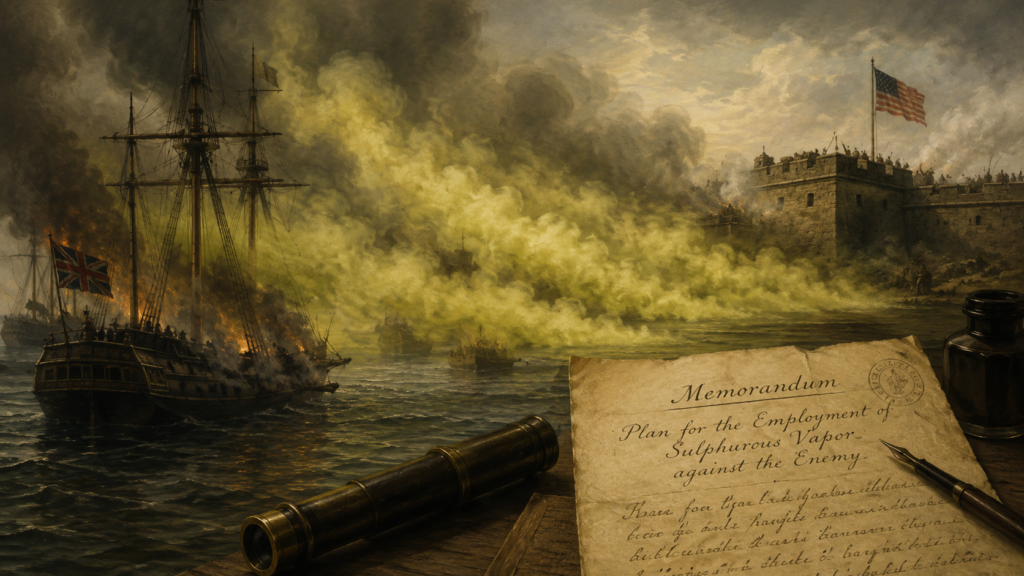
A newly discovered memorandum has revealed that Royal Navy officer Thomas Cochrane developed a secret plan to use toxic fumes against American forces during the War of 1812.
The 23-page document, uncovered by historian Peter Moore at the National Records of Scotland, suggests that the proposal went beyond a theoretical military experiment. Cochrane had been appointed to serve under the British naval commander in North America, while senior officers were prepared to consider deploying his unconventional weapon if conditions proved favourable.
The discovery was first reported by The Times and was subsequently covered by GB News. The memorandum, titled Statement of Claims, was written by Cochrane’s secretary in 1844 and contains handwritten additions and corrections attributed to the naval commander himself.
A weapon designed to bypass coastal defences
Cochrane’s plan involved setting fire to specially prepared vessels carrying large quantities of sulphur and other combustible materials. The resulting toxic fumes would then be driven towards enemy ships, forts or coastal positions under the cover of dense smoke.
Rather than destroying vessels with conventional cannon fire, the fumes were intended to incapacitate or drive away sailors and defenders. Cochrane believed the weapon could pass through fortifications and neutralise positions that would otherwise be difficult to capture.
According to the newly examined memorandum, the idea developed after Cochrane visited Sicily in 1811 and observed the dangerous gases associated with sulphur mining. He later presented the proposal to a secret committee that reportedly included senior military officials, the Duke of York and the Prince Regent, who later became King George IV.
The committee concluded that the method could prove extremely difficult to resist. However, its members also feared that revealing the technology might allow Britain’s enemies to use similar weapons against British colonies. Cochrane was consequently ordered to keep the project secret.
The War of 1812 brought the plan close to deployment
The opportunity to use the weapon emerged after Britain entered war with the United States.
Cochrane’s uncle, Vice-Admiral Alexander Cochrane, was appointed commander-in-chief of British naval forces operating in North America. Thomas Cochrane was selected as his flag captain and was expected to take command of HMS Tonnant.
In his memorandum, Cochrane claimed that his uncle understood the importance of the new attack method and intended to employ it if military circumstances allowed. The younger officer’s presence was considered essential because he knew how the weapon should be prepared and deployed.
The intended target was not identified conclusively. The surviving document has prompted speculation that the operation could have been directed against New York, Baltimore or New Orleans, all strategically important locations during the conflict. However, no surviving order confirms that any one of these cities had been selected.
The plan collapsed before Cochrane could cross the Atlantic. In 1814, he was convicted in connection with a major London Stock Exchange fraud, removed from naval service and prevented from joining the North American fleet.
Britain later captured and burned Washington, including the White House and other public buildings, but suffered a major defeat at New Orleans shortly before the conflict ended. Cochrane remained convinced that the war would have produced a different result had he been permitted to deploy his weapons.
Would it have been history’s first chemical attack?
The newly found document has been described as evidence of what could have become the first chemical weapons attack in recorded history. That description, however, requires qualification.
Toxic smoke and poisonous substances had been used in warfare long before the 19th century. Archaeological evidence from Dura-Europos in present-day Syria suggests that Sasanian Persian forces burned sulphur and bitumen inside a siege tunnel around AD 256, producing fumes that may have asphyxiated Roman defenders.
A study published by archaeologist Simon James in the American Journal of Archaeology described the Dura-Europos incident as one of the earliest archaeologically documented examples of what would now be classified as chemical warfare.
Cochrane’s proposal would therefore not have been humanity’s first use of toxic chemicals in combat. It could, however, have become one of the earliest planned naval gas attacks of the modern period and an unprecedented attempt to deploy toxic fumes on a large operational scale.
Modern large-scale chemical warfare is generally associated with the German chlorine-gas attack near Ypres on April 22, 1915. The Organisation for the Prohibition of Chemical Weapons describes that attack as the beginning of large-scale chemical warfare—more than a century after Cochrane devised his plan.
Discovery tied to a new Thomas Cochrane biography
Peter Moore discovered the memorandum while researching a new biography of the controversial naval commander.
A Dangerous Game: Thomas Cochrane’s Life on the Edge will be published by Chatto & Windus on September 3, 2026. The publisher states that the 640-page biography draws on newly uncovered material to examine Cochrane’s careers as a naval officer, political radical and revolutionary commander.
Cochrane became famous for daring naval operations during the Napoleonic Wars and later assisted independence movements in Chile, Peru, Brazil and Greece. His exploits also helped inspire Patrick O’Brian’s fictional naval officer Jack Aubrey.
The newly identified memorandum does not prove that a final attack order was issued. It nevertheless indicates that Cochrane’s toxic-smoke weapon was being considered for a real conflict and that British commanders believed it could be used against the United States.
Who Was Thomas Cochrane?
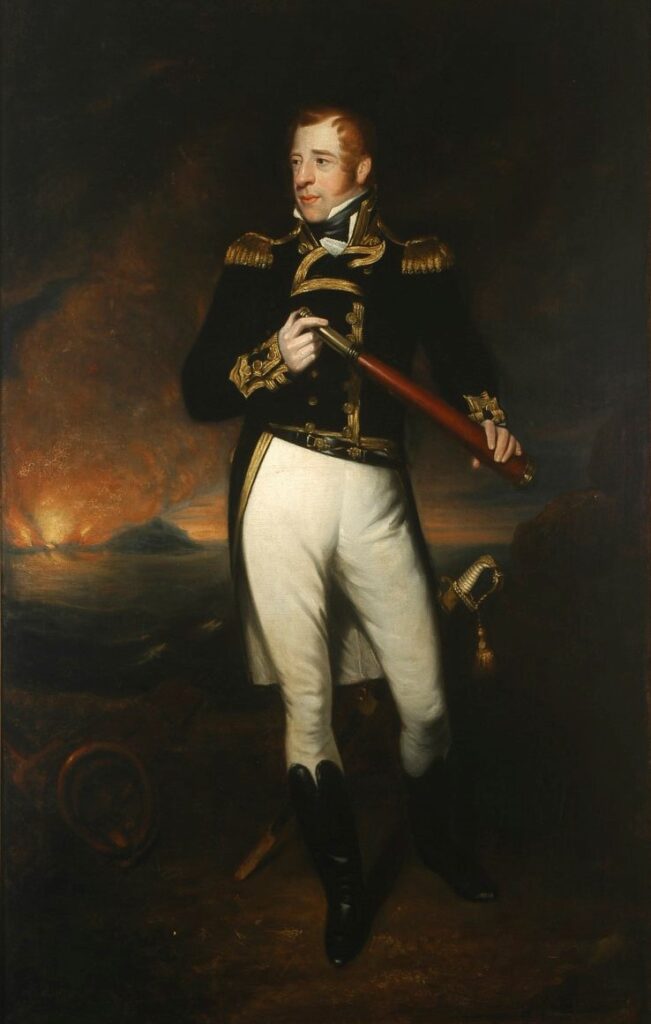
Thomas Cochrane (1775–1860), later the 10th Earl of Dundonald, was one of the Royal Navy’s most unconventional and daring commanders. He gained fame through bold naval operations during the Napoleonic Wars but was also known for developing experimental weapons and unconventional attack methods. After leaving British service, he played prominent roles in the navies of Chile and Brazil, while his extraordinary career later helped inspire Patrick O’Brian’s fictional naval officer Jack Aubrey.
James, S. (2011). Stratagems, combat, and “chemical warfare” in the siege mines of Dura-Europos. American Journal of Archaeology, 115(1), 69–101. https://doi.org/10.3764/aja.115.1.0069
