
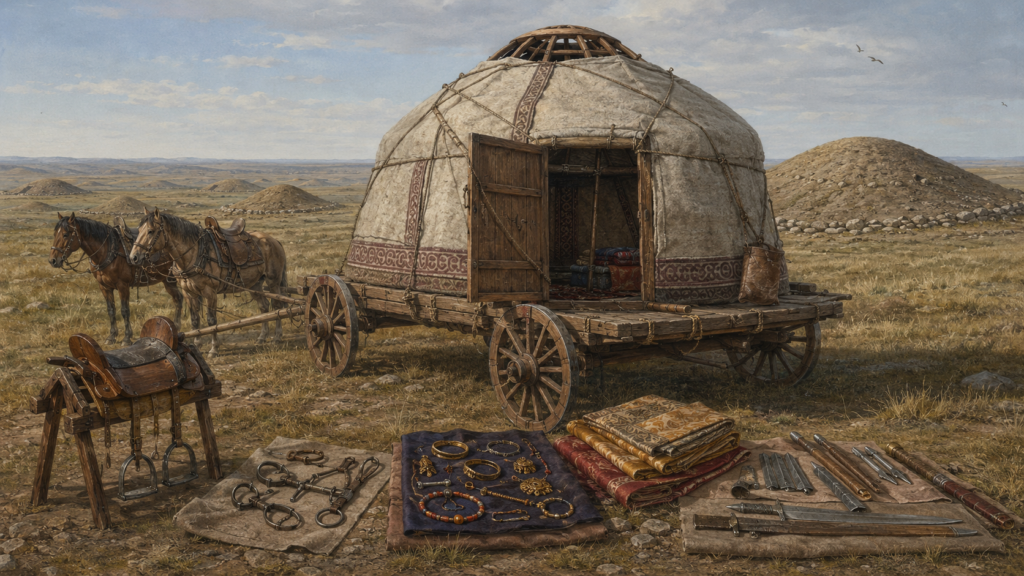
Archaeologists in northeastern Kazakhstan have uncovered an exceptionally preserved wooden wheeled dwelling dating to the Kimak-Kipchak period, offering a rare physical glimpse into how medieval nomadic communities travelled, lived, and displayed status across the Eurasian steppe.
The structure consists of a wooden cart supporting a tent-like shelter whose form resembles a traditional Kazakh yurt. Pavlodar regional authorities described the discovery as having no known archaeological parallel in Kazakhstan or elsewhere in the wider steppe region. Until now, comparable mobile dwellings were known largely through written accounts and schematic historical depictions.
A nomadic home preserved inside a burial ground
The wheeled dwelling was found at the Baydala burial complex in the Kenzhekol rural district near the city of Pavlodar. Archaeological investigations at the site have been directed by Kazakh archaeologist Timur Smagulov for more than 20 years.
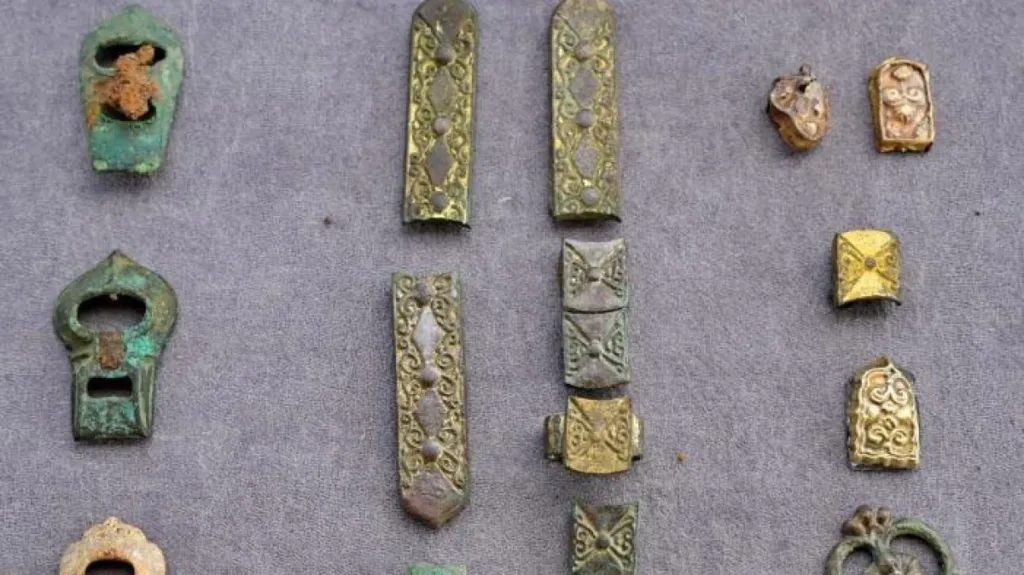
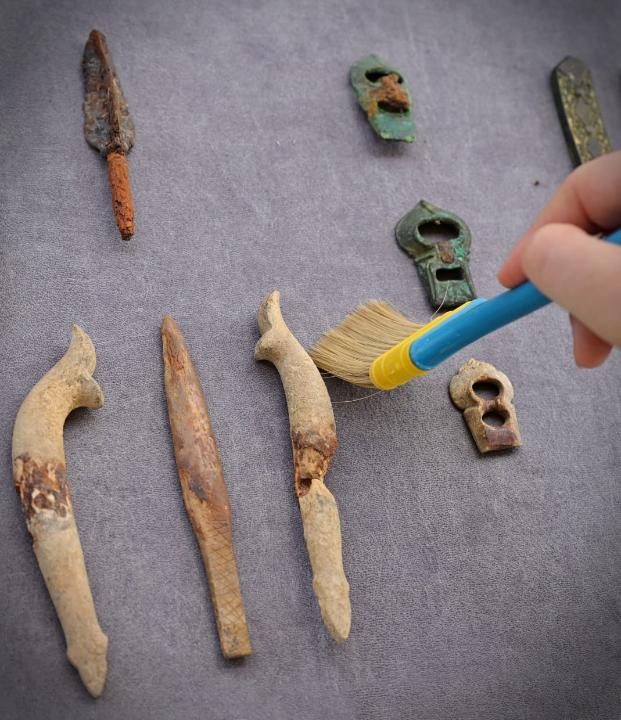
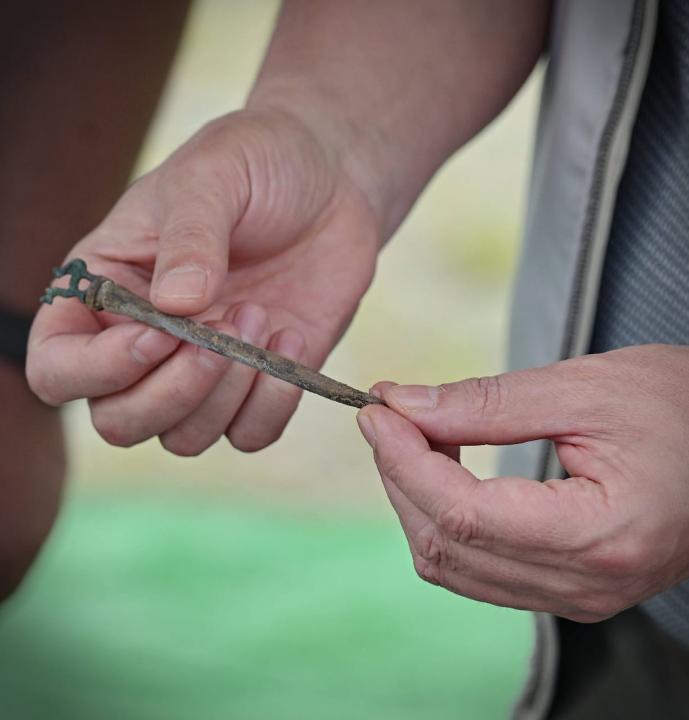
Alongside the mobile structure, researchers recovered a wooden saddle, stirrups, horse bits, weapon components, jewellery, silk textiles and other objects associated with medieval steppe life. Together, the finds provide evidence not only of transportation technology but also of horsemanship, craft production, clothing and long-distance connections.
The preservation of the wooden construction is particularly significant. Organic materials such as timber and textiles usually decay quickly, leaving archaeologists to reconstruct nomadic dwellings from metal fittings, postholes or indirect historical descriptions.
At Baydala, however, enough of the structure survived to reveal how a substantial tented residence could be mounted on wheels and transported across the landscape. The discovery challenges the familiar image of mobile pastoralists relying exclusively on tents that had to be dismantled and rebuilt at every stop.
A real “house on wheels”
Mobile dwellings were practical solutions for elite families and political leaders whose lives depended on seasonal movement. Unlike an ordinary wagon used only to carry possessions, the Baydala vehicle appears to have functioned as a dwelling in its own right.
Its tent-like superstructure recalls the engineering principles of the yurt: a lightweight wooden frame covered with flexible materials and designed to withstand the winds and temperature changes of the open steppe. The wheeled platform would have allowed its occupants to move without completely dismantling their residence.
The cart’s association with a burial context also suggests that it carried meaning beyond everyday transportation. Placing such a structure in a funerary complex may have reflected the deceased person’s status, identity or continuing journey after death, although further study will be required before archaeologists can determine its precise ritual significance.
Could Baydala be connected to the lost capital of Imakia?
Researchers believe the wider Pavlodar region may have contained Imakia, the political centre of the Kimak Khaganate mentioned by medieval Arab and Persian geographers.
The official announcement states that tenth-century maps place Imakia in this part of the Irtysh region. Historical studies similarly describe the Kimak ruler’s headquarters as a major destination on caravan routes linking the Irtysh with Central Asia, the Volga region and neighbouring Turkic territories.
The connection between Baydala and Imakia remains a working archaeological hypothesis rather than a confirmed identification. A burial complex alone cannot establish the precise location of a political capital. However, the richness of the discoveries indicates that the area was closely connected to powerful communities within the Kimak-Kipchak world.
Who were the Kimaks?
The Kimak—or Kimek—Khaganate emerged as a major Turkic political power during the late ninth and early tenth centuries. Its territories were centred on the Irtysh River and extended across parts of present-day northern, eastern and central Kazakhstan, the western Altai and neighbouring steppe regions.
Early traditions describe a confederation of seven tribes: the Eymur, Imek, Kipchak, Tatar, Bayandur, Lanikaz and Ajlad. As the confederation expanded, medieval sources referred to as many as 12 constituent tribes. Its supreme ruler adopted the title khagan, marking the transformation of the alliance into an organised steppe state.
Although livestock herding remained central to Kimak society, the population was not exclusively nomadic. Historical and archaeological evidence points to settlements, craft production, trade, writing and social divisions between wealthy elites and poorer groups. Caravan routes connected the Kimak lands with the Volga Bulgars, the Samanid territories of Central Asia, the Oghuz, Karluks and other regional powers.
The khaganate weakened around the beginning of the 11th century. Internal political struggles, the growing independence of the Kipchaks and large-scale tribal migrations contributed to its collapse. The Kipchaks subsequently became the dominant power across much of the former Kimak territory and expanded westward across the Eurasian steppe.
New excavations planned at Baydala
During the current field season, archaeologists are examining one of the surviving burial mounds at Baydala. They have already cleared sections of its funerary ditch and identified the bones of animals apparently deposited as sacrifices.
The opening of the mound’s central burial is scheduled for August or September. Regional officials have also ordered plans for continued excavation, conservation and restoration of the recovered artefacts, as well as the possible development of Baydala as a museum and heritage complex.
For archaeologists, the importance of the “house on wheels” lies in its material reality. Medieval texts described mobile residences travelling across the steppe, but the Baydala discovery provides something far rarer: the surviving remains of a structure built to turn movement itself into a way of living.
Government of Kazakhstan (Gov.kz)
Cover Image Credit: Author’s reconstruction of the wagon-mounted nomadic dwelling discovered at the Baydala burial complex, based on published descriptions of the find. Some architectural and decorative details are hypothetical.
