
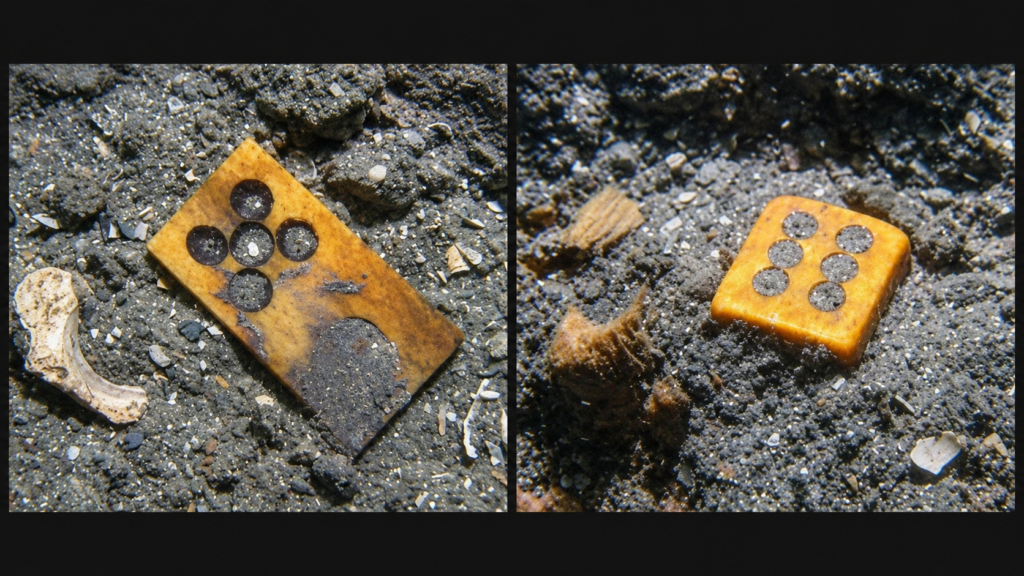
Kublai Khan conquered China but failed to take Japan, and his massive invasion fleet of 1281 left behind more than traces of warfare. Archaeologists investigating a Mongol invasion ship off the coast of Japan have discovered 29 gaming pieces and five dice that had lain on the seabed for nearly 745 years.
Professor Yoshifumi Ikeda of Kokugakuin University joined researchers from the Matsuura City Board of Education in investigating the wreck off Takashima Island in Japan’s Nagasaki Prefecture. Announced in October 2026, the discovery marks the first time gaming pieces have been found among the Mongol invasion shipwrecks in the area.
Gaming Stones Resting on the Seabed for 745 Years
While examining the stern of a ship located about 150 meters from the shore at a depth of 18–19 meters, researchers recovered 34 gaming pieces. Five of these are dice, approximately one centimeter in size, while the other 29 are rectangular stones about three centimeters long. The markings on the stones bear a resemblance to pieces used in traditional games played in China.
A connection to a Chinese-origin game called Tianjiu is particularly noteworthy. Researchers believe the stones belong to a tradition that may have a historical relationship with games that developed later, such as mahjong. However, researchers have yet to identify exactly which game the pieces belonged to.
One of the most striking aspects of the discovery is the location of the gaming pieces. In the same section, archaeologists unearthed iron objects believed to be food containers, a grinding bowl, and a knife. These items suggest that the stern of the ship may have housed a section used for food preparation or provisions storage.
Yoshifumi Ikeda, an archaeologist from Kokugakuin University participating in the dig, suggests that those tasked with food preparation may have played games during their breaks. Although this remains a hypothesis, the discovery of gaming pieces alongside kitchen-related artifacts is a significant detail showing that life on the ship consisted of more than just military activities.
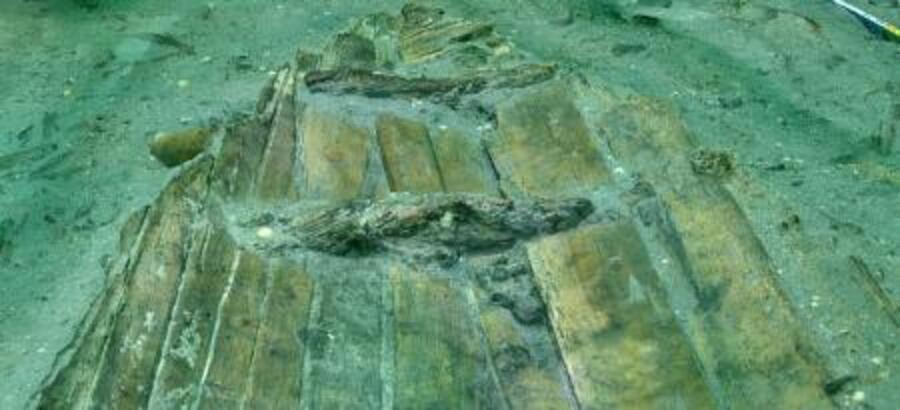
The stern of a Mongol invasion ship discovered off Takashima Island in Nagasaki Prefecture, Japan. Credit: Matsuura City Board of Education.
Why Couldn’t Kublai Khan, Who Conquered China, Capture Japan?
Kublai Khan, the grandson of Genghis Khan, established the Yuan Dynasty in 1271 and completed the conquest of China by defeating the Southern Song Dynasty in 1279. Having established a powerful administration over the eastern lands of the Mongol Empire, the ruler sought to extend his hegemony to Japan. However, two major military campaigns launched against Japan ended in failure.
Following the first attempt in 1274, Kublai Khan prepared an even larger invasion fleet in 1281. This operation, involving forces from China and Korea, was one of the largest overseas military operations of its time. While Japanese defenses hindered the invaders’ progress, a violent typhoon in August 1281 destroyed a large portion of the fleet.
In Japanese tradition, these storms eventually became associated with the concept of kamikaze, or “divine wind.” However, it would be inaccurate to attribute the failure of the invasion solely to weather conditions. Japanese resistance, supply issues within the fleet, and the overall difficulties of the military operation also influenced the outcome.
The seabed around Takashima has become one of the most important archaeological research sites for this failed expedition. The ship remains found in the area allow researchers to directly examine the physical evidence of the invasion described in historical narratives.
The Third Wreck of the Mongol Invasion Fleet
In the underwater research off Takashima, the first invasion ship was identified in 2011, and the second in 2015. Remains of a third ship were detected in 2023, and subsequent research provided new information regarding the ship’s structure.
During excavations carried out in October 2026, divers examined the stern of the ship, its wooden compartments, and structural pieces believed to be the keel. Evaluations of the preserved remains indicate that the ship may have been approximately 30 meters long. If confirmed, this ship could be the largest of the three invasion wrecks identified in the region.
Features of the ship linked to Chinese shipbuilding traditions are also a vital part of the research. Kublai Khan’s fleet was composed of ships and manpower sourced from different regions. Therefore, these wrecks are valuable for understanding the maritime technology of the Yuan Dynasty and how a large-scale military expedition was organized.
