
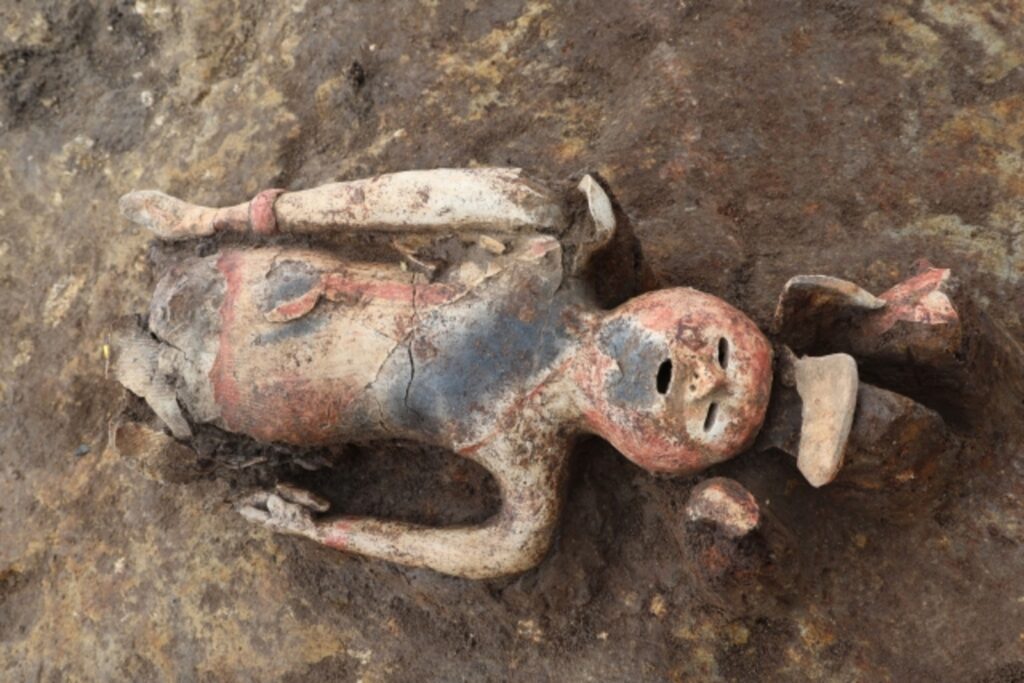
Archaeologists in Japan have discovered a 1,500-year-old clay figure depicting a woman believed to have participated in religious rituals. Found at a fifth-century burial mound in Gunma Prefecture, the remarkably preserved sculpture retains detailed jewelry, an elaborate hairstyle, and traces of red paint.
A clay figure holding a mysterious ceremonial object has emerged from an ancient burial mound in central Japan. The 1,500-year-old sculpture depicts a woman wearing bracelets and a sash across her chest, with carefully styled hair and traces of red paint still visible on her face.
The approximately 40-centimeter-tall figure, known as a haniwa, was recovered from a ditch surrounding Tomb No. 1 at the Nishikaminomiya archaeological site in Isesaki, Gunma Prefecture. Dating to the second half of the fifth century, it is among the earlier examples of human-shaped haniwa discovered in the region.
A Woman Holding a Ceremonial Object
The figure stands out for its unusually well-preserved details. Its head and upper body survive, allowing archaeologists to examine the woman’s hairstyle, fingers, bracelets, and clothing. A sash crosses her chest from the right shoulder, while traces of red pigment remain visible on her face and the sash.
Both arms extend downward, and the left hand holds a rod-shaped object that researchers interpret as a ceremonial implement. Based on these features, the Gunma Prefectural Archaeological Research Center identifies the figure as a miko, a woman associated with religious or ritual activities.
The Japanese term miko refers to women associated with religious rituals, sometimes involving practices described as shamanic. However, identifying the figure as a female shaman remains an archaeological interpretation rather than a confirmed identity.
The identification offers an intriguing interpretation of the sculpture, although its precise role in the burial ceremony remains uncertain. The object in her hand has not been identified more specifically, and archaeologists have not established whether the figure represents an actual individual or a symbolic ritual participant.
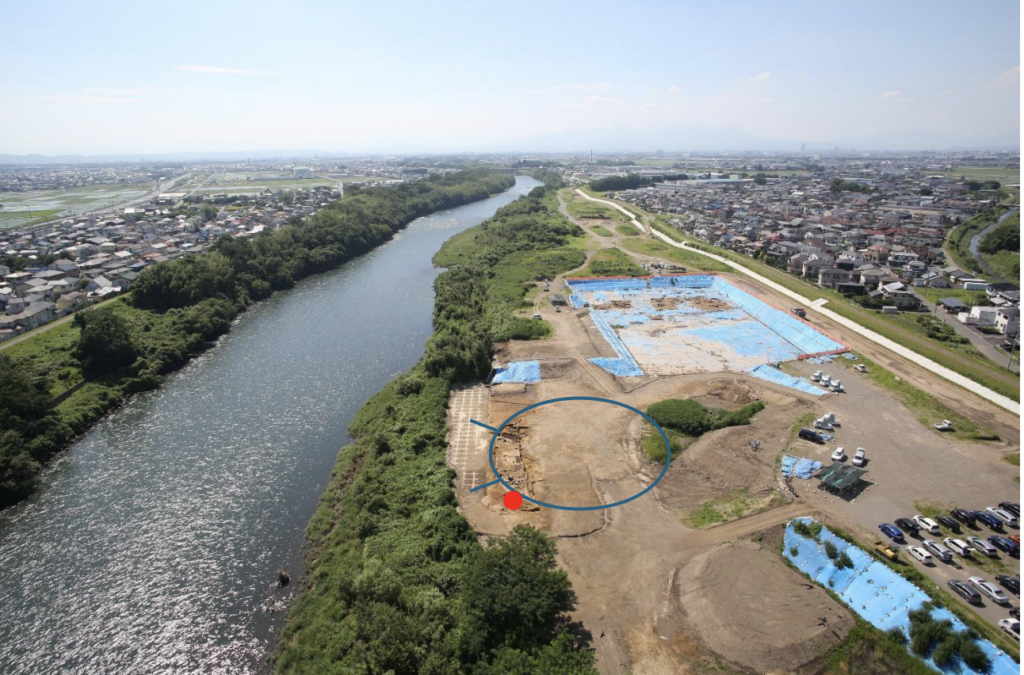
Aerial view of the Nishikaminomiya archaeological site beside the Tone River in Gunma, Japan. The blue outline marks Tomb No. 1, while the red dot indicates where the female haniwa figure was discovered. Credit: Gunma Prefecture.
An Ancient Burial Mound Beside the Tone River
The discovery came during excavations connected to river improvement works along the Tone River. Archaeologists began investigating the Nishikaminomiya site in 2020 and have since identified 11 burial mounds dating to Japan’s Kofun period.
Researchers found the female figure in August 2026 in the ditch surrounding Tomb No. 1. According to the official excavation report, the sculpture had fallen from a projecting section of the burial mound into the surrounding ditch, offering an important clue to its original placement.
Dating to the second half of the fifth century, Tomb No. 1 measures approximately 45–50 meters in length, making it the largest of the 11 burial mounds identified at the site. Archaeologists initially believed it was circular, but the 2026 excavations revealed a projecting section that changed their understanding of its original layout. Earlier investigations also recovered part of a boat-shaped stone coffin from the tomb.
The excavations also revealed cylindrical and morning-glory-shaped haniwa that once stood around the burial mound. Four examples lay fallen along the western side of the ditch, approximately 1.3 meters apart, providing evidence of how the burial monument was originally decorated.
Haniwa and the Burial Traditions of Ancient Japan
Haniwa were terracotta objects placed on and around burial mounds during Japan’s Kofun period, which lasted from approximately the third to the seventh century AD. The earliest examples generally took cylindrical forms, but artisans gradually developed elaborate representations of houses, animals, weapons, and human figures.
Human-shaped haniwa portrayed warriors, musicians, and people engaged in ceremonial activities. Their clothing, hairstyles, and ornaments provide valuable evidence of how ancient Japanese communities represented social identities and ritual roles.
The newly discovered Gunma figure belongs to an early stage of this figurative tradition. Its unusually well-preserved features allow researchers to examine details of personal adornment and ceremonial gestures that might otherwise have disappeared from the archaeological record.
The Gunma Prefectural Archaeological Research Center has announced plans to display the figure from October 28 to November 30, 2026, at its Archaeological Information Museum. The exhibition will give visitors an opportunity to see an early example of a female haniwa recovered from one of the region’s fifth-century burial mounds.
Gunma Prefecture – Official Archaeological Announcement
