
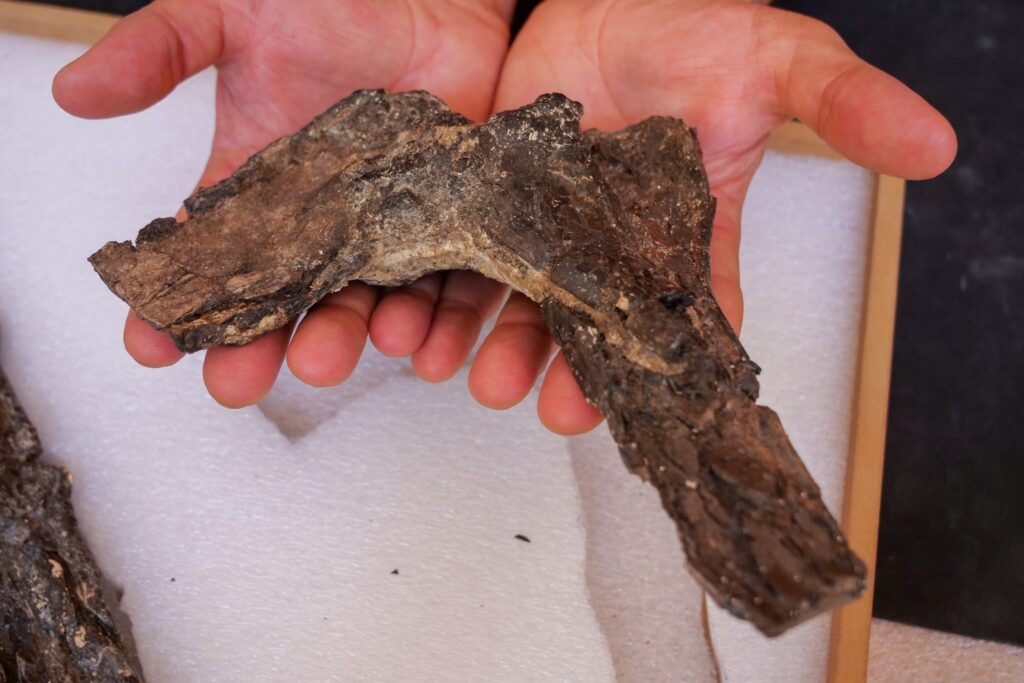
Scientists have identified traces of ancient blood inside a 115-million-year-old dinosaur bone from Brazil, including chemical compounds associated with hemoglobin and microscopic structures that appear to be fossilized red blood cells. The findings suggest that some components of dinosaur blood can survive for more than 100 million years under exceptional conditions.
An international team led by Professor Kliti Grice of Curtin University in Australia examined the fossilized leg bones of Aratasaurus museunacionali, a meat-eating dinosaur that lived during the Early Cretaceous. Their study, published in the Proceedings of the National Academy of Sciences (PNAS), provides chemical evidence linking ancient blood molecules to structures preserved within the dinosaur’s bone.
Blood Cell Remains Inside a Dinosaur Bone
Paleontologists discovered the fossil in 2008 at Mina Pedra Branca, near Santana do Cariri in northeastern Brazil. The remains came from the Romualdo Formation, a geological deposit known for its exceptionally preserved fossils.
Aratasaurus museunacionali belonged to an early branch of coelurosaurian theropods, a group that also includes modern birds. Researchers estimate that the animal was approximately four years old when it died, measured around 3.1 meters long and weighed about 34 kilograms.
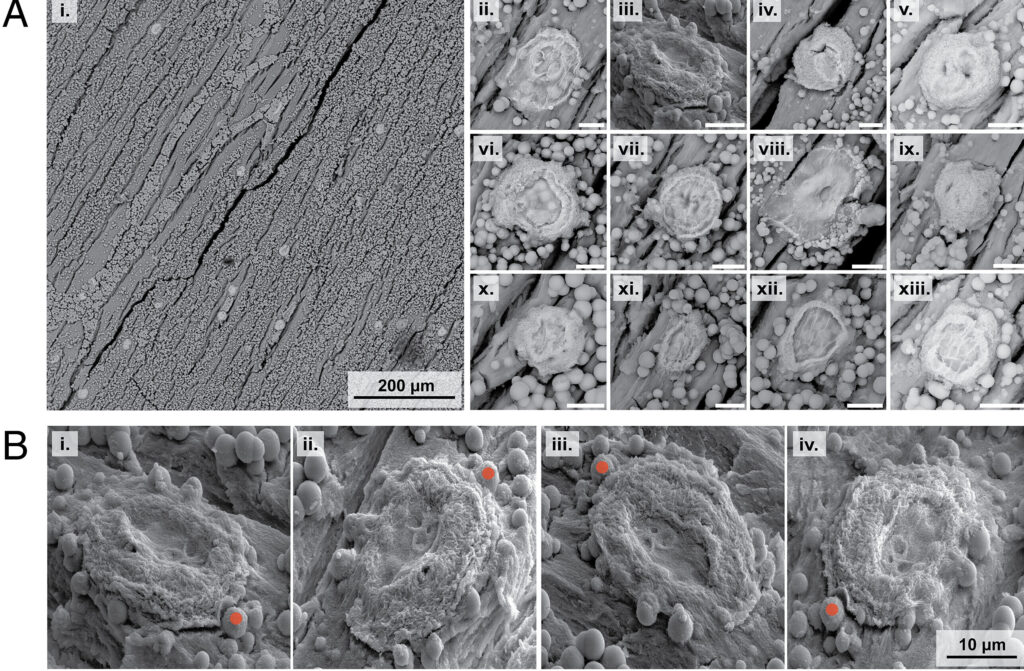
During the latest investigation, scientists examined tiny vascular canals within the fossilized bone. Inside these spaces, they identified numerous oval microscopic structures resembling red blood cells.
The structures measured approximately 23 micrometers in length and 19.5 micrometers in width. They appeared larger and rounder than red blood cells in modern birds and crocodilians, although the researchers suggest that fossilization may have altered their original appearance.
Their location offered an important clue. The structures occurred within the bone’s vascular canals, where blood vessels once carried blood through the living animal’s skeleton.
Chemical Evidence of Ancient Dinosaur Blood
The researchers went beyond examining the structures under a microscope. They combined mass spectrometry, electron microscopy, and Raman spectroscopy to investigate their chemical composition and determine whether the material originated from the dinosaur.
The analyses identified heme B, an iron-containing molecule that forms part of hemoglobin, along with a chemically altered compound called 3,8-diethyl heme B. The team also detected iron, carbon, and nitrogen associated with the microscopic structures.
These findings strengthened the interpretation that the structures represent mineralized remains of ancient red blood cells rather than ordinary mineral deposits.
The researchers compared the bone with the surrounding fossilized microbial material to investigate possible contamination. While the surrounding material contained chemical signatures dominated by compounds derived from chlorophyll, the bone showed a distinctly different pattern dominated by heme-related molecules.
The fossil does not contain liquid blood or complete hemoglobin proteins. Instead, it preserves chemical components and mineralized structures that the researchers interpret as remnants of the dinosaur’s original blood cells.
How Dinosaur Blood Survived for 115 Million Years
The team also investigated why such fragile biological material might have survived for so long. Their results point to an unusual combination of burial conditions and mineral processes.
The dinosaur’s remains lay within an ancient microbial mat in a marine environment with limited oxygen. These conditions likely slowed the breakdown of organic material during the earliest stages of fossilization.
Researchers also identified hausmannite, a manganese oxide mineral, closely associated with the cell-like structures. They suggest that this mineral helped stabilize the biological material and protect some of its chemical components during fossilization.
This mineral connection could help scientists understand why certain fossils retain molecular evidence while most lose their original organic compounds.
New Evidence for Dinosaur Biology
Scientists have previously reported blood vessel-like structures and possible blood-related molecules in dinosaur fossils. However, identifying original biological material remains difficult because chemical contamination and geological processes can produce misleading results.
The new study combines the microscopic appearance and location of the structures with several independent chemical analyses. The researchers argue that this evidence supports their identification as mineralized red blood cells containing heme-derived molecules.
Some uncertainty remains. The structures differ in size and shape from blood cells in living birds and crocodilians, and the researchers acknowledge that fossilization may have changed their appearance.
The discovery opens another way to investigate dinosaur biology beyond bones and teeth. Studying ancient blood-related molecules could eventually help researchers explore how extinct animals transported oxygen and how their bodies functioned millions of years ago.
K. Grice,Y. Isaji, J. Wiemann, P.F. Greenwood, M. Tripp, M.A. Diaz Mateus, S.F. Poropat, X. Sun, C.P. Fox, L.M. Brosnan, R.A.M. Bantim, L. Schwark, P.T. Visscher, N.O. Ogawa, J. Demore, A.A.F. Saraiva, W.D.A. Rickard, N. Ohkouchi, J.M. Sayão,[…] & A.W.A. Kellner, Heme signatures in mineralized red blood cells within vascular canals of a 115-million-year-old dinosaur bone, Proc. Natl. Acad. Sci. U.S.A. 123 (46) e2614248123, https://doi.org/10.1073/pnas.2614248123 (2026).
