
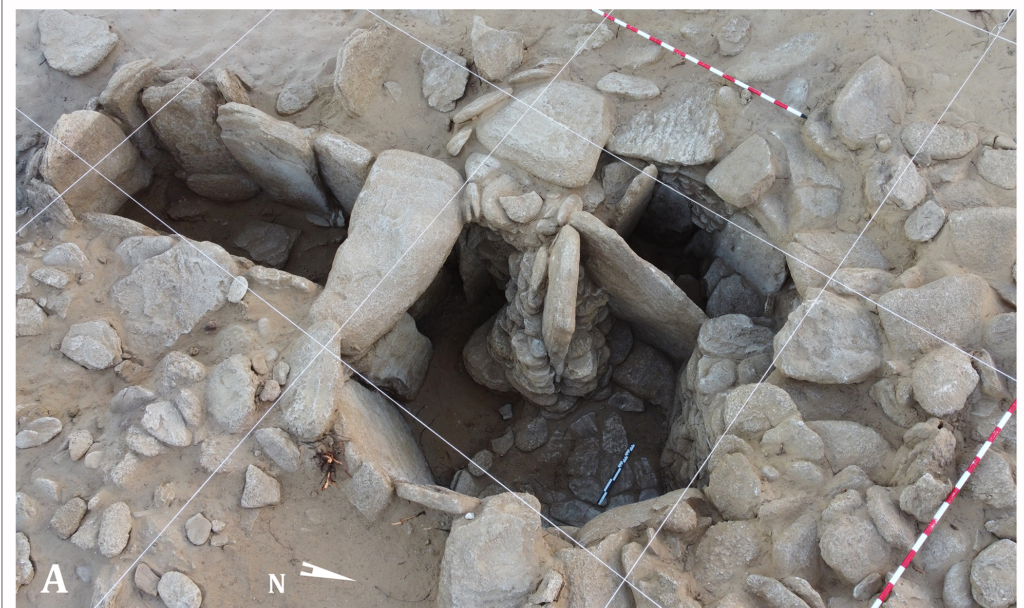
Two approximately 3,800-year-old collective tombs discovered on Spain’s Atlantic coast may prompt a reassessment of the established chronology of megalithic monuments in Europe. New radiocarbon analyses indicate that these collective graves, constructed with large stone blocks, were still in use during a period in the Bronze Age when individual burials were becoming more common. Researchers believe these structures cannot be explained solely by the reuse of older graves and may have been built directly during the Bronze Age.
An international research team led by the University of Cádiz conducted a detailed examination of two megalithic graves excavated near Cape Trafalgar in 2021 and 2022. The study, published in the journal PLOS ONE on November 11, 2026, evaluates grave architecture, human remains, and burial gifts made of gold, silver, and ivory, supported by 16 radiocarbon dates.
An Ancient Tradition Continuing into the Bronze Age
Megalithic graves are among the characteristic monuments of the Neolithic and Chalcolithic periods in many parts of Europe. However, in the south of the Iberian Peninsula, both the number and monumental scale of these structures began to decline around 2200–2100 BCE. During the same process, new funerary practices emerged where individuals were buried in separate graves.
The findings at Trafalgar demonstrate that this transformation did not occur uniformly across all regions. Dates obtained from human bones place the primary period of use for these graves between approximately 1875 and 1600 BCE. A single date found in the corridor of Grave I indicates a later burial or a phase of reuse.
According to researchers, this chronology makes the Trafalgar necropolis a significant example for understanding the final stages of the megalithic tradition in the Iberian Peninsula. In particular, the second grave with its circular chamber may be one of the latest examples known in the region.
However, the age of the human remains does not definitively prove when the stone structures themselves were built. The team suggests that the graves might have been constructed from scratch during the Bronze Age, though they do not rule out the possibility that older structures were cleaned and reused. Optically Stimulated Luminescence (OSL) dating is required to determine the exact construction date.
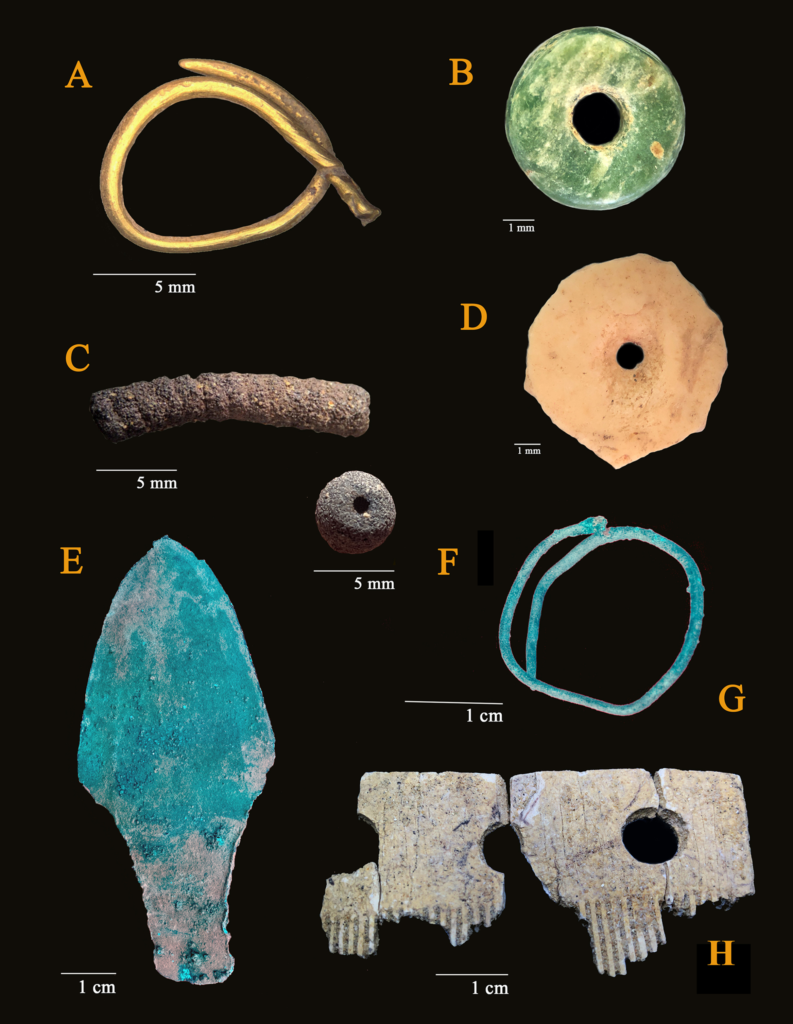
Grave goods recovered from the Trafalgar megalithic tombs, including a gold earring, ornamental beads, copper objects, and fragments of an ivory comb. Credit: Vijande-Vila et al. (2026), PLOS ONE, Fig. 15. CC BY 4.0.
Two Graves, At Least 20 Individuals, and Changing Burial Practices
Cape Trafalgar is situated on a prominent coastal formation extending into the Atlantic Ocean near the Strait of Gibraltar. Researchers uncovered the first grave in 2021 and the second, approximately 180 meters southeast, in 2022. The second structure was preserved beneath a dune layer approximately three meters thick.
Grave I consists of a corridor formed by upright stone slabs and an underground burial chamber carved into the bedrock. Grave II opens into a circular chamber approximately 2.9 meters in diameter at the end of the corridor. After the original roof of this structure was damaged, supports were added in ancient times, reducing the usable area of the chamber.
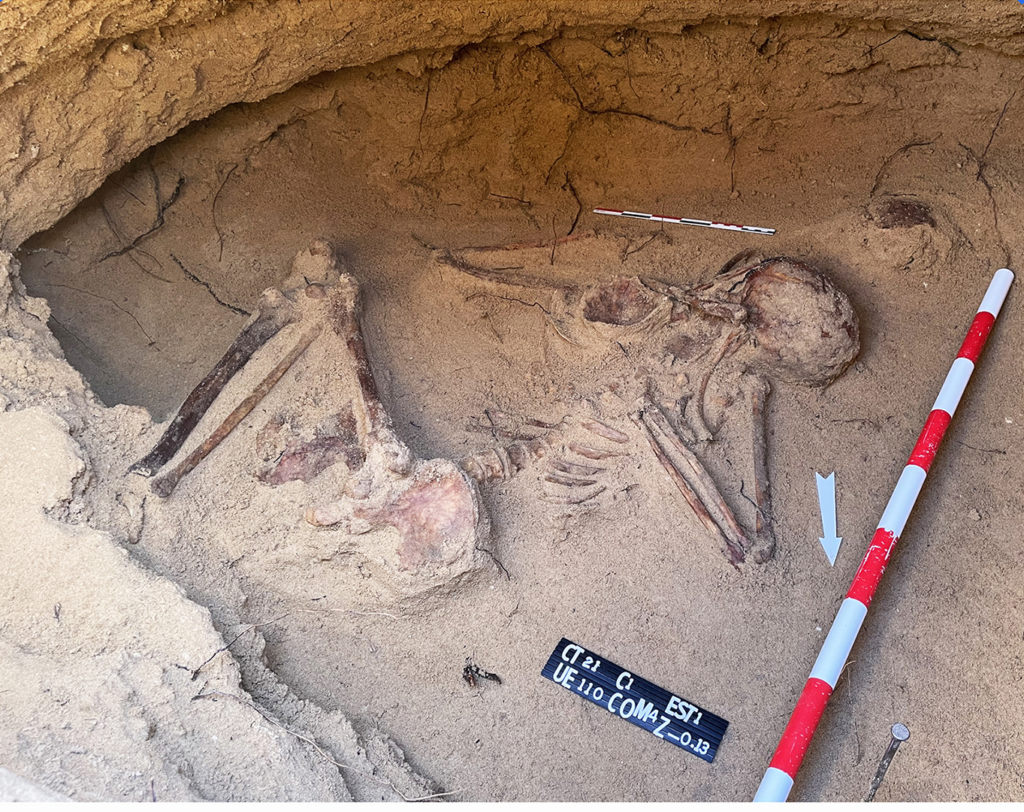
Skeletal analyses show that at least 13 people were buried in the first grave and at least seven in the second. A significant portion of the bones lost their anatomical integrity, suggesting that some remains were rearranged during subsequent burials.
Dating results reveal that the two graves were largely used during the same periods. While initial burials were primarily conducted in the chambers, later burials utilized the corridors. Researchers state that these practices likely reflect an intensive funerary tradition spanning several generations rather than disconnected, long-term phases of use.
Gold Earrings and Ivory Combs Point to Distant Connections
In the burial chamber of the first grave, the remains of a young adult woman with preserved anatomical positioning were found. Valuable objects associated with this burial include two gold earrings, three silver beads, green mica beads, and a comb made of ivory. In the second grave, a piece of jewelry and an arrowhead made of arsenic-copper were detected.
Archaeometric analyses performed at the University of Cádiz laboratories showed that much of the material used in these objects cannot be explained by local geological sources. Researchers evaluate that the ivory may be of African origin, although the exact source has not yet been determined. There are also various possibilities regarding the raw materials for the silver and green mica beads.
These artifacts suggest that the communities around Trafalgar may have had access to exchange networks that extended beyond their immediate surroundings. However, the presence of precious materials from distant regions does not alone prove that direct maritime trade took place.
Coastal Graves Bearing Traces of Social Change
The location of the necropolis is also a key element of the research. Cape Trafalgar, near the Strait of Gibraltar, is a position from which prehistoric communities could establish connections via sea routes while maintaining a vantage point over the surrounding land and sea landscapes.
Researchers believe this coastal area held not only economic but also symbolic meaning. Monumental graves built on the border between sea and land may have been part of how communities related to their past and their environment.
The study also links the continuation of the collective burial tradition to the possibility of local resistance against the more centralized and socially stratified orders developing during the Bronze Age. However, this interpretation is presented as an explanation based on regional differences in burial traditions rather than directly proven political opposition.
The Trafalgar research reveals that funerary traditions in Europe did not follow a unidirectional and simultaneous transformation. While some communities shifted toward individual graves, others maintained ancient monumental burial practices or may have even constructed new structures for this tradition.
Vijande-Vila, E., Becerra-Martín, S., Morell-Rovira, B., Díaz-Zorita Bonilla, M., Molina-Piernas, E., Muñoz-Muñoz, A., Moreno-Márquez, A., González-Fernández, P., Domínguez-Bella, S., Gómez-Sánchez, M. L., Fernández-Sánchez, D. S., Ramírez-Amador, J. L., Corona-Borrego, J. M., Carmona-Gil, M., Corrales Díaz, J., & Cantillo-Duarte, J. J. (2026). The last builders of megaliths in the south of the Iberian Peninsula? The Bronze Age necropolis of Trafalgar (Barbate, Cádiz, Spain). PLOS ONE, 21(11), Article e0359220. https://doi.org/10.1371/journal.pone.0359220
