
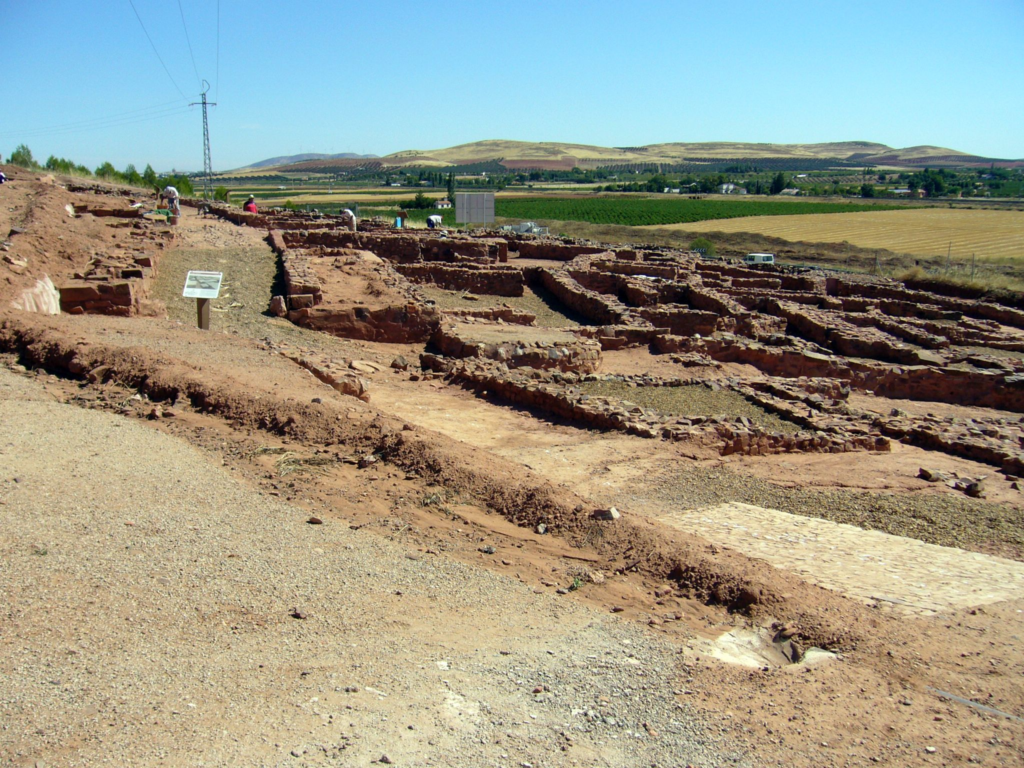
Two violently killed men found beside six deer antlers at Cerro de las Cabezas in Spain reveal a rare “bad death” ritual in the Iberian world.
Archaeologists in central Spain have identified one of the most unusual deposits ever recorded in the Iberian archaeological record: two adult men, both showing signs of violent death, placed beside six large red deer antlers outside the defensive wall of Cerro de las Cabezas.
The find, discovered during excavations in 2010 at the Iberian oppidum of Cerro de las Cabezas in Valdepeñas, Ciudad Real, has now been examined through a multidisciplinary study combining archaeology, physical anthropology and stable isotope analysis. The results suggest that the deposit was not a normal burial, but a carefully structured act linked to violence, exclusion and possibly ritual protection.
Researchers describe the context as a rare example of what archaeologists call “bad death” — a term used for deaths considered socially abnormal, violent, disgraceful or ritually problematic by a community.
A burial that broke Iberian customs
The Iberians of southern and eastern Spain usually cremated their dead. Ashes were placed in urns and deposited in cemeteries, often with grave goods that reflected social identity and status. Complete, unburned adult skeletons are therefore rare in Iberian contexts.
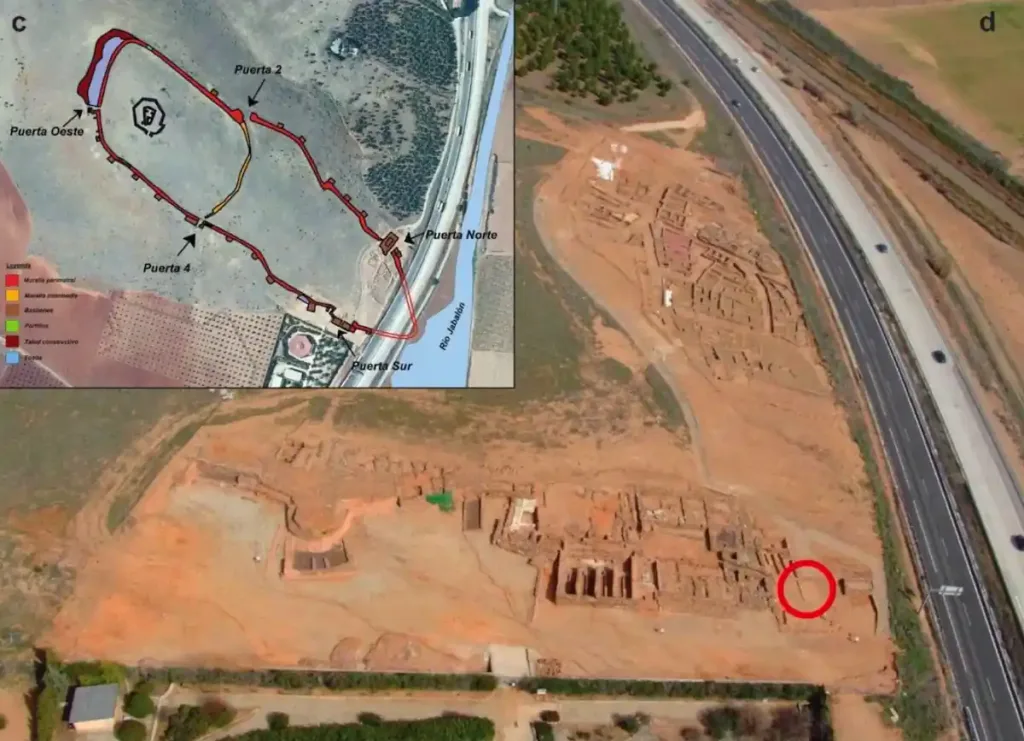
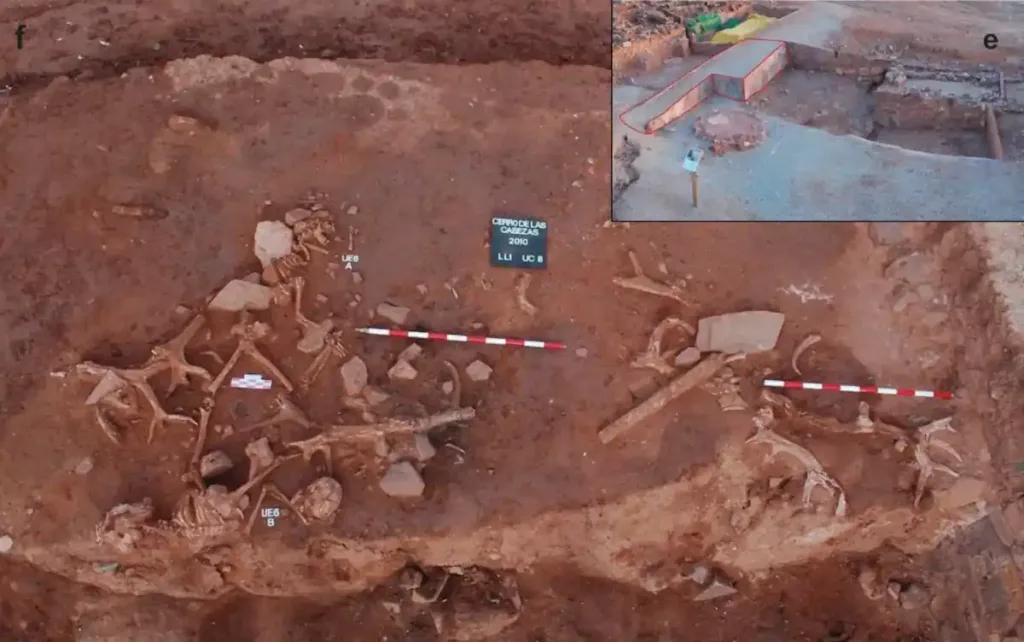
At Cerro de las Cabezas, the two men were not found in a cemetery. They were discovered outside the south-eastern defensive wall of the settlement, in anatomical articulation, without a grave cut, coffin, funerary architecture or formal arrangement. The bodies appear to have been deposited quickly, perhaps thrown into place, and then covered soon after death.
The site itself was an important fortified settlement of the Oretani, one of the Iberian peoples of central and southern Spain. Located on a hill overlooking the Jabalón River, Cerro de las Cabezas occupied a strategic position between the Meseta, Upper Andalusia and the eastern Iberian coast. Excavations show that the settlement was occupied from the Late Bronze Age until the end of the 3rd century BC and developed substantial fortifications from the 5th century BC onward.
The unusual deposit belongs to the final occupation phase of the oppidum and is dated to the late 3rd or early 2nd century BC.
One man was cut through the leg, the other was decapitated
The anthropological study identified both individuals as adult males.
Individual A was between 35 and 45 years old. His skeleton showed a healed injury to the frontal bone of the skull, meaning he had survived a serious blow to the head weeks before his death. His fatal injury was different: a deep cut across the lower part of the right femur, made by a sharp-edged weapon such as a sword or axe.
The cut penetrated deeply into the bone but did not fully sever the leg. Researchers argue that the blow likely cut major blood vessels behind the knee, causing massive bleeding and death. The position of the leg suggests the injury happened around the time of death, probably while the man was already prone or incapacitated.
Individual B, aged between 40 and 59, had been decapitated. His skull, jaw and first cervical vertebrae were found together, still articulated, but separated from the rest of the body by about 40 centimeters. This pattern cannot be explained by later disturbance of the soil. It indicates that soft tissue was still present when the head was removed or deposited.
Unlike other Iberian examples in which severed heads were displayed at entrances or mounted as trophies, this head was placed with the body, at the top of the deposit. That difference is important. Cerro de las Cabezas does not look like a simple trophy-head context. It appears to combine execution, disposal, ritual symbolism and social exclusion.
Why were deer antlers placed with the bodies?
The six red deer antlers are one of the most striking parts of the discovery. Some were more than one meter long. They were found both below and above the human remains, showing that they were placed as part of the same event, not added later.
Deer antler had practical value in Iberian society, but it also carried symbolic weight. Deer remains are known from sanctuaries, votive deposits and other ritual contexts across the Iberian Peninsula. In Celtiberian and Celtic areas, deer antlers have been found beneath walls, buildings and defensive structures, probably as apotropaic or foundation deposits intended to protect a community and its boundaries.
That context may help explain Cerro de las Cabezas. The two bodies were placed beside the southern wall, at the edge of the settlement, together with large antlers. The authors of the study argue that this fits a possible foundation or protective ritual, although they do not reduce the find to a single explanation.
The violence matters. These men were not carefully buried. They were excluded from normal funerary treatment. Their placement beside the wall may have carried a public or symbolic message.
Isotope analysis adds another clue
Stable isotope analysis was used to examine diet and possible mobility. The results are cautious rather than dramatic.
Individual A appears to have had a diet rich in animal protein, with little change between adolescence and adulthood. His skeleton also showed signs consistent with regular long-distance walking, which may point to a mobile lifestyle or activities connected with herding.
Oxygen isotope values differed between the two men, suggesting that they may have drawn drinking water from areas with different isotopic signatures. However, the authors stress that the evidence is not strong enough to prove that either man was non-local. Both values fall within the broader range documented for the surrounding region.
This caution is important. The study does not claim that the men were certainly foreigners, enemies or captives. It shows that they lived different life histories and died in an exceptional social context.
A rare glimpse of violence and power in pre-Roman Iberia
Cerro de las Cabezas now provides a rare case study for how violence, ritual and social control may have intersected in Iberian society.
The deposit is exceptional because it brings together several elements rarely found in one place: two complete adult bodies, violent death, decapitation, exclusion from normal cremation rites, placement beside a defensive wall and six large deer antlers. The researchers describe it as unique in the Iberian archaeological record.
Its meaning cannot be reduced to a single label. It may have been a punitive act. It may have been a ritualized execution. It may have served as a warning, a boundary rite or a symbolic act meant to protect the settlement. More likely, several of these meanings overlapped.
What is clear is that these two men were not treated as ordinary dead. Their bodies were used in a deliberate act at the edge of the community, in a place where the settlement’s physical wall also marked a social and symbolic boundary.
For archaeologists, that makes the discovery more than a violent episode. It opens a narrow but powerful window into how an Iberian community may have dealt with death that fell outside accepted norms — and how punishment, ritual and power could be written into the landscape of a fortified town.
Herrerín, J., Grandal-d’Anglade, A., Šarkić, N., González., T.T., Rivas., J.V., Maroto, D. F., Fernández, E.G., Vázquez, A.G., (2026). “Bad death” at the Ibero-Oretani site of Cerro de las Cabezas (Valdepeñas, Spain): an anthropological and multi-isotopic (δ13C, δ15N, δ18O) study. Research Square, doi.org/10.21203/rs.3.rs-9781535/v1
Cover Image Credit: Public Domain
