
Archaeologists working at Şanlıurfa Castle in southeastern Türkiye have announced a major step forward in understanding one of the region’s most significant early Christian discoveries.
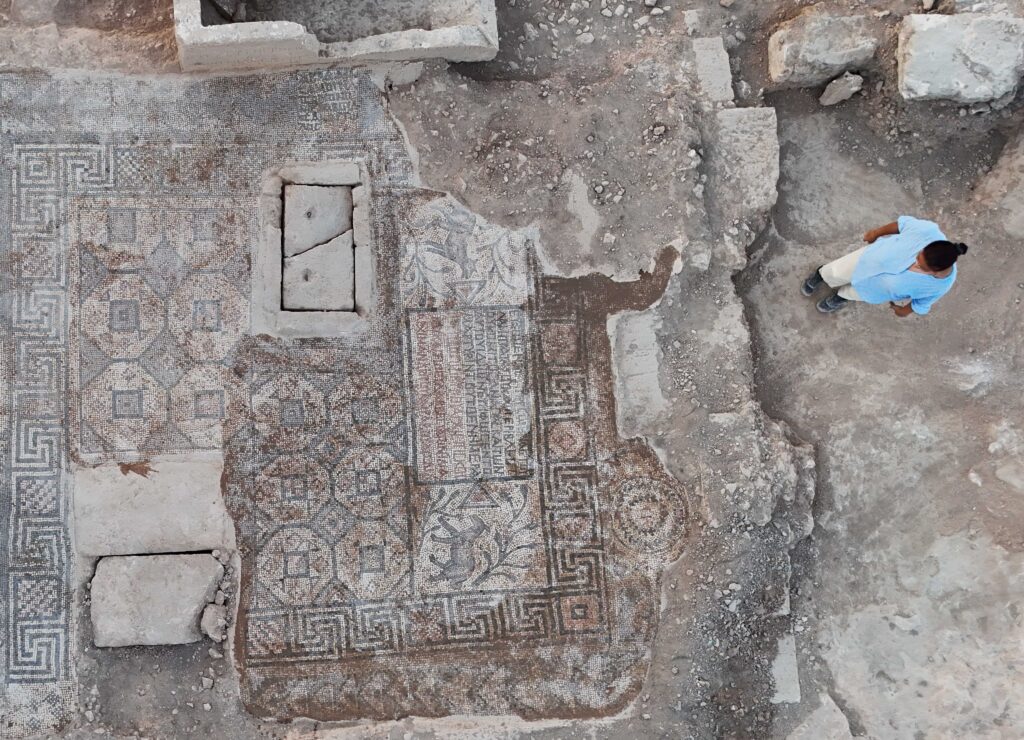
Excavation director Prof. Dr. Gülriz Kozbe of Batman University confirmed that roughly 60 square meters of an inscribed floor mosaic first detected during the 2025 season have now been fully uncovered, and that new evidence points to the structure functioning as a martyr’s church rather than an ordinary place of worship.
From a 2025 Discovery to a 2026 Breakthrough
The story began in late 2025, when excavators working in the southern terrace of the Balıklıgöl complex, adjacent to the castle, uncovered a fifth-century floor mosaic built with small red, black, and white stones, decorated with botanical motifs, animal figures, and geometric patterns.
At the time, Kozbe suggested the mosaic likely belonged to a church, a chapel, or a martyrium: a shrine built to honor a martyr.
Stylistic and linguistic analysis of that first inscription dated the floor to between A.D. 460 and 495, and the Greek text named a local benefactor, Count Anaskas, invoking divine protection for him and his family while also referencing senior clergy: Bishop Küros, the presbyter Elyas, and a deacon named Rabulus.
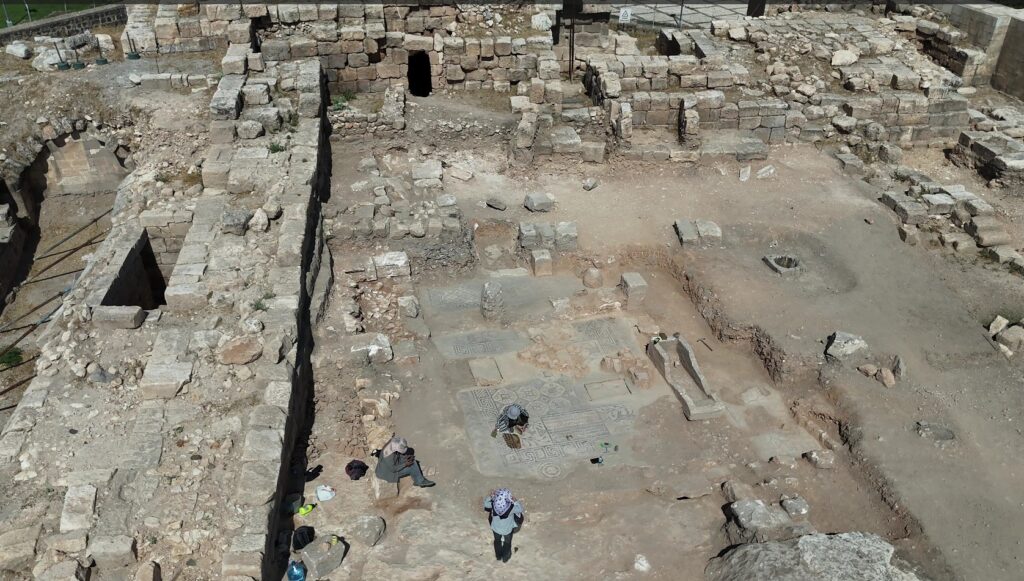
Now, with the 2026 excavation season, that identification has been strengthened considerably. According to Kozbe, the area known as the Western Tower Sector contains the floor of a structure dated to the Early Byzantine period, and “in light of the new data obtained,” the site is now believed to belong to a martyr’s church.
New Inscriptions and Burials Uncovered in 2026
This year’s fieldwork added significant new material to the site’s record:
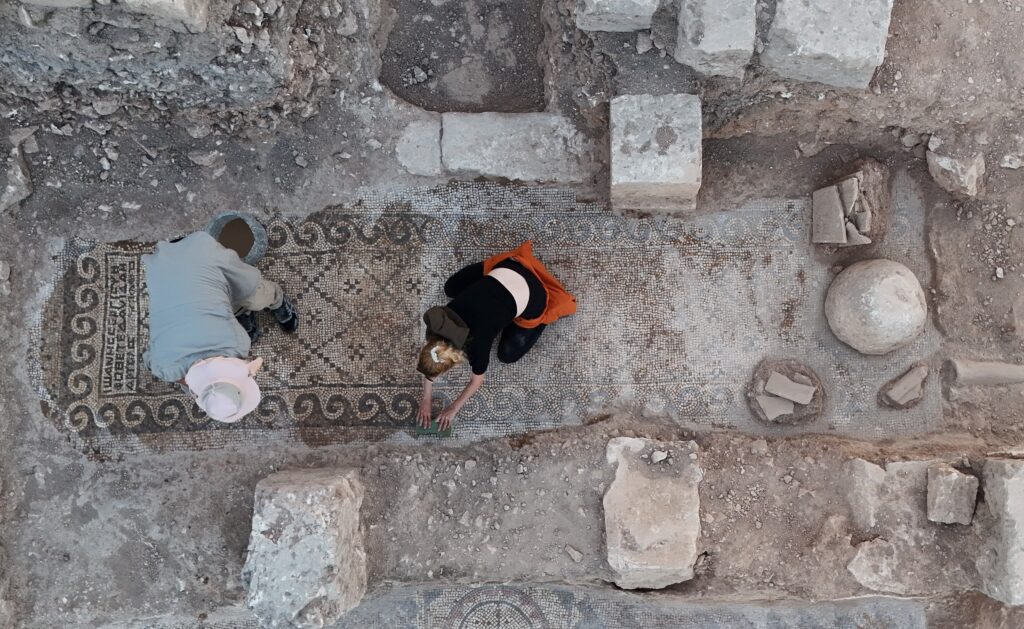
Two newly found inscriptions: one of 3 lines and one of 5 lines — discovered directly on the mosaic floor, in addition to the 9-line Greek inscription already identified in 2025.
Five khamasorion graves and one sarcophagus grave, found within the three-nave basilical structure.
A further Greek inscription located on the broken side of the sarcophagus, whose decipherment is still underway.
Kozbe noted that the geometric patterning and inscription panels, taken together, closely match Early Byzantine spatial flooring known from church mosaics of the 5th and 6th centuries across Syria, Southeastern Anatolia, Jordan, and Palestine — reinforcing the site’s religious function.
Edessa’s Place in Early Christian History
The find adds another layer to the story of ancient Edessa, as Şanlıurfa was known in antiquity. The city’s earliest name, Adma, appears in Assyrian cuneiform records, and it was later renamed Edessa by Alexander the Great’s commander Seleucus I.
Following the Seleucid–Parthian Wars, Edessa became the capital of the Kingdom of Osroene and developed into a center of Greek and Syriac theological thought, home to the renowned School of Edessa.
Kozbe emphasized that Urfa held a privileged position in the Christian world, sustaining a strong Christian community especially through the 2nd and 3rd centuries — a status that continued until the arrival of Islamic armies in the region in 639 marked the beginning of Islam’s spread in the area.
What Comes Next
Restoration and documentation work is ongoing, and a specialized restoration team has been tasked with preserving the mosaic, which is expected to go on display at the Şanlıurfa Archaeology Museum eventually.
Kozbe said the 2026 excavation season will wrap up in the coming days, but cautioned that many open questions about the structure’s precise identity and history will likely only be resolved in 2027, when further seasons of excavation and inscription analysis are planned.
The Şanlıurfa Castle excavations are carried out under the “Legacy for the Future” project of Türkiye’s Ministry of Culture and Tourism, continuing since 2020 under Kozbe’s direction.
