
A child laid beside an adult in a medieval grave might appear to offer a familiar explanation: a parent and child buried together after dying at roughly the same time. Ancient DNA from Swedish cemeteries now shows that this interpretation was usually wrong.
Researchers analyzed genetic material from 142 people buried between the Late Viking Age and the medieval period at Fjälkinge, Sigtuna, and Västerhus. The group included 68 children and adolescents whose biological sex often could not be determined reliably from their skeletons alone.
The results, published in Science Advances, found that children sharing graves with adults rarely had a close biological relationship with them. Instead, the burials appear to reflect a broader idea of belonging—one shaped by extended relatives, households, community ties, and the emerging rules of Christian burial.
Shared Graves Were Rarely Nuclear Family Graves
Archaeologists often assume that people placed in the same grave were close relatives, especially when an adult and child were buried together. Genetic analysis allowed the researchers to test that assumption directly.
At Västerhus, only 12 percent of the multiple graves with usable DNA contained first-degree relatives. These included two sisters, a father and son, and a probable pair of siblings. At Sigtuna, close or second-degree biological relationships were identified in 12.5 percent of the adequately sampled multiple graves.
Across the cemeteries, researchers detected many genetic connections between individuals buried in separate graves. Yet only about 6.38 percent of the wider relationships identified through shared DNA occurred between people placed in the same grave.
The cemeteries therefore contained extended biological networks spread across several generations, but individual shared graves were not normally organized around parents, children, and siblings. They may instead have brought together members of the same household, distant relatives, dependants, servants, apprentices, fostered children, or people connected through social obligations that DNA cannot reconstruct.
Boys and Girls Followed Adult Burial Patterns
The study also examined whether children were placed according to the gendered geography of early Christian churchyards.
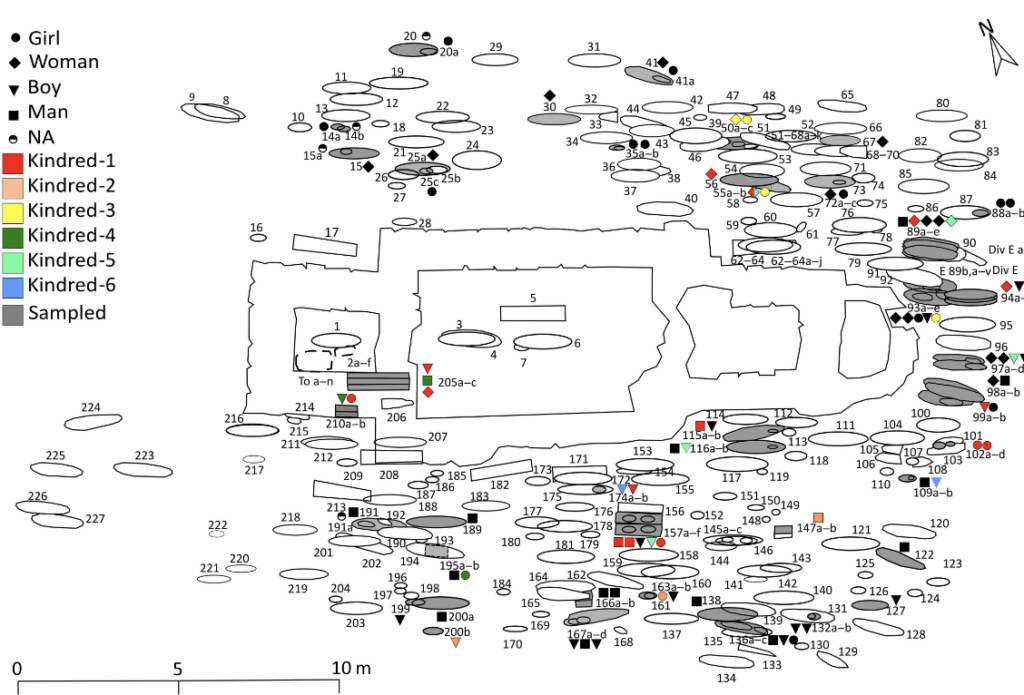
Some Scandinavian burial grounds separated adult men and women spatially, commonly placing women on the northern side of a church and men on the southern side. At Västerhus, genetically identified boys and most girls broadly followed the same division.
The pattern was also visible within shared graves. Of 28 graves containing both adults and children, 17—about 61 percent—paired adults with children of the same biological sex. Computer simulations indicated that this concentration was unlikely to have occurred by chance.
A broader statistical test did not find a strict relationship between the age composition and sex composition of every grave, however. The evidence suggests a strong preference rather than an inflexible rule.
The placement of children alongside adults of the same biological sex indicates that gendered burial practices began early in life. Children were not consistently treated as a separate, socially neutral category simply because they had not reached adulthood.
Five Infant Girls Broke the Pattern
The cemetery at Västerhus also preserves several striking exceptions.
Four infant girls were buried in the southern area normally associated with males. Each was placed with male individuals, usually adult men, although one shared a grave with young boys. Another infant girl was buried with males beneath the southern wall of the church atrium.
Researchers found no equivalent case of a young boy buried with adult women in the northern part of the cemetery.
Mixed burials were especially common near transitional or symbolically important locations, including the chancel and the church porch. These placements suggest that status, household relationships, local circumstances, or religious considerations could sometimes outweigh the usual division between male and female burial space.
Some infants and fetuses may also have been affected by baptismal rules. Early Christian regulations could exclude unbaptized children from consecrated ground, particularly when death occurred before baptism was possible. The authors propose that unusual placements may reflect communities adapting formal religious rules to accommodate the dead, though the graves themselves cannot establish whether individual children had been baptized.
A Pilgrim Woman Among Västerhus’ Leading Families
One extended family network at Västerhus offers a more personal view of status and mobility.
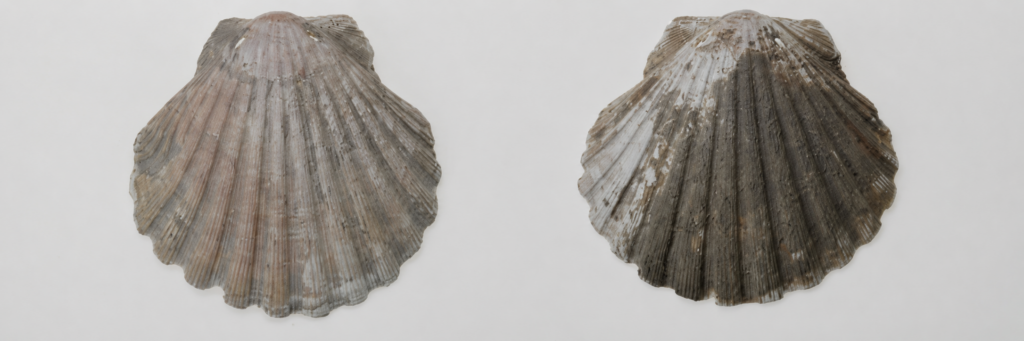
Members of this kindred were frequently buried near the church, a location generally associated with higher social standing. One woman was interred with a scallop shell, one of only two found in the cemetery.
Scallop shells became recognized symbols of pilgrimage to Santiago de Compostela in northwestern Spain. The researchers interpret the example from Västerhus as evidence that the woman had completed the long journey.
Its presence is particularly unusual because early Christian graves in Scandinavia generally contained few or no objects. Combined with her position within a well-connected kindred and her burial near the church, the shell suggests that she held an elevated place within the community.
Her grave also records the mobility of a medieval Scandinavian woman whose journey may have carried her thousands of kilometers before she returned to be buried among her wider social and biological network.
Medieval Kinship Extended Beyond Biology
Most of the multiple burials examined were primary, apparently simultaneous interments, meaning that the individuals probably died at or near the same time. The study found no widespread trauma or demographic pattern that could securely connect them with warfare, accidents, or epidemics.
What linked the dead may therefore have been less visible than a shared cause of death.
Late Viking and medieval households could include extended relatives, servants, enslaved people, employees, foster children, and others whose position was socially recognized even without a close biological connection. Christianity introduced new rules concerning consecrated ground, churchyard location, and appropriate burial, but those rules operated within existing local relationships.
Ancient DNA reveals that biological families remained important at the community level. Relatives were often buried near one another across the cemetery and over several generations. But the people sharing a single grave usually belonged to a more complicated social world.
The adult beside a child was not necessarily a mother or father. They may instead have been connected by a household, a distant family line, social rank, religious affiliation, or a relationship that left no genetic signature.
Maja Krzewińska et al., 2026, Equal in death: Ancient genomic analysis of children’s early Christian burials.Sci. Adv.12,eaeb8588(2026).DOI:10.1126/sciadv.aeb8588
Cover Image Credit: The two scallop shells found at the västerhus cemetery (wes056 and wes007) (Photo: C. Åhlin, 2012, Historiska museet. cc BY 4.0.). Maja Krzewińska et al., 2026
