
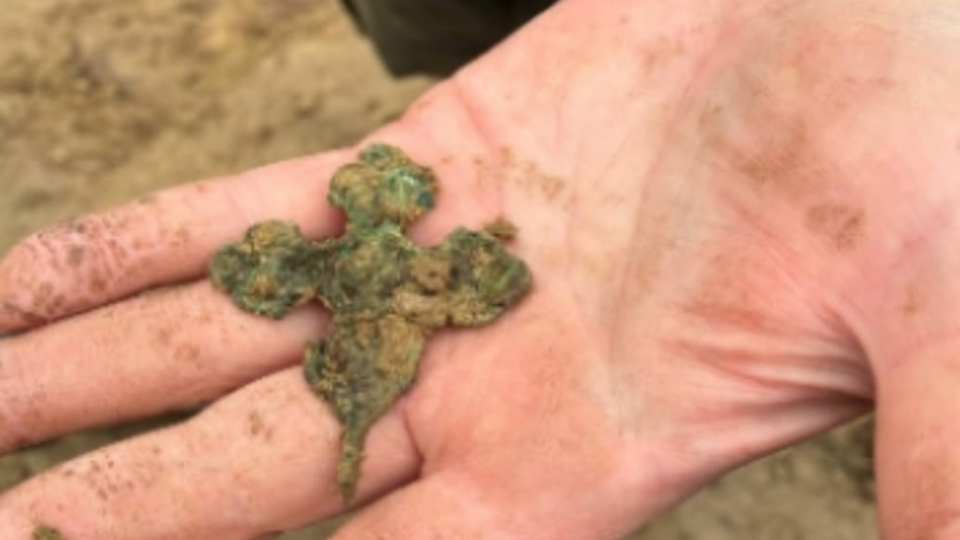
A rich medieval burial of a Karelian warrior discovered in northwestern Russia is shedding new light on the early Christianization of Karelia and its connections to the wider Baltic world. Archaeologists working in the Priozersky District of the Leningrad Region uncovered what appears to be the grave of a high-status retainer—likely a member of a princely military elite serving Novgorod.
The find, dating to the 13th century, includes an exceptional assemblage of grave goods: a sword, spurs, silver coins, decorative metal fittings, and most notably, a rare bronze pectoral cross that may point to long-distance cultural and religious links across the Baltic Sea.
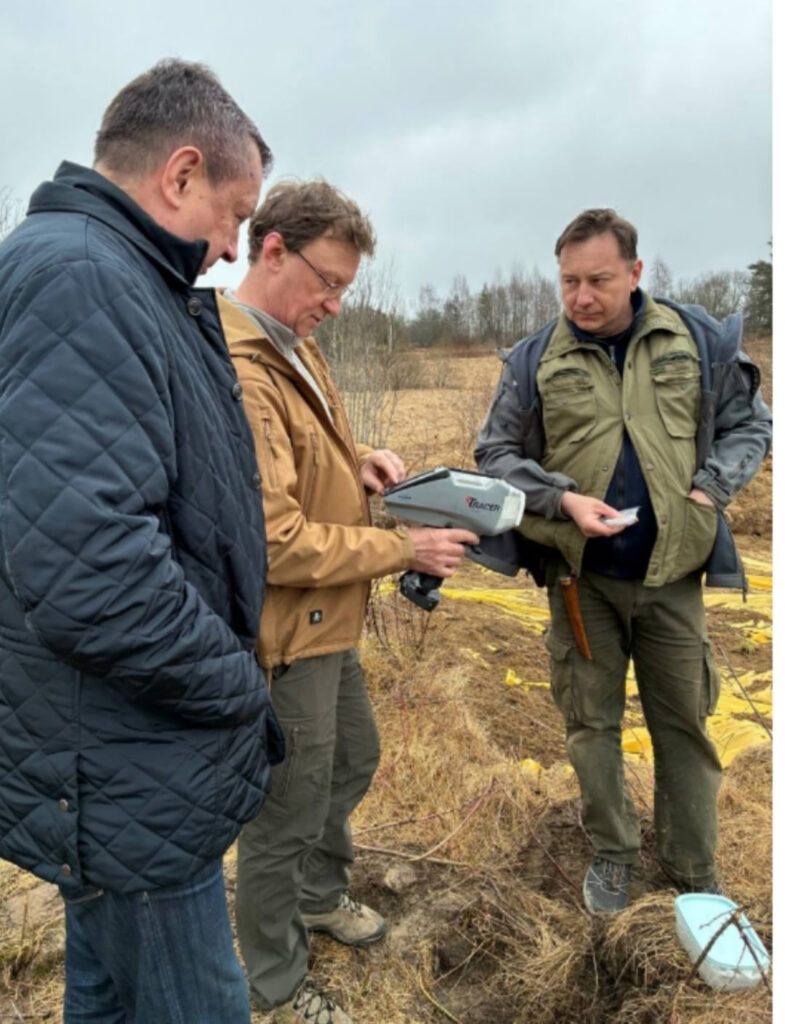
The excavation is being led by specialists from the Peter the Great Museum of Anthropology and Ethnography of the Russian Academy of Sciences. Over the weekend, the site was inspected by Alexander Soklakov, head of the Priozersky District administration, together with a local initiative group from the Sevastyanovskoye settlement.
A High-Status Warrior from Medieval Karelia
The burial was identified within a cemetery associated with the period when the Karelians—Finno-Ugric people inhabiting regions between modern-day Russia and Finland—were undergoing profound religious transformation. Archaeologists believe the individual interred was not an ordinary soldier, but a druzhinnik, a professional warrior in service to a prince, likely connected to the powerful medieval city-state of Novgorod.
The presence of weaponry such as a sword and riding equipment like spurs indicates not only martial status but also mobility and elite affiliation. These items were typically reserved for individuals integrated into princely military structures, suggesting that Karelia was more deeply tied to the political networks of medieval Rus’ than previously assumed.
Silver coins and ornate metal appliqués found in the grave further reinforce the idea of wealth and prestige. Such items often served both as markers of identity and as symbols of allegiance within the hierarchical world of medieval Eastern Europe.
The Cross: A Symbol of Faith and Identity
At the center of the discovery is a bronze pectoral cross, worn on the chest and likely displayed openly during life. This detail is particularly significant in the context of Karelia’s Christianization, which officially began in 1227 under Prince Yaroslav Vsevolodovich.
Unlike earlier periods where religious identity might remain less visible, newly converted elites often emphasized their faith publicly. Wearing a cross over clothing was not just a spiritual act—it was also a political and cultural statement, signaling alignment with Orthodox Christianity and the expanding influence of Novgorod.
What makes this cross especially remarkable is its rarity. According to archaeologists, comparable examples have only been found on the island of Gotland, a major trading hub in the Baltic Sea during the medieval period. This raises compelling questions about trade routes, artistic exchange, and shared religious symbolism between Karelia and Scandinavian-influenced regions.
Karelia at a Cultural Crossroads
The discovery underscores Karelia’s position as a borderland between East and West, where Orthodox Christianity, local traditions, and external influences intersected. During the 13th century, the region was not isolated; rather, it was part of a dynamic network linking Novgorod, the Baltic trade sphere, and even Northern Europe.
Karelians, originally practicing animistic and shamanistic belief systems, gradually adopted Christianity through political integration and missionary activity. However, archaeological evidence suggests that this transition was neither immediate nor uniform. Graves like this one illustrate a hybrid cultural identity, where traditional burial customs coexist with new Christian symbols.
The presence of a cross alongside weapons is particularly telling. In strictly Christian burial norms, weapons were often excluded, yet here they remain central. This suggests a negotiated conversion, where warrior identity and spiritual transformation were intertwined rather than mutually exclusive.
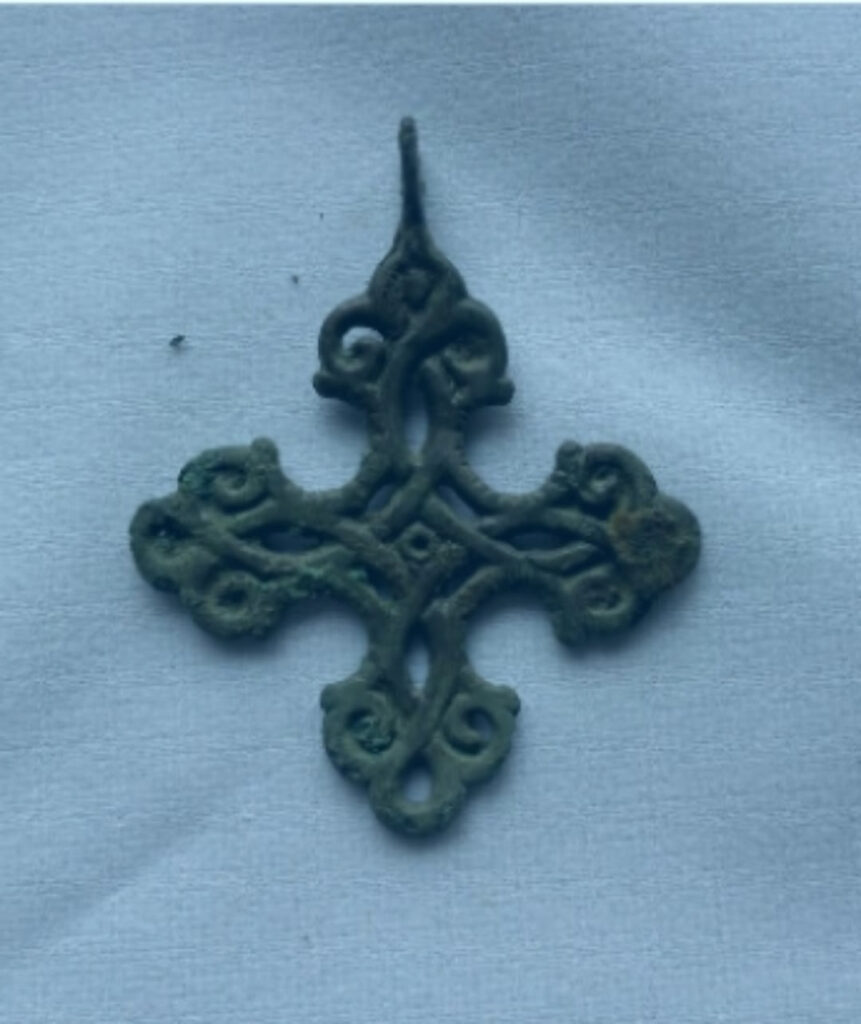
What makes this cross especially remarkable is its rarity. According to archaeologists, comparable examples have only been found on the island of Gotland, one of the most important trading hubs in the medieval Baltic world. Credit: Great Museum of Anthropology and Ethnography
Scientific Analysis and Future Plans
Researchers have conducted X-ray fluorescence (XRF) analysis on the burial objects, allowing them to determine the elemental composition of the metals. This non-destructive technique provides insight into manufacturing techniques, trade connections, and material sourcing—key factors in understanding the broader economic landscape of medieval Karelia.
Local authorities have already expressed interest in preserving and promoting the site. Plans are underway to expand the excavation area and potentially designate the location as a historical and cultural heritage site. There is also discussion of creating a regional heritage cluster to support tourism, education, and continued research.
A Region Shaped by Faith and Trade Networks
Beyond the richness of the grave itself, this discovery contributes to a growing body of evidence that Karelia played a more active role in medieval Eurasian networks than previously recognized. The rare cross, in particular, acts as a tangible link between distant regions, hinting at connections that transcend modern national boundaries.
For historians and archaeologists, the burial offers a rare glimpse into the lives of individuals navigating a world in transition—where faith, loyalty, and identity were being redefined.
Source: 47 Channel
Cover Image Credit: Peter The Great Museum of Anthropology and Ethnography
