
Approximately 1,500 years ago, on the North Sea coast of Germany, a man was buried in a wooden boat over four meters long. An ornate wooden throne and valuable belongings were left in his grave. This extraordinary burial, discovered by archaeologists years ago, is now revealing possible connections to the Roman world thanks to DNA analysis.
In a study published in the journal iScience, scientists led by Kiel University examined human remains from the Fallward cemetery using genetic methods. The results provide new clues regarding the origin of the man in the boat grave and reveal traces of a disease he suffered from during his lifetime.
A 1,500-Year-Old Boat Grave on the North Sea Coast
Fallward is located in northwestern Germany, in the coastal region between the Elbe and Weser rivers. In ancient times, the people living here established their settlements on artificial mounds to protect themselves from the tides and storm surges of the North Sea. The fertile marshlands provided favorable conditions for agriculture and livestock breeding.
Excavations carried out in the 1990s uncovered a vast cemetery used from the late 3rd century to the late 5th century AD. In an area containing approximately 200 cremation burials and 60 inhumation burials, moist clay layers ensured the preservation of numerous organic materials, ranging from wooden objects and fabrics to furs and plant covers.
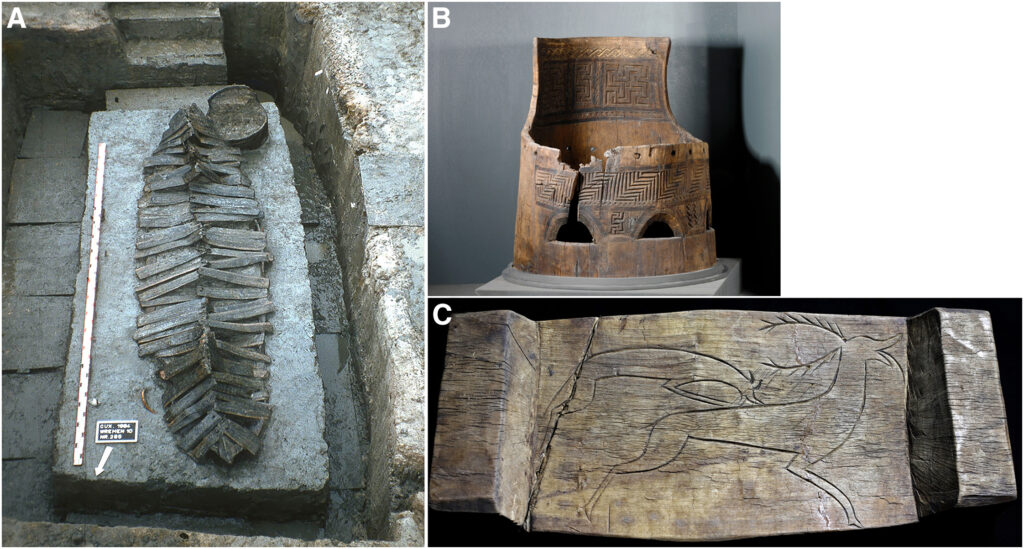
One of the most striking examples of the cemetery was the grave recorded by archaeologists as number 265. Dating to the second quarter of the 5th century AD, this grave contained a man who died at approximately 50 years of age. The community had placed the man’s body in a boat made of oak, over four meters long, and covered it with wooden panels arranged in a roof-like structure.
Wooden Throne, Runic Inscription, and Roman Military Belt
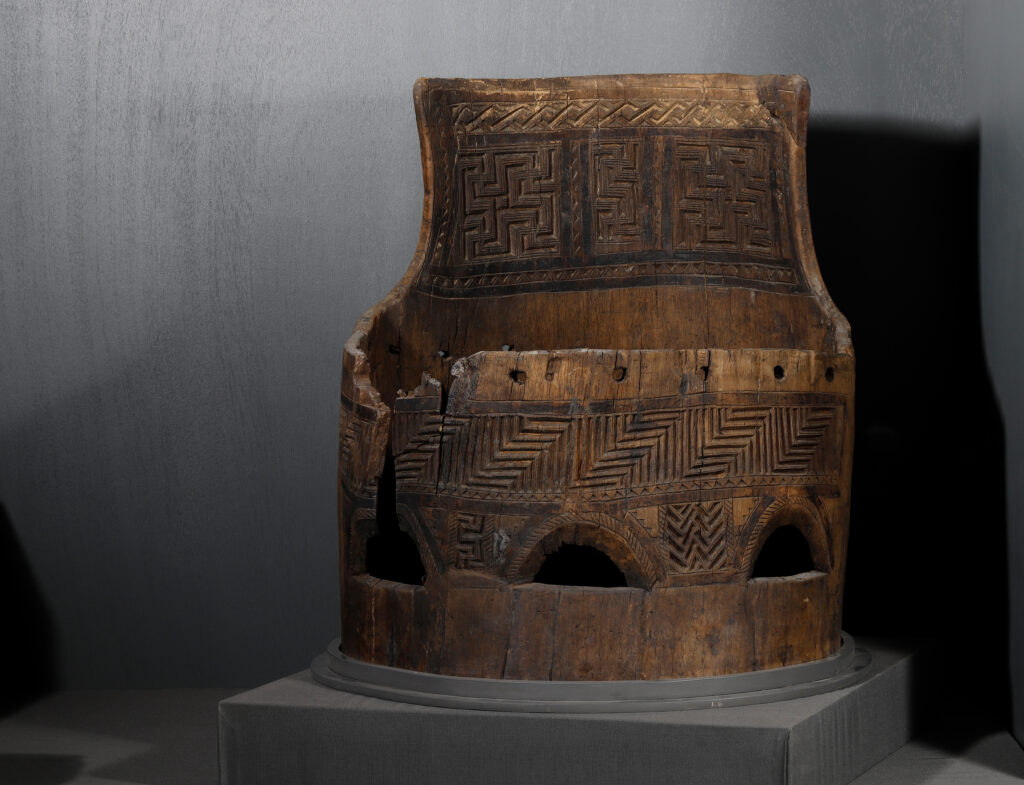
The burial method was not the only thing that set the boat grave apart from an ordinary burial. Outside the boat, archaeologists found a large wooden seat carved from alder and decorated with notches. This object, often interpreted by researchers as a throne, carries important clues regarding the deceased’s position in society.
It is believed that the seat may have originally been painted. Its meticulous craftsmanship and striking form make it more than just a piece of furniture produced for daily use. Researchers assess that the seat may have served as a symbol of authority or status.
Another wooden object found near the man’s feet contains different details. On the underside of a small stool made of maple, there is a hunting scene and a runic inscription. Researchers point to various comparative examples from the territories of the Roman Empire for these decorations.
The grave also contained a game board, a bronze basin, a ceramic vessel, and a belt associated with Roman military culture. Signs of use and repair on these items suggest they were not prepared solely for the funeral ceremony. They were most likely objects the man used during his life or acquired from his immediate circle.
The examination of the wooden materials revealed another important detail. Local tree species were used in the construction of the objects; however, the decorative style showed similarities to the art and craft traditions of the Late Antiquity under Roman influence.
DNA Analysis Points to the Danube Borders of the Roman Empire
Researchers from the Institute for Molecular Clinical Biology at Kiel University took a total of 12 skeletal samples from 11 individuals at the Fallward cemetery. Due to the quality of the DNA data, scientists were able to perform detailed population genetic comparisons on only three individuals.
The genetic characteristics of two of these individuals showed similarities to Iron Age and early Medieval communities of Northwestern Europe. Specifically, a close affinity with British Iron Age and early Anglo-Saxon communities was notable. However, the genetic results of the man in the boat grave presented a different picture.
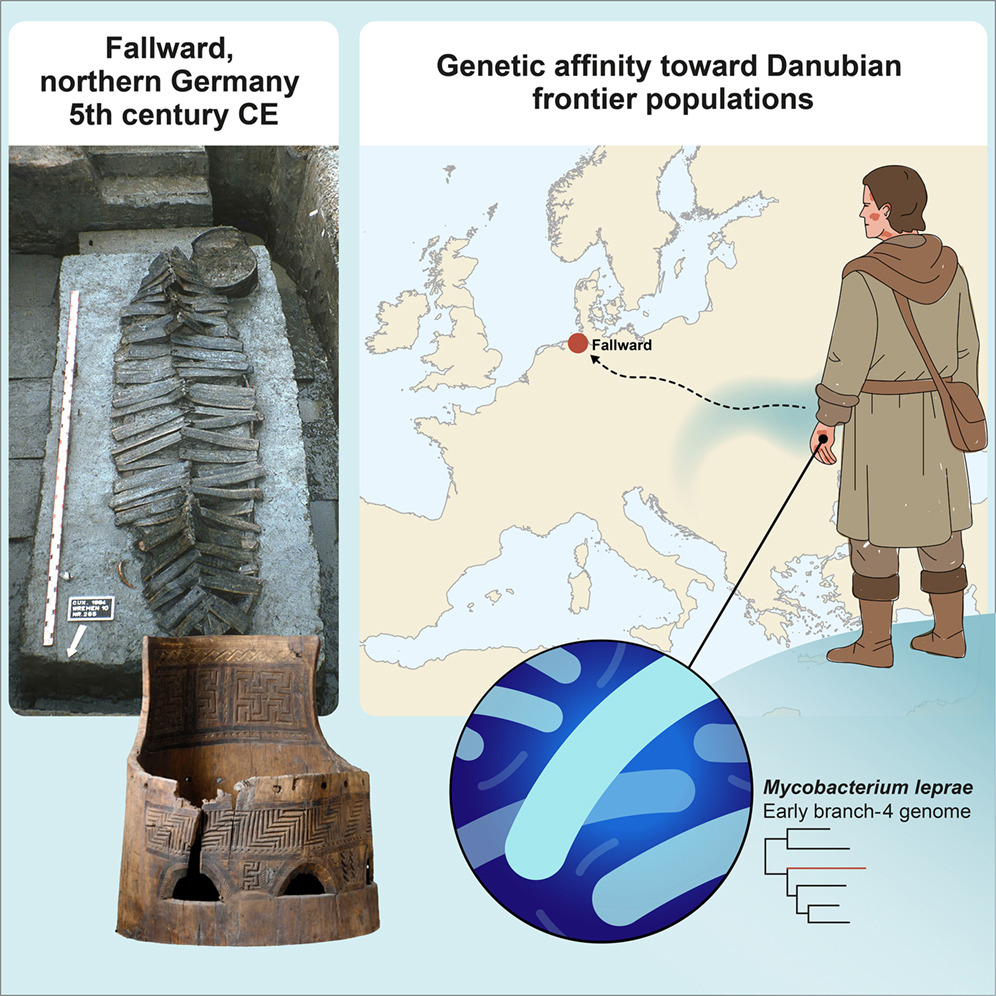
Researchers compared the DNA of the man, identified as G265, with ancient samples obtained from various regions of Europe. The most striking similarities emerged with communities living in the Danube border region during the Roman Iron Age and the Migration Period. This geography covers parts of present-day Croatia, Slovenia, Hungary, and Serbia.
A model analyzing the geographical distribution of genetic similarities showed the highest probability value in a region near the old Roman border, approximately 1,400 kilometers southeast of Fallward. This result suggests that the man or his close ancestors may have come from southeastern Europe. However, researchers specifically emphasize that the current DNA data is not sufficient to determine a precise geographical origin.
Credit: © Petra Horstmann / Cluster ROOTS, Kiel University.
Could the Man in the Grave Have Served in the Roman Army?
The genetic results give new meaning to the Roman-style military belt found in the grave. Researchers are considering the possibility that the man may have been one of the allied warriors known as foederati who served in the Roman army.
In Late Antiquity, the Roman Empire utilized warriors from various communities by making military agreements with border regions. Such a background could explain the Roman-related objects in the grave and the possible southeastern European connection. However, the military belt does not necessarily indicate service in the Roman army; it could have been acquired through trade, inheritance, or as war booty.
Other clues about the man’s life point to a strong connection with the sea or rivers. Inside the boat, archaeologists found fish bones, reed mats, and a small box in the shape of a waterfowl. Skeletal examinations revealed that the muscles of the upper arms were quite developed, leading researchers to suggest that he may have been engaged in rowing or fishing.
1,500-Year-Old Leprosy Infection in His DNA
One of the most unexpected results of the study concerned the man’s health history. Scientists detected the DNA of the bacterium Mycobacterium leprae, which causes leprosy, in samples taken from his tooth and heel bone.
Despite this, the man’s skeleton showed no distinct bone lesions associated with leprosy. Researchers believe the infection may have progressed without damaging the bones or that the disease only affected the soft tissues. Consequently, it is unknown whether the man showed symptoms of the disease or how the infection affected his daily life.
Since leprosy is a chronic infectious disease that can develop over many years, the presence of the bacterium does not explain the cause of death. The authors of the study state that it is more likely the man died of another cause.
By reconstructing the bacterium’s genome, researchers placed it in the 4th genetic lineage of M. leprae. One of the known older samples of this lineage was obtained from an Egyptian mummy dating between the 4th and 2nd centuries BC. The Fallward find provides new data on the genetic diversity of the bacterium in the ancient world; however, it does not prove that the disease was transported directly from Egypt to Northern Germany.
A Changing World on the North Sea Coasts
The 5th century, in which the man in the boat grave lived, was a period of significant change for the communities around the North Sea. The Fallward settlement gradually shrank throughout this century and was likely completely abandoned by the end of the century. During the same period, population and settlement activities decreased in many settlements on the southern coast of the North Sea.
Researchers evaluate these changes within the historical context of migrations from continental Europe to Britain. The genetic similarity of the other two individuals at Fallward with early Anglo-Saxon communities is also notable in the context of the population movements of this period. However, the available data does not prove that these individuals or their relatives migrated directly to Britain.
Therefore, the Fallward research provides new data not only on the past of the man in the boat grave but also for examining the mobility of communities around the North Sea during the final centuries of the Roman Empire.
Myburgh, D. A., da Silva, N. A., Romeyer-Dherbey, J. H., et al. (2026). Paleogenomics reveals leprosy at the late antique burial site of Fallward in northern Germany. iScience, 29, 117877. https://doi.org/10.1016/j.isci.2026.117877
