
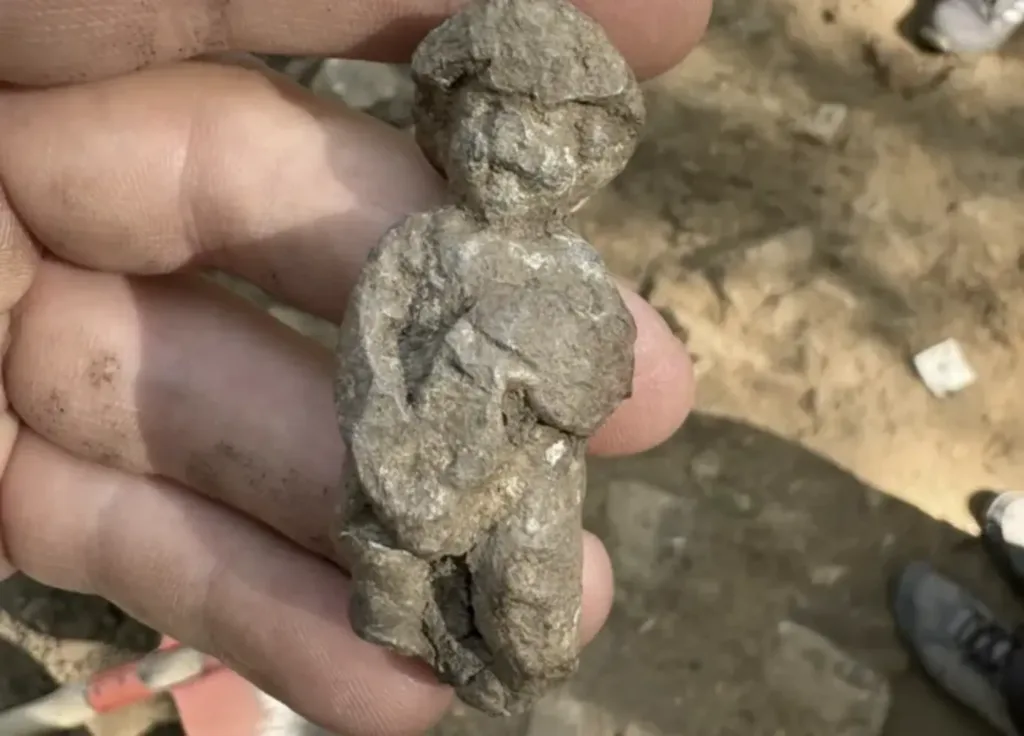
A tiny lead figurine found in a Roman village in Hungary has revealed something archaeologists had never previously identified at the site: a direct trace of religious life.
The figurine represents Venus Pudica, one of the most recognizable forms of the Roman goddess Venus. It emerged during metal-detector research at Pilisszentiván–Hárs-erdő, where archaeologists have spent four consecutive seasons investigating a Roman-period rural settlement.
For a site that has already produced houses, pottery, tools, coins and evidence of everyday work, the small object adds a very different dimension. According to Eötvös Loránd University (ELTE), it is the first known find from the settlement with a religious association.
A Roman village beyond Aquincum
The settlement lies at Pilisszentiván, northwest of modern Budapest, in the hinterland of Aquincum, one of the most important Roman centers in the region.
Archaeologists from ELTE’s Department of Ancient Archaeology have been excavating the site under the direction of Bence Simon for four years. Earlier research revealed stone-founded buildings, large quantities of pottery and evidence that at least part of the settlement supported workshop activities.
The 2026 season, which ended on September 23, focused on buildings previously identified around the Hársas spring. Researchers wanted to establish their boundaries more precisely and better understand how different parts of the settlement had been used.
The Venus figurine emerged during that work. Made of lead and discovered with a metal detector, it provides a type of evidence that had been conspicuously absent from earlier seasons.
Until now, excavations had offered increasingly detailed glimpses of how people at Pilisszentiván lived and worked. The small Venus introduces the possibility of exploring how belief and religious practices fitted into that same rural world.
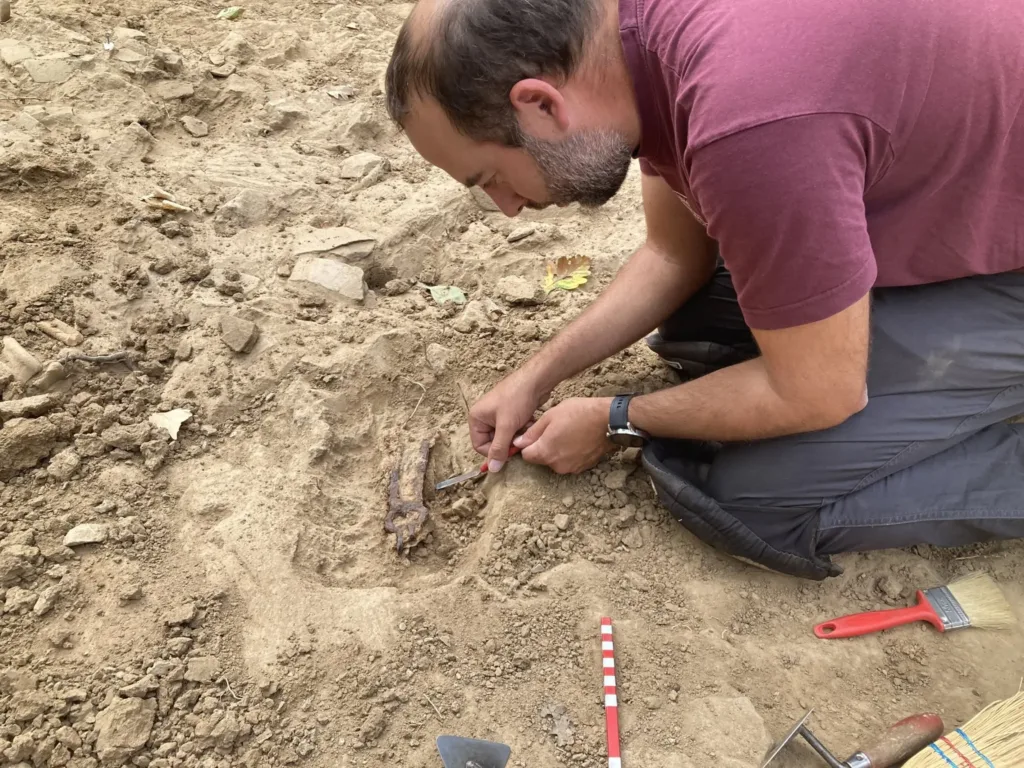
Archaeologists also discovered a fragment of a leaded bronze mirror, iron tools, brooches, and coins. Credit: Müller Ákos – Eötvös Loránd University (ELTE)
More than a single remarkable object
The figurine was not the only metal find recovered this season.
Archaeologists also discovered a fragment of a leaded bronze mirror, iron tools, brooches and coins. Together, these objects add to an assemblage that is gradually transforming the site from a collection of building foundations into a more detailed picture of an inhabited Roman community.
Some of the most informative evidence, however, came from what archaeologists call Building E.
Excavations examined its residential section and northern foreground. Along the edge of the living area, the team uncovered a stone-paved surface similar to features identified beside other buildings at the settlement. Archaeologists believe the area may have been connected with economic or working activities.
Previous research had already shown that Building E was larger than initially expected, while archaeological material suggested that its abandonment occurred around the beginning of the third century AD.
A collapsed layer preserves everyday life
In the northern part of the newly excavated area, archaeologists encountered something particularly valuable: an undisturbed collapse layer.
Such deposits can preserve groups of objects close to where they were being used before a building was abandoned or destroyed, offering archaeologists a more coherent snapshot than isolated finds disturbed over centuries.
At Pilisszentiván, the layer contained a large quantity of pottery, including vessels surviving in unusually complete condition. An almost completely preserved pair of iron tongs was also recovered.
These finds may help researchers determine what happened inside and around Building E and clarify the activities carried out there. Combined with evidence accumulated during previous seasons, they are beginning to reveal distinctions between residential spaces, working areas and other parts of the village.
The Venus figurine now adds another category to that picture.
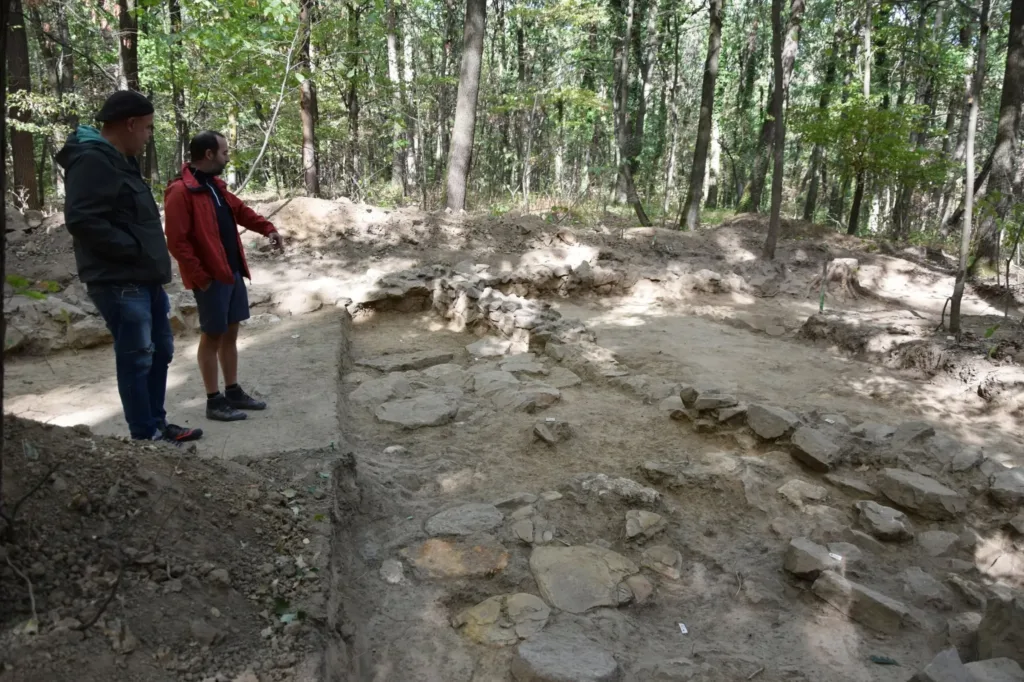
Building E at Pilisszentiván–Hárs-erdő, where excavations revealed residential spaces, stone-paved surfaces and a well-preserved collapse layer. Credit: Müller Ákos – Eötvös Loránd University (ELTE)
A village beginning to reveal its people
Roman rural settlements can easily be reduced archaeologically to walls, pottery scatters and economic activity. Pilisszentiván is increasingly providing something more tangible.
A mirror evokes personal appearance. Brooches belonged to clothing. Tools point toward work, pottery toward cooking, storage and consumption. Coins connect the settlement to a wider economic system. And now a small image of Venus suggests that religious ideas also accompanied the people who lived there.
Much remains unresolved. Analysis of the finds and archaeological features from the 2026 season is continuing, while the research team hopes to return to the settlement next year.
After four seasons, however, Pilisszentiván–Hárs-erdő is no longer simply revealing the plan of an ancient village. Piece by piece, it is beginning to expose different dimensions of the lives once lived there — and one of the smallest finds of the season may have opened one of the most intriguing.
