
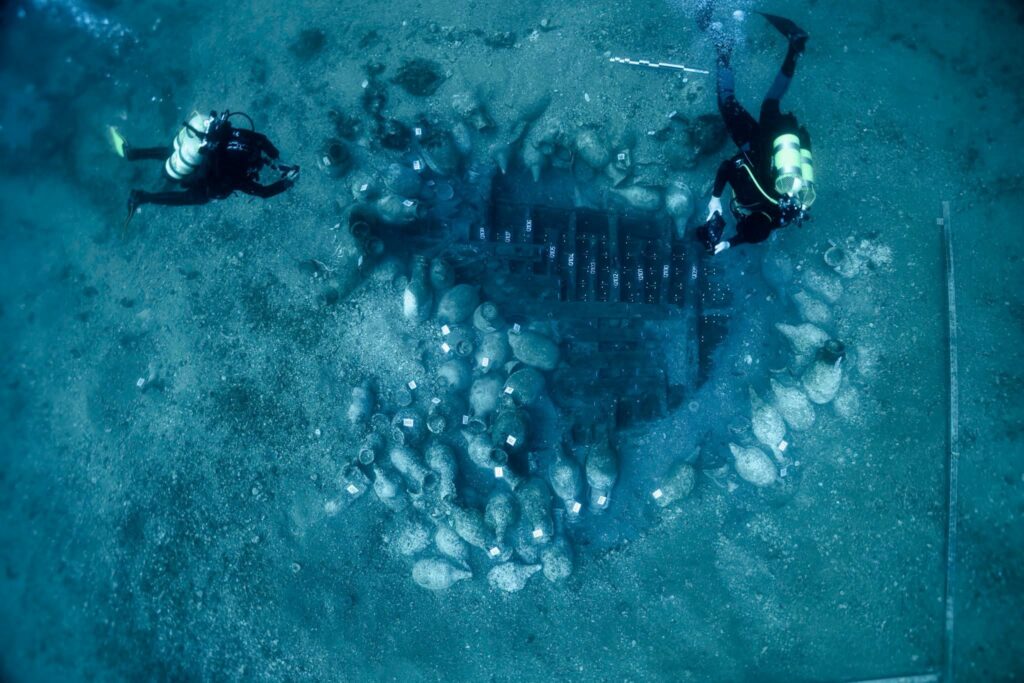
A discovery has been made off the coast of Mallorca, Spain, of a shipwreck believed to date back to the Islamic period, which could be the first shipwreck of its kind discovered in the Balearic Islands. The small vessel, much of whose wooden hull remains preserved, contained millstones, large ceramic jars, and a significant number of deer antlers. Following the discovery, the Island Council of Mallorca (Consell de Mallorca) re-covered the wreck with sand to protect it from the risks of looting and deterioration. Authorities are not disclosing the exact location of the archaeological site.
The dating of the wreck has not yet been finalized. However, if the period indicated by the initial findings is confirmed, the discovery could fill a significant archaeological gap regarding the maritime trade conducted by Mallorca during its more than three centuries of Islamic rule.
A Discovery That Began With a Casual Swim
The story of the discovery dates back to July 2026. A resident of the island, who had gone swimming off the coast of Mallorca, noticed wooden remains emerging from the sands of the seabed. Suspecting they might belong to an ancient ship, they reported the situation to the Consell de Mallorca.
Underwater archaeologists who arrived at the scene following the report documented partially exposed wooden structural elements during their initial inspection. At that stage, however, there were insufficient findings to determine the period to which the ship belonged.
A second inspection carried out at the end of August changed the course of the research. Ceramics and other cargo remnants associated with the ship allowed researchers to propose a preliminary dating pointing to the Islamic period.
The Spanish newspaper Última Hora, which announced the discovery on November 18, reported that the council took emergency action to protect the wreck and kept its location secret to avoid attracting potential looters.
Deer Antlers and Millstones in the Ship’s Cargo
One of the most striking features of the wreck is the diversity of the materials it carried. Archaeologists identified millstones, large storage jars, various ceramic fragments, and a significant amount of deer antlers.
The wooden hull of the ship also holds valuable information for researchers. It is noted that the vessel is relatively small in size, and a significant portion of its structural elements, extending both transversely and longitudinally, are preserved. These remains may allow for the examination of the ship’s construction techniques in the future.
The deer antlers, in particular, raise new questions about the ship’s cargo. In the Middle Ages, horn and bone were among the raw materials used in the production of box linings, ornaments, and various everyday objects. Therefore, it is possible that the antlers were being transported as commercial cargo.
However, researchers have not yet disclosed which species of animal the antlers belong to, where they were brought from, or where they were being taken. There is also no direct evidence that they were being sent to a specific craft workshop.
Answering these questions could help in understanding not only where the ship came from but also the role it played in Mediterranean trade networks.
Why Have No Other Islamic Period Wrecks Been Found?
Mallorca came under Muslim rule in 902 and remained part of the Islamic world until the conquest by James I in 1229. During this process, the island was connected to maritime transport and trade networks in the Western Mediterranean.
Despite this, it is noteworthy that no shipwreck confirmed to belong to the Islamic period has been documented in the waters of the Balearic Islands until now.
Sebastià Munar, an underwater archaeologist who participated in the initial inspections, states that one of the reasons for this may be the different cargo-carrying materials used in different periods.
Roman merchant ships often carried hundreds of ceramic amphorae. When a ship sank, these durable containers accumulated on the seabed, both covering the wooden remains and making it easier to detect the location of the wreck.
In later periods, however, non-durable materials such as cloth sacks and wooden containers were used more frequently for transporting commercial goods. The disappearance of these materials over time may have made it more difficult to identify the archaeological traces of some ships.
In a statement given to Última Hora on November 20, Munar emphasized that the primary importance of the discovery stems not from the exceptional size of the ship or the valuable items it carried, but from the possibility that it is a wreck from the Islamic period.
Why Was the Wreck Re-covered With Sand?
Following the initial inspections, researchers removed some of the exposed ceramic fragments and deer antlers. The remainder of the ship was re-covered with sand after being documented.
Two primary dangers underlie this decision: looting and the deterioration of archaeological materials exposed to the marine environment.
The preservation of wooden structures that have remained underwater for centuries is a particularly complex process. When conditions on the seabed change, wooden pieces can become more susceptible to physical and biological decay. Therefore, extracting an entire wreck is not always the safest option.
The long-term conservation of waterlogged wood removed from the sea also requires expertise, appropriate facilities, and significant financial resources. A comprehensive extraction and conservation program has not yet been announced for the new wreck in Mallorca.
The Ses Fontanelles wreck from the Roman period on the island underwent a different preservation process. Discovered in 2019, the ship was removed from the water after extensive studies and moved to a specially prepared tank to preserve its wooden structure.
For the newly discovered wreck, the priority is to preserve the remains in situ until more detailed research can be conducted.
A New Page in Mallorca’s Maritime History
Palma, known as Madina Mayurqa during the Islamic period, was one of the important settlements in the Western Mediterranean. However, information regarding the physical remains of merchant ships arriving at or departing from the island during this period is extremely limited.
The new wreck offers a significant research opportunity to address this deficiency. The wooden structure of the ship could provide direct evidence of the shipbuilding techniques of the period, and its cargo could offer insights into the products transported and commercial connections.
Nevertheless, it is not yet known when the ship sank, which port it departed from, or where it was heading. It has not yet been determined which century within the Islamic period it belongs to.
According to Munar, the two inspections so far are only the beginning of revealing the wreck’s scientific potential. Researchers have comprehensive work ahead, including dating the ship, examining its cargo, and deciding on its preservation.
