
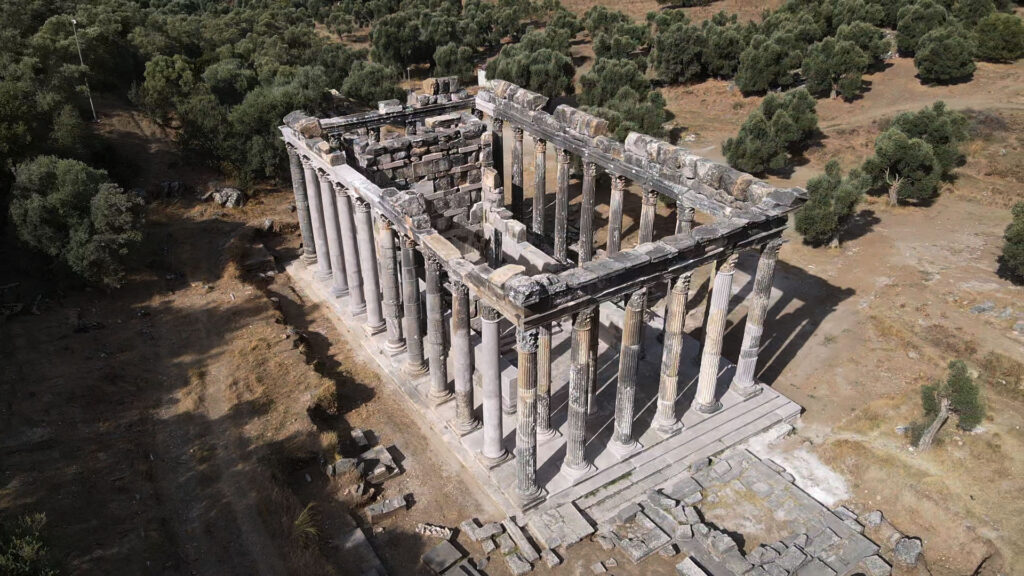
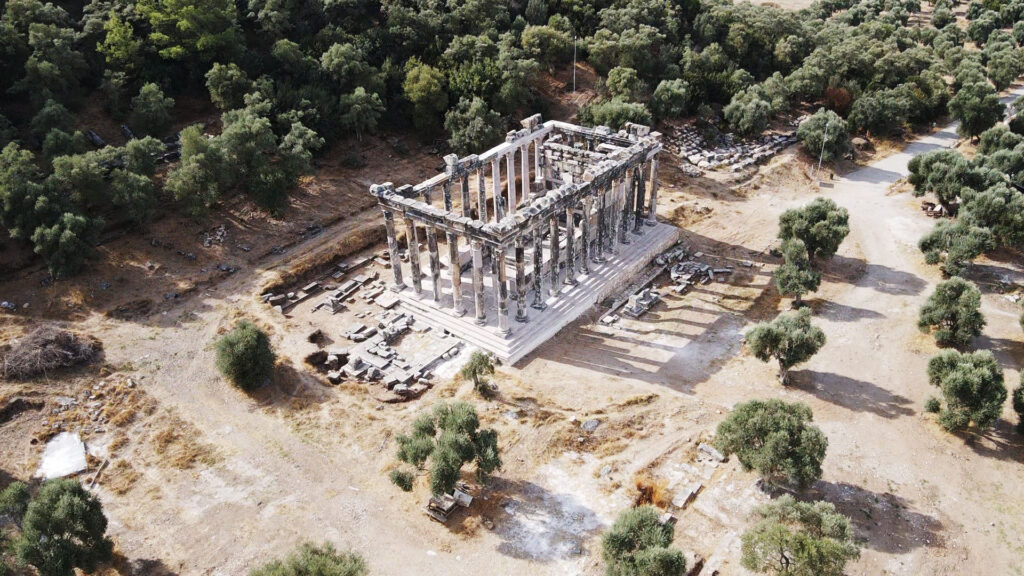
A 1,900-year-old Roman temple in southwestern Türkiye has regained much of its ancient appearance following an extensive restoration project that returned hundreds of architectural stones to their original positions. The Temple of Zeus Lepsynos, one of the best-preserved ancient sanctuaries in Anatolia, stands in the ruins of Euromos, near Milas in Muğla Province.
The restoration, directed by Prof. Dr. Abuzer Kızıl, involved examining approximately 900 architectural blocks, with around 70 percent reportedly returned to their original locations. The project has renewed the appearance of a monument whose surviving columns have stood for nearly two millennia.
Restoring a Monument from the Roman Empire
Believed to have been constructed during the reign of Emperor Hadrian (AD 117–138), the temple is an impressive example of Roman-period architecture in ancient Caria.
Its Corinthian design featured six columns across the front and eleven along each side. Although many ancient temples survive only as scattered foundations, the Temple of Zeus Lepsynos retained a substantial portion of its original colonnade.
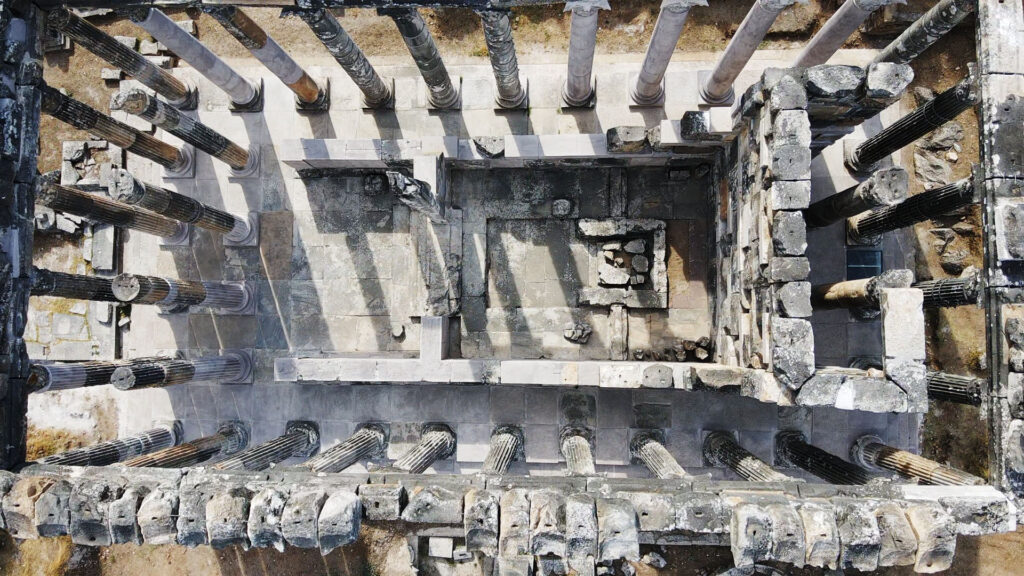
Restoration work began with architectural documentation in 2015. Specialists measured, numbered, and catalogued surviving stones before determining where individual elements belonged.
The project also involved strengthening foundations and stabilizing columns. Damaged architectural elements that could not be reused were replaced with carefully prepared marble from regional quarries.
The objective was not to construct a new temple, but to preserve and reassemble as much of the ancient monument as possible.
Ancient Columns Tell a Story of Wealth and Devotion
Beyond its imposing architecture, the temple preserves evidence of how religious buildings were financed in the Roman world.
Several columns carry Greek inscriptions identifying individuals who contributed to their construction. Rather than being funded entirely by a single ruler, parts of the sanctuary were supported by local benefactors who commemorated their donations in stone.
The temple also contains an unusual religious symbol: a double-headed axe, known as a labrys, flanked by representations of human ears.
Researchers have examined whether this imagery reflects the belief that Zeus Lepsynos listened to the prayers and appeals of worshippers. The interpretation remains a subject of scholarly discussion, but the relief offers an intriguing connection to religious traditions that predate the surviving Roman temple.
Archaeological investigations have also identified evidence of earlier sacred buildings at Euromos, indicating that the location held religious significance long before Hadrian’s reign.
A Remarkable Survivor of Ancient Caria
Euromos stood in the heart of Caria, a region of southwestern Anatolia where indigenous traditions interacted with Greek, Persian, and, eventually, Roman influences. Its position on the route connecting coastal settlements with the interior made it an important regional center, second only to nearby Mylasa in the surrounding area.
During the fourth century BC, Caria was ruled by the Hecatomnid dynasty under the Persian Empire. Its best-known ruler, Mausolus, transformed the region through ambitious building projects and political reforms. His monumental tomb at Halicarnassus, the Mausoleum, became one of the Seven Wonders of the Ancient World.
Euromos was already an established settlement by this period. Known in earlier records as Hyromos or Kyromos, the city later adopted its Greek name, reflecting the cultural changes taking place across Caria.
Its religious history extended even further into the past. Archaeological evidence indicates that the sanctuary of Zeus was established centuries before the surviving Roman temple, while inscriptions and coins demonstrate the enduring importance of the god’s local cult.
The city also possessed a theater, agora, fortifications, and other public buildings, although none has survived as impressively as the Temple of Zeus Lepsynos.
Today, the restored sanctuary stands as a reminder that Roman architecture in Anatolia was often built upon much older religious traditions. Its surviving columns, inscriptions, and sacred symbols preserve the history of a community whose identity developed across centuries of political and cultural change.
