
16 June 2026 The Future is the Product of the Past

“Euromos”, The Luckiest Ancient City of Anatolia

The city in the region called Caria was known from the 5th century BC as Cyramos (Hyramos). During the reign of King Mausolus of Halicarnassus (4th century BC), the city was subordinated to Milas and lost its independence. At the same time, its name was changed to Euromos (meaning “Strong”), which resulted from the Caria Hellenization program implemented by Mausolus.

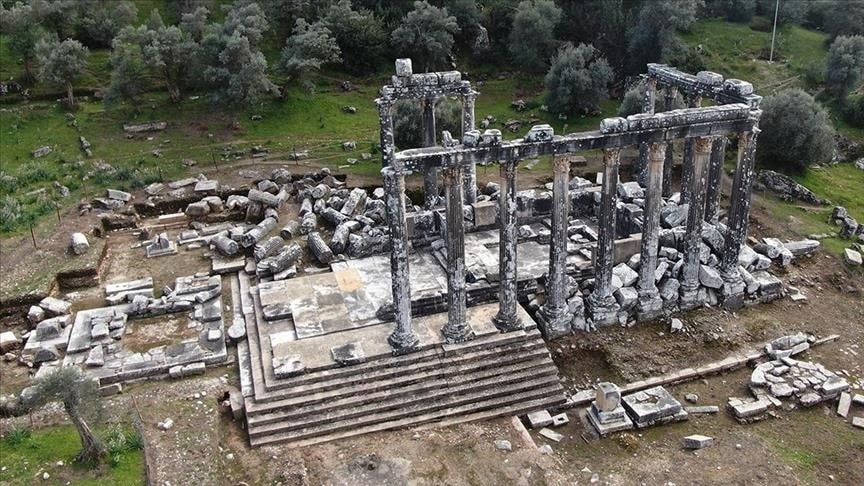
A Turkish excavation team is doing careful work to unearth a temple of Zeus in the ancient city of Euromos, a short distance from the city of Bodrum on the Turkish Riviera.

Speaking to Anadolu Agency, Abuzer Kizil, an archaeologist at Mugla Sitki Kocman University in southwestern Turkey near the Aegean, said that they brought artifacts to the surface in excavations they started in 2011, and aim to bring more historical remains to light.

Saying that cleaning, drilling, mapping, and excavation has been carried out in the ancient city’s temple, agora, theater, bath, and city walls in recent years, Kizil said Euromos’ location makes it “among the luckiest ancient cities of Anatolia.”

Kizil said that Euromos is one of the important cities of Caria, adding that they are planning important projects for the temple.


📣 Our WhatsApp channel is now LIVE! Stay up-to-date with the latest news and updates, just click here to follow us on WhatsApp and never miss a thing!!


He said the local temple to the ancient Greek god Zeus is one of the best-preserved temples in all of Turkish Anatolia.
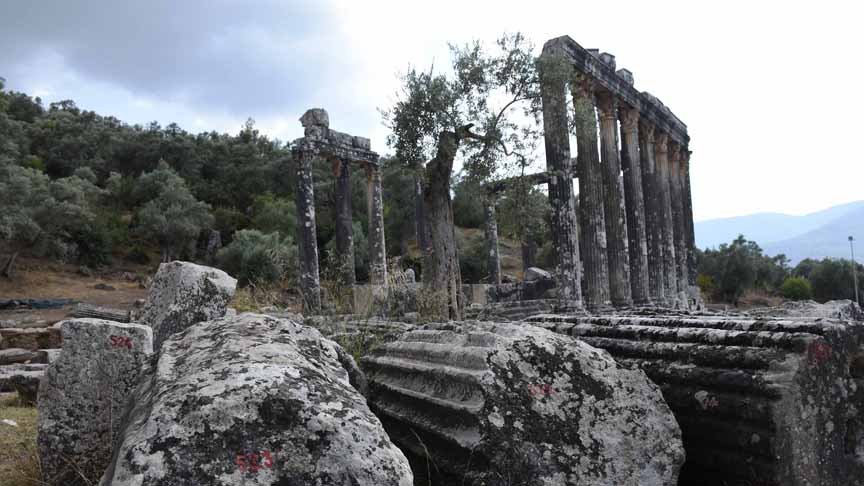
Euromos ancient city
Restoration work continues at Euromos. Photo: AA

Kizil said that initially, they did partial excavation and cleaning work in the temple and documented the same area, adding that they prepared a project for serious restoration.

After funding comes through, the work will begin, he explained.

He said to address one of their biggest problems, a slope at the north facade of the temple will be re-done and strengthened in case of an earthquake.

“The Temple of Zeus will take its rightful place,” he said. “It will be one of the best, most interesting, and most-visited temples in Anatolia.”

He underlined that they want to preserve the materials they unearthed during years of work, underlining that the site has great importance for promoting the region and tourism in Turkey.

The Temple of Zeus Lepsynos was built in the 2nd century BC, near Selimiye in Milas District.

In recent years, special work has been initiated to include the ancient city of Euromos, which includes Zeus Lepsynos, one of the best-preserved temples of the ancient period, built in the 2nd century BC, to the UNESCO World Heritage Tentative List.

Related Articles

Ancient Latin texts written on papyrus reveal new information about the Roman world

11 January 2023

11 January 2023

Researchers funded by the European Union have deciphered ancient Latin texts written on papyrus. This work could reveal a lot...

Ushabti figurines on display at Izmir Archeology Museum

18 September 2021

18 September 2021

The 2,700-year-old “Ushabti” statuettes, discovered in archaeological digs in western Turkey and used in Egyptian burial ceremonies, are being shown...

The tomb of the “Bird Oracle Markos” was found in the ancient city of Pergamon

31 August 2022

31 August 2022

During the excavations carried out in the Ancient City of Bergama, which is on the UNESCO World Heritage List, the...

A female executive’s seal from 3000 years ago was discovered in Turkey

29 October 2021

29 October 2021

During the excavations carried out in southeastern Turkey’s Gaziantep’s Karkamış (Carchemish) Ancient City, seals and prints determined to belong to...

5,000-Year-Old “Küllüoba Bread” Discovered in Türkiye Reveals Ancient Baking and Fertility Rituals

30 May 2025

30 May 2025

5,000-year-old bread found in Küllüoba Höyük, Turkey reveals ancient baking methods and fertility rituals. Unique archaeological discovery with rich nutritional...

An exciting discovery in Hattusa, the capital of the Hittites

11 September 2022

11 September 2022

It is aimed to reach new information about the traditions of the Hittite civilization with 249 new hieroglyphs discovered in...

Ancient Roman Fast Food: Songbirds Were a Popular Snack in 1st-Century Mallorca

11 June 2025

11 June 2025

Roman fast food, ancient Roman cuisine, song thrush consumption, Roman street food, Mallorca archaeology, Pollentia findings, Roman bird bones, ancient...

7,600-year-old child skeleton and a silver ring found in Türkiye’s Domuztepe Mound

12 September 2024

12 September 2024

A child skeleton and a silver ring presumed to be used for babies dating back to 7,600 years ago were...

New Evidence for Roman’s Emerald Production in Egypt’s the Eastern Desert

16 April 2021

16 April 2021

Archaeological excavations in Egypt’s eastern desert provide new data. Excavations in the Egyptian Eastern Desert delivers proof of emerald mines...

Ancient DNA From Turkish Cave Reveals 5,000-Year-Old Charcoal Therapy and Hidden Antibiotic Resistance

13 September 2025

13 September 2025

Ancient DNA recovered from İnönü Cave in Türkiye’s Zonguldak province has uncovered evidence that prehistoric people used charcoal-based remedies to...

2-Meter Athena Statue Discovered in Laodicea with Extraordinary Artistic Detail

23 April 2026

23 April 2026

A remarkable archaeological discovery has emerged from the ancient city of Laodicea in southwestern Türkiye, where excavations have revealed a...

Extraordinary Discovery at Göbeklitepe: 12,000-Year-Old Human Statue Found Inside Wall

19 September 2025

19 September 2025

Türkiye’s Minister of Culture and Tourism Mehmet Nuri Ersoy has announced a groundbreaking archaeological discovery at Göbeklitepe, the world-renowned UNESCO...

4,000 Years of Innovation: Indigo-Dyed and Nålbinding Textile Discovered at Beycesultan Höyük

23 February 2026

23 February 2026

Excavations carried out between 2016 and 2018 at Beycesultan Höyük (Beycesultan Mound) in western Anatolia have yielded an extraordinary discovery:...

One of its kind, 1,500-year-old Roman ‘Lorica Squamata’ legion armor restored

19 June 2024

19 June 2024

The 1,500-year-old Roman ‘Lorica Squamata’ legion armor, the only known example in the world, found in the ancient city of...

2,400-Year-Old Submerged Structures Captured Beneath Turkey’s Dicle Dam Waters

17 March 2026

17 March 2026

In the quiet district of Eğil, history has resurfaced—quite literally—from beneath the waters. Recent underwater imaging has revealed remarkably preserved...