
8 November 2025 The Future is the Product of the Past

Archaeologists Discover Northernmost Hellenistic Elite Residence Featuring Ionic Architecture and Graffito in North Macedonia

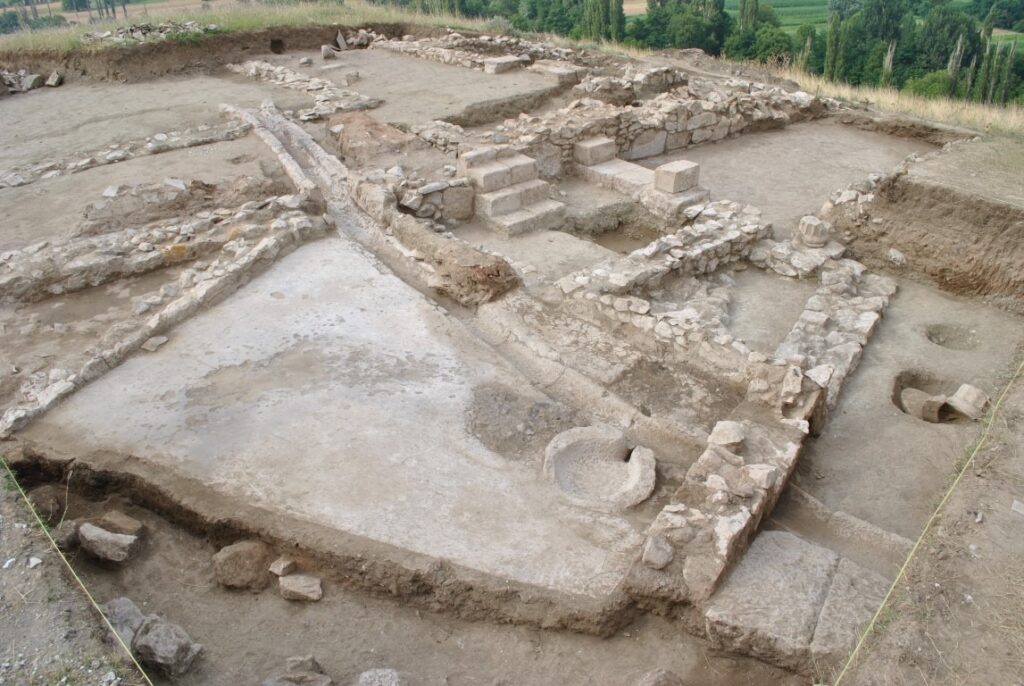
In a groundbreaking archaeological campaign, the NL Museum of Kumanovo has unearthed a remarkable Hellenistic-era residence near the village of Mlado Nagoričane. Directed by Dejan Gjorgjievski, the excavation at the Gradishte site has revealed what experts are calling one of the most significant discoveries in the central Balkans, shedding new light on the region’s cultural ties to the Hellenistic world during the late 4th century BCE.

The structure — believed to have been the home of a local nobleman — rests atop the summit of the Gradishte hill, a location interpreted as the ancient acropolis. Its architectural layout closely mirrors that of elite Hellenistic houses commonly found in the Mediterranean, but rarely so far north. The building includes a central courtyard surrounded by a portico, interior walls decorated with painted plaster in masonry-style techniques, and a private bath equipped with a plastered floor and a water-supply system — features that suggest not only wealth but also deep cultural integration with the Greek world.
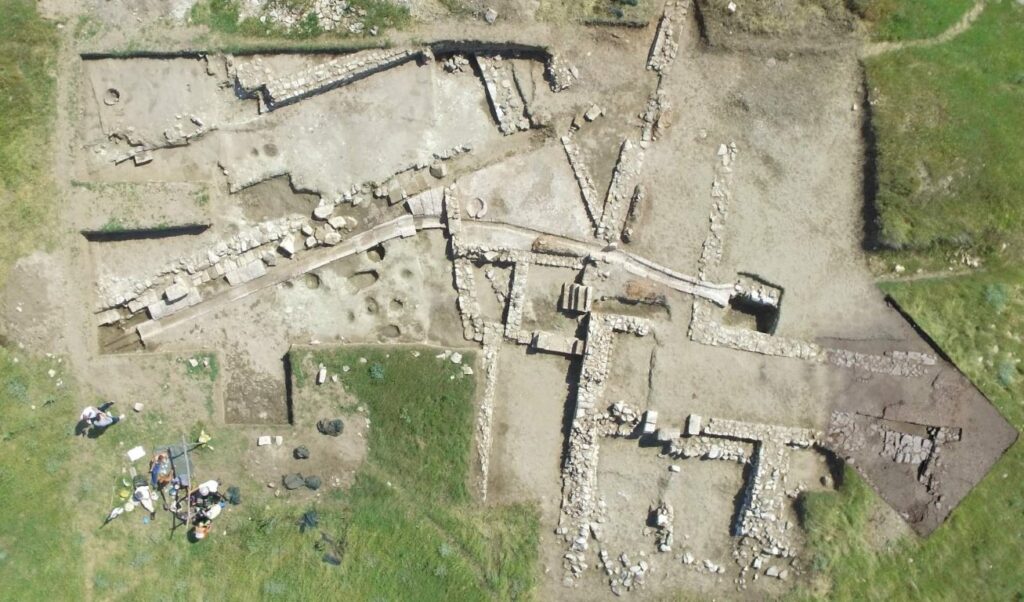
A detailed aerial view of the Gradishte site, providing valuable insights into its spatial organization and archaeological features. Credit: Courtesy of Dejan Gjorgjievski

A Hellenistic Footprint in the Northern Balkans

One of the most striking finds from this season’s excavation is the presence of fully preserved Ionic capitals and bases, coated with plaster. In his statement to Arkeonews, project director Dejan Gjorgjievski explained, “These are currently the northernmost examples of such classical architectural elements known in the Hellenistic world.” Their preservation and stylistic execution point to skilled craftsmanship and a deliberate alignment with Mediterranean elite aesthetics.

The discovery aligns with broader regional patterns discussed in the academic study A Tale of Two ‘Hellenised’ Sites, co-authored by Gjorgjievski and Ivan Vranić. That study compares Gradishte with another site in the region, emphasizing how Hellenistic cultural practices — especially in architecture, luxury consumption, and symbolic spatial organization — penetrated deep into the interior Balkans during the late Classical and early Hellenistic periods.
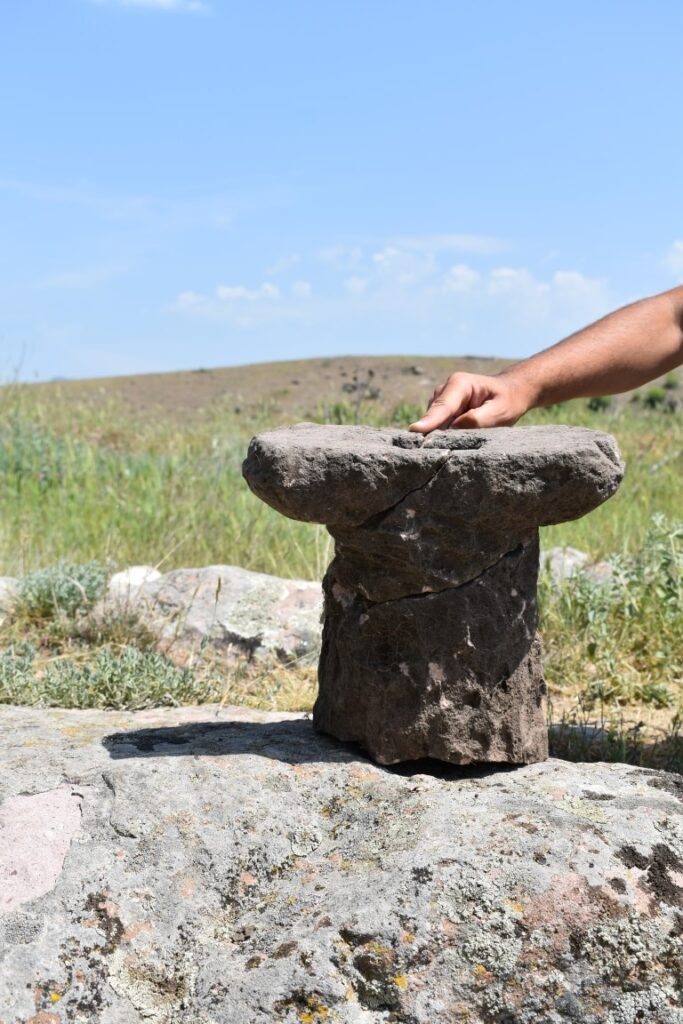

One of the most striking finds from this season’s excavation: fully preserved Ionic capitals and bases, coated with plaster. Credit: Courtesy of Dejan Gjorgjievski

Artifacts of Trade, Culture, and Daily Life

In addition to architectural remains, the excavation team recovered a wide range of imported and local artifacts. These include West Slope pottery, Thasian amphorae, and unguentaria, clearly dated to the 4th–3rd centuries BCE.


📣 Our WhatsApp channel is now LIVE! Stay up-to-date with the latest news and updates, just click here to follow us on WhatsApp and never miss a thing!!


A particularly notable object is a locally made ceramic sherd inscribed with a Greek vulgar graffito (“Ψωλή κύ…”) — an example of what scholars term aporretic inscriptions. This inscription is now the northernmost known example of its kind, offering a rare glimpse into everyday speech and informal literacy in Hellenistic frontier zones.
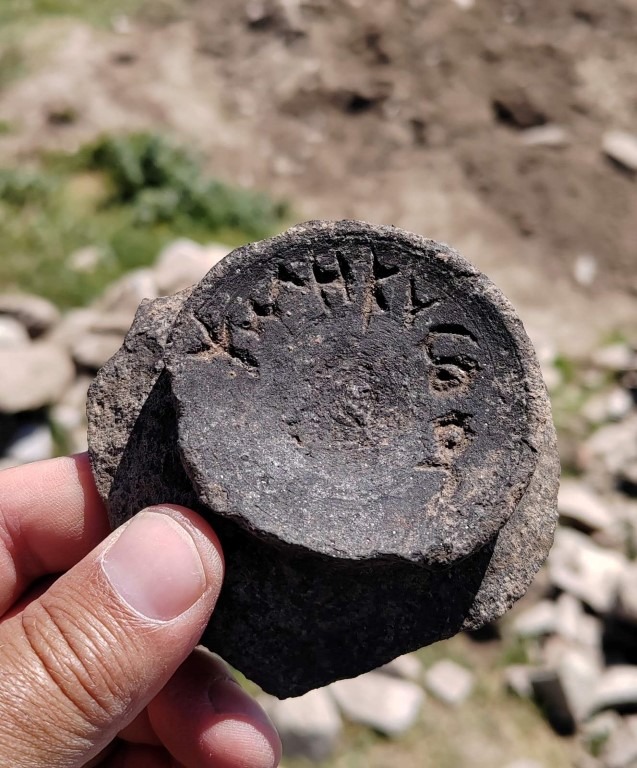
A particularly notable object: a locally made ceramic sherd inscribed with a Greek vulgar graffito ("Ψωλή κύ..."), exemplifying what scholars term aporretic inscriptions. Credit: Courtesy of Dejan Gjorgjievski
A particularly notable object: a locally made ceramic sherd inscribed with a Greek vulgar graffito (“Ψωλή κύ…”), exemplifying what scholars term aporretic inscriptions. Credit: Courtesy of Dejan Gjorgjievski

Unresolved Layers of History

Beneath the grand residence, archaeologists encountered traces of massive stone walls, possibly from an earlier elite structure. However, due to stratigraphic ambiguity, these remains remain undated. Future excavation seasons aim to resolve this chronological uncertainty and determine whether Gradishte had multiple phases of elite occupation.

Elsewhere on the site, prior seasons revealed evidence of an internal fortification wall and a stylobate-like platform, as well as a rock-cut sanctuary — a ritual space reminiscent of the sanctuary at Rachi in Isthmia, Greece. These elements reinforce the interpretation of Gradishte as a well-fortified and ritually significant settlement embedded in Hellenistic cultural frameworks.
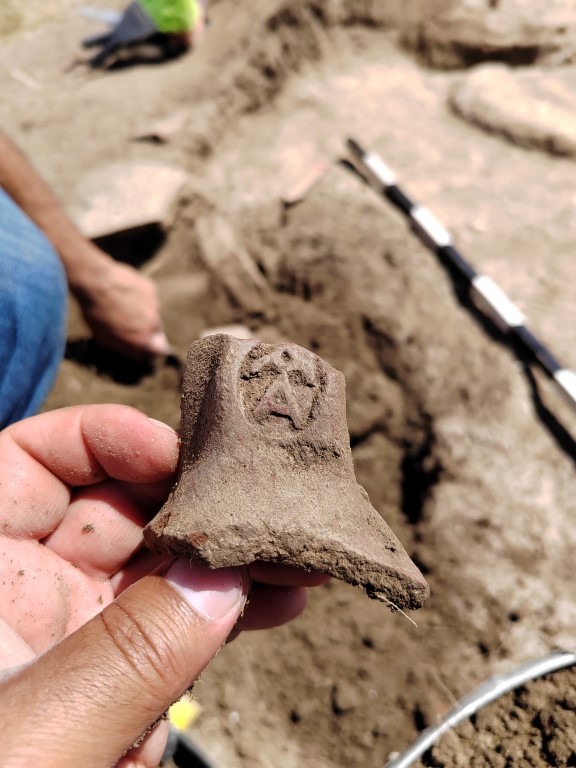
In addition to architectural remains, the excavation team recovered a wide range of imported and local artifacts. Credit: Courtesy of Dejan Gjorgjievski

NL Museum of Kumanovo at the Forefront

The excavation was conducted under the leadership of Dejan Gjorgjievski and organized by the NL Museum of Kumanovo, a regional institution increasingly recognized for its contributions to Balkan archaeology. This latest discovery not only adds valuable data to academic discussions but also enhances cultural tourism prospects and heritage awareness in North Macedonia.

In Gjorgjievski’s words, “Our findings at Gradishte contribute to a growing understanding that Hellenistic influence in the Balkans was not limited to coastal colonies or trade posts — it extended into local power structures and domestic life.”
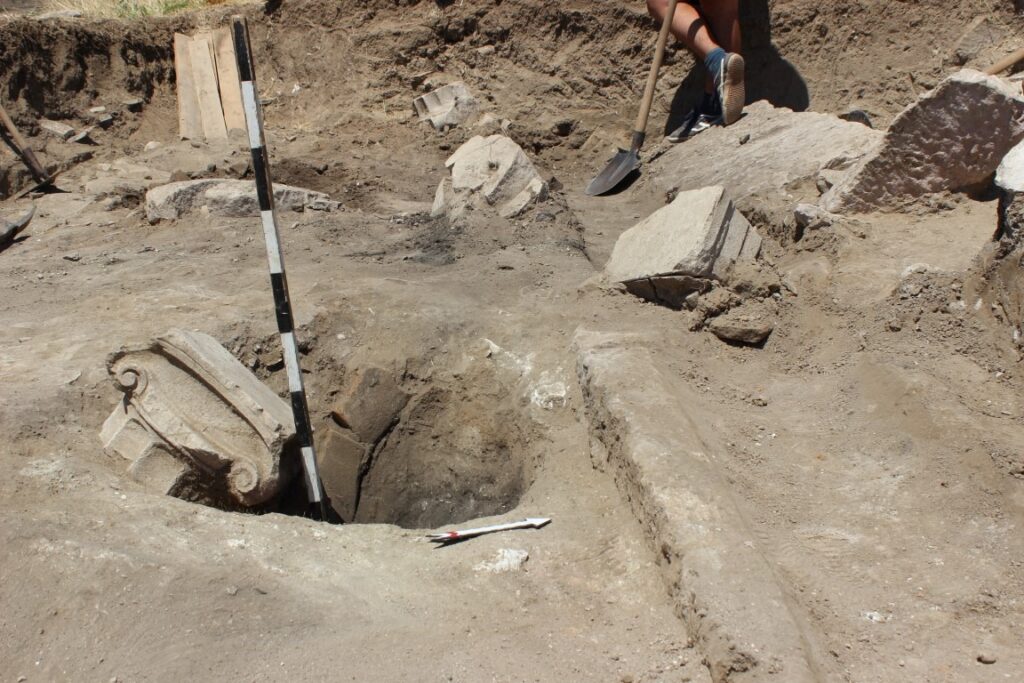
 Fully preserved Ionic capitals. Credit: Courtesy of Dejan Gjorgjievski
Fully preserved Ionic capitals. Credit: Courtesy of Dejan Gjorgjievski

What’s Next for Gradishte?

Plans for future excavation seasons include extending the dig to lower layers, performing material analyses, and initiating conservation efforts. There is also interest in using digital tools to reconstruct the elite residence virtually, offering both scholars and the public a more vivid understanding of life in this high-status Hellenistic home.

As the Gradishte site continues to reveal its secrets, the work of the NL Museum of Kumanovo and researchers like Dejan Gjorgjievski ensures that North Macedonia plays a pivotal role in redefining the cultural boundaries of the ancient Hellenistic world.
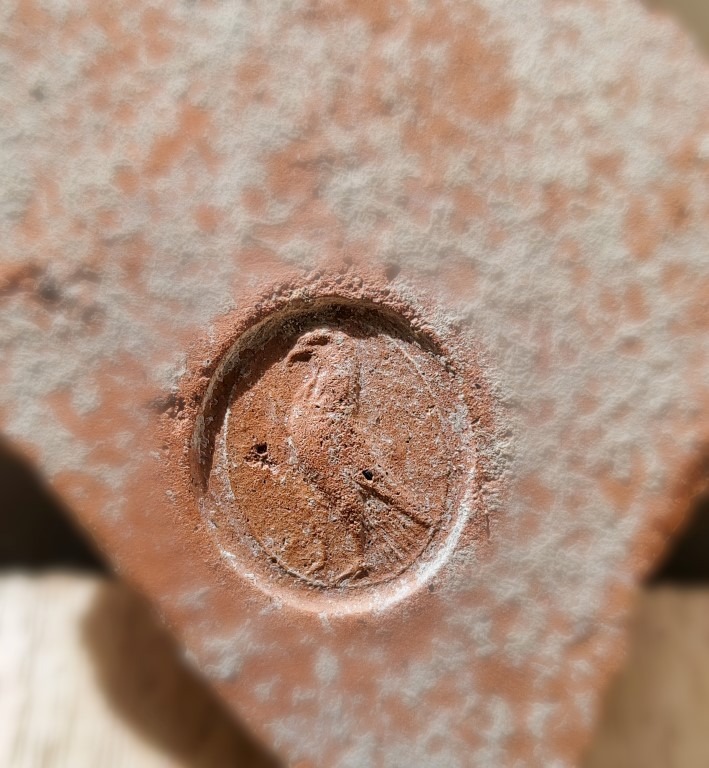
The excavation team recovered a wide range of imported and local artifacts. Credit: Courtesy of Dejan Gjorgjievski

Vranić, I., & Gjorgjievski, D. (2025). The story of two ‘Hellenized’ sites in southeastern Europe: Recent studies of Kale-Krševica and Gradište-Mlado Nagoričane (5th–3rd centuries BC). In J. Tzvetkova, V. Sarakinski, & F. Milivojević (Eds.), The unclassical Balkans: Ancient societies and cultures of the Balkan Peninsula beside the Graeco-Roman world (Special edition). Antiquité Vivante.

NL Museum of Kumanovo

Cover Image Credit: Courtesy of Dejan Gjorgjievski

Related Articles

How Evolutionary Biology Is Reshaping Our Understanding of the New Testament: The Case of the Missing ‘Son of God

5 August 2025

5 August 2025

In the remote wilderness of Egypt’s Sinai Peninsula, a forgotten room revealed one of the most significant biblical manuscript discoveries...

Colossae Ancient City Excavation Works Begin

8 September 2021

8 September 2021

Excavations of the ancient city of Colossae, located in the Honaz district of Denizli province in western Turkey, are starting...

Purdue Professor Documents 53 Biblical Figures Confirmed by Archaeology

5 September 2025

5 September 2025

For centuries, debates have raged over whether the Bible is history, myth, or something in between. Now, significant research by...

Saudi Arabia’s “Gates of Hell” and Mysterious Structures

30 March 2024

30 March 2024

The region of Saudi Arabia, where the mysterious neolithic structures called the “Gates of Hell” are located, has around 400...

Little Known Powerful Kingdom of History’s “Mitanni Kingdom”

3 February 2021

3 February 2021

Hurrians; They became a state organization with a warrior and ruling class of Indo-Aryan origin who came from North-West Mesopotamia...

Remains of first Islamic madrassa found in Turkey’s Harran

1 December 2021

1 December 2021

The remnants of a 12th-century madrassa (Islamic institution of higher instruction) have been discovered in the archaeological site of Harran,...

A rare 3,300-year-old wooden yoke found in northern Italy

30 October 2023

30 October 2023

After eight years of complex excavation, recovery, and restoration, a rare 3,300-year-old wooden yoke discovered in a Late Bronze Age...

New discoveries have been made at a 9,000-year-old Amida mound in Turkey

1 January 2022

1 January 2022

The most recent archeological investigations at the 9,000-year-old Amida Mound in southeastern Turkey’s Diyarbakir province have uncovered fresh finds that...

Oldest known alphabet unearthed in ancient Syrian city -500 years older than thought

22 November 2024

22 November 2024

Johns Hopkins University researchers uncovered evidence of the oldest alphabetic writing in human history. The writing was etched onto finger-length...

Archaeologists discovered the earliest Iron Age house in Athens and Attica

26 May 2023

26 May 2023

A research team from the University of Göttingen discovered the earliest  Iron Age house in Athens and Attica. Archaeologists from...

Excavations at Coleshill may rewrite English Civil War history

5 February 2023

5 February 2023

Archaeologists excavating the site of Coleshill Manor in Warwickshire have revealed evidence of what could be one of the first...

The Ancient City of Miletos’s “Sacred Cave” Opened to Visitors

2 October 2021

2 October 2021

In the ancient city of Miletos, which had an important place in the advancement of philosophy, art, and science in...

Archaeologists unearthed fresh evidence that bedbugs came to Britain with the Romans

3 February 2024

3 February 2024

Archaeologists working the Roman garrison site of Vindolanda in Northumberland, south of Hadrian’s Wall, have discovered new proof that the...

Ukrainian Soldiers Uncover 6th–5th Century BC Burial Site During Fortification Works

1 April 2025

1 April 2025

In a remarkable archaeological find, soldiers from the 123rd Territorial Defence Brigade have uncovered an ancient burial site dating back...

Turkey’s second ancient lighthouse found in the Bathonea

28 July 2023

28 July 2023

The excavations in the ancient Greek city of Bathonea, located in the Küçükçekmece Lake basin in the Avcılar district of...