
19 January 2026 The Future is the Product of the Past

Rare Bronze Age Metalworking Hoard Discovered in Wiltshire, Including an Anvil

A remarkable discovery has been made in Urchfont, a village located in Wiltshire, England, where a Bronze Age hoard of copper alloy tools has been unearthed, including an exceptionally rare anvil. This collection, dating back to approximately 1650-900 B.C., is believed to have belonged to a skilled metalworker.

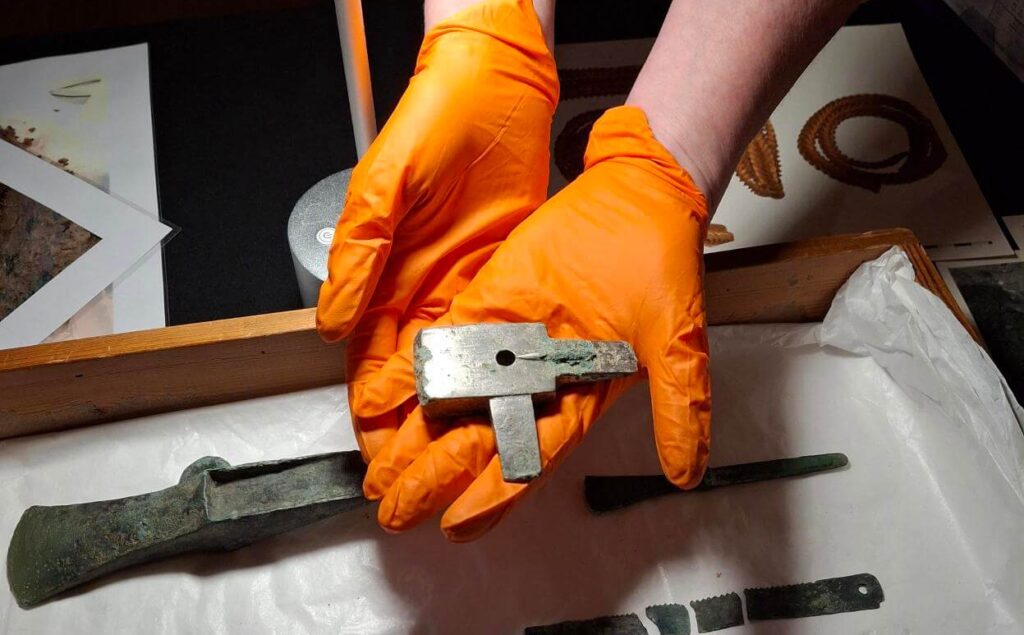
The significance of this find lies not only in the rarity of the artifacts but also in what they reveal about ancient metalworking practices. The presence of the anvil, a crucial tool for shaping and crafting metal, suggests that the owner was engaged in specialized metalwork, possibly as a goldsmith. This contrasts with the more common role of blacksmiths, indicating a focus on fine metalwork and the creation of intricate designs.

The find began last February when a metal detectorist stumbled upon a tanged chisel. Recognizing the significance of the discovery, he promptly ceased digging and reported the find to the Wiltshire Finds Liaison. Subsequent excavations revealed several additional artifacts, including fragments of copper alloy sheeting and a copper alloy rod.

Archaeologists transported the remaining hoard in a single soil block to the British Museum for micro-excavation under controlled laboratory conditions to ensure careful analysis.
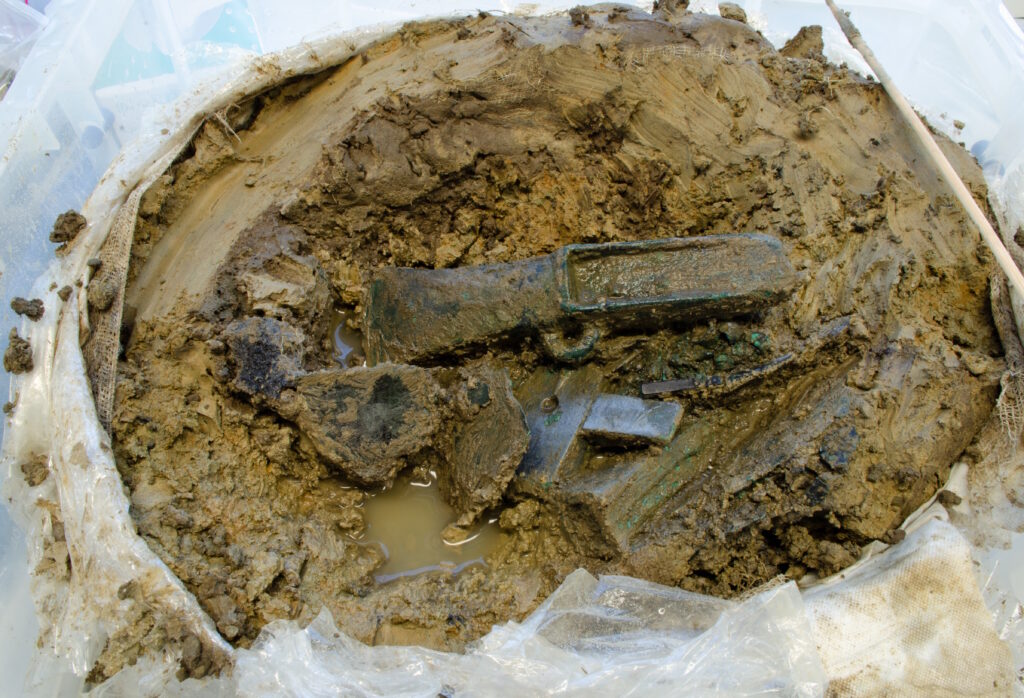

Archaeologists transported the remaining hoard in a single soil block to the British Museum for micro-excavation under controlled laboratory conditions to ensure careful analysis.

The excavation of the soil block yielded an array of intriguing items: more fragments of copper alloy sheeting, a hacksaw blade, a looped palstave axe, and remnants of at least two decorated copper alloy vessels. Additionally, fragments of sheet metal and a small copper alloy bar, likely part of a chisel handle or another small tool, were discovered. Notably, organic and charred materials were also preserved within the dense soil, providing further insights into the context of the hoard.


📣 Our WhatsApp channel is now LIVE! Stay up-to-date with the latest news and updates, just click here to follow us on WhatsApp and never miss a thing!!


Among the most telling artifacts are two pieces of a pouring basin with sprues, indicating that the hoard’s owner was likely a metal craftsman. The presence of the small, silver-colored anvil suggests that this individual specialized in fine metalwork, possibly as a goldsmith rather than a blacksmith.

The Wiltshire Museum has expressed a great interest in acquiring this significant hoard, which not only sheds light on the craftsmanship of the Bronze Age but also enriches our understanding of the region’s historical metalworking practices. This discovery is a testament to the enduring legacy of ancient artisans and their contributions to the development of metallurgy.

Cover Image Credit: Wiltshire Museum

Related Articles

Found in Spain a poem by Virgil engraved in a Roman amphora

22 June 2023

22 June 2023

Archaeologists have deciphered a verse by Virgil, the greatest poet of Rome’s Golden Age, carved into the clay of a...

A new study provides the earliest evidence of rice harvesting, dating to as early as 10,000 years ago

8 December 2022

8 December 2022

A new study of stone tools from southern China reveals the earliest evidence of rice harvesting, dating back 10,000 years....

Archaeologists find the earliest evidence Maya sacred calendar in the Guatemalan pyramid

14 April 2022

14 April 2022

Archaeologists identified two plaster fragments depicting a date that the Maya civilization called ‘7 deer’ and was part of the...

Archaeologists discovered the earliest Iron Age house in Athens and Attica

26 May 2023

26 May 2023

A research team from the University of Göttingen discovered the earliest  Iron Age house in Athens and Attica. Archaeologists from...

Artifacts found in Japan could be prototypes of ninja weapons

14 January 2022

14 January 2022

Artifacts discovered in the ruins of structures associated with warlord Toyotomi Hideyoshi’s 1590 Siege of Odawara may be prototypes of...

The first settlement of the Cimmerians in Anatolia may be Büklükale

7 June 2022

7 June 2022

Archaeologists estimated that the first settlement in Anatolia of the Cimmerians, who left Southern Ukraine before Christ (about 8th century...

A rare 3,300-year-old wooden yoke found in northern Italy

30 October 2023

30 October 2023

After eight years of complex excavation, recovery, and restoration, a rare 3,300-year-old wooden yoke discovered in a Late Bronze Age...

The ancient city of Karkamış “House of the Seal” brings a different perspective to the Hittite-Assyrian relations with its important finds

6 May 2022

6 May 2022

Historical artifacts discovered during excavations by Turkish and Italian teams in the ancient city of Karkamış (Carchemish) in southern Gaziantep...

Roman-era Pottery Workshop discovered in Alexandria

29 April 2022

29 April 2022

The Egyptian archaeological mission discovered a Roman-era pottery workshop at the site of Tibet Mutawah, west of Alexandria. The researchers...

Archaeologists Unearth Cisterns at Izmir’s Ancient “City of Mother Goddess”

2 June 2021

2 June 2021

In the ancient city of Metropolis, in western Turkey, in the province of Izmir, something that played an important role...

In the “Siberian Valley of the Kings”, archaeologists have discovered a burial mound containing ornate treasures dating back 2,500 years

20 January 2022

20 January 2022

A Polish-Russian team of archaeologists, excavating in the “Siberian Valley of the Kings” have announced the discovery of a burial...

2600-year-old Med period artifacts found in Oluz Höyük, in Turkey

17 October 2022

17 October 2022

During the Oluz Höyük excavations in Amasya, artifacts dating back to the Med Kingdom period were found, dating back to...

Ancient Bone Flute Discovered in Iran Offers Rare Glimpse into 8,000-Year-Old Musical Traditions

29 June 2025

29 June 2025

The National Museum of Iran has launched an exciting initiative in collaboration with the Public Relations Department of the Ministry...

An architectural gem from the medieval monastery of Posa, Germany

26 July 2023

26 July 2023

Archaeological excavations have been taking place on the Posaer Berg (Posa Hill) near Zeitz (Burgenland) every year since 2017. They...

15 new sculptures discovered in Turkey’s sculpture paradise Yesemek

8 December 2021

8 December 2021

Archaeologists discovered 15 new sculptures during recent digs around the Yesemek Open Air Museum and Sculpture Workshop in the Islahiye...