
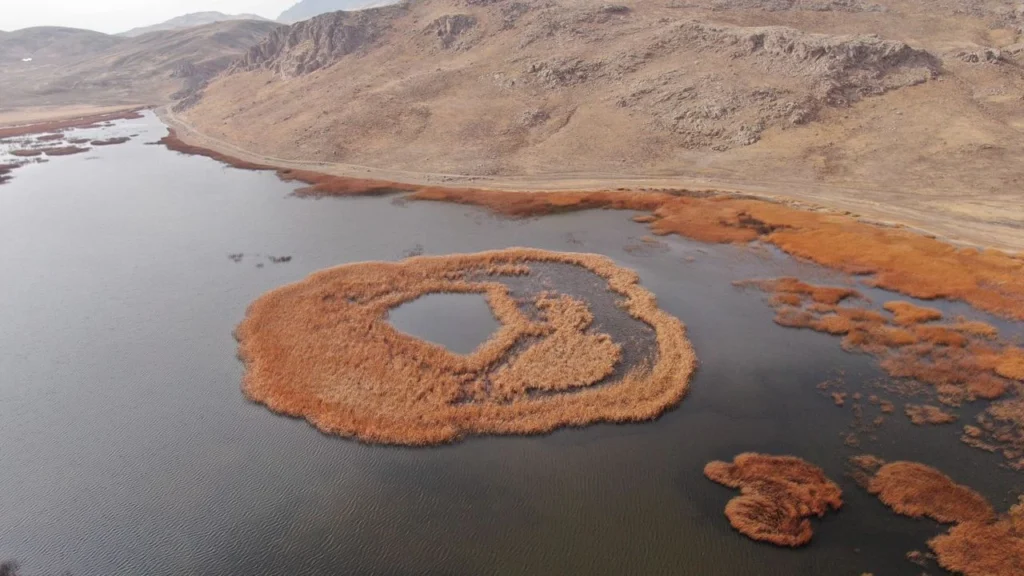
For decades, the story of ancient water engineering has been dominated by Rome—its aqueducts, its urban systems, its monumental scale. But long before Roman engineers reshaped the cities of the Mediterranean, another civilization was already transforming entire landscapes under far harsher conditions.
In the rugged highlands of eastern Anatolia, the Urartians built vast networks of dams, reservoirs, and irrigation canals nearly 2,700 years ago—systems so resilient that some continued to function for millennia. Emerging archaeological evidence now suggests that, in certain contexts, these early hydraulic works may have rivaled—or even surpassed—the effectiveness of early Roman water management.
This was not simply about moving water. It was about survival, control, and the deliberate reshaping of an unforgiving environment into a sustainable agricultural system.
A Kingdom Built on Water Control
The Kingdom of Urartu (9th–6th centuries BCE), centered around Lake Van in modern Türkiye, is often remembered for its fortresses and metalwork. Yet its most remarkable achievement may lie in its hydraulic engineering systems, which reshaped entire landscapes.
Archaeological research, including the comprehensive study by Oktay Belli, reveals that Urartian dams and irrigation systems were not isolated constructions but part of a coordinated state-driven agricultural strategy.
Recent research suggests that Urartian hydraulic systems were not only engineering achievements but also adaptive responses to environmental stress and tools of political control—an approach that differs significantly from the urban-focused water systems later developed by the Romans.
The region’s environmental constraints made this necessary. Annual rainfall was limited, evaporation rates were high, and fertile land was confined to narrow valleys. Without irrigation, agriculture would have been nearly impossible.
The Urartians responded with engineering on a scale rarely seen in the ancient world.
Turning Arid Landscapes into Agricultural Powerhouses
Before Urartian intervention, much of eastern Anatolia consisted of dry, underutilized land. Royal inscriptions repeatedly emphasize this transformation:
“The land was empty… barren… no canals had been opened.”
These statements were not rhetorical. They reflect a deliberate state policy: convert marginal land into productive farmland through water management.
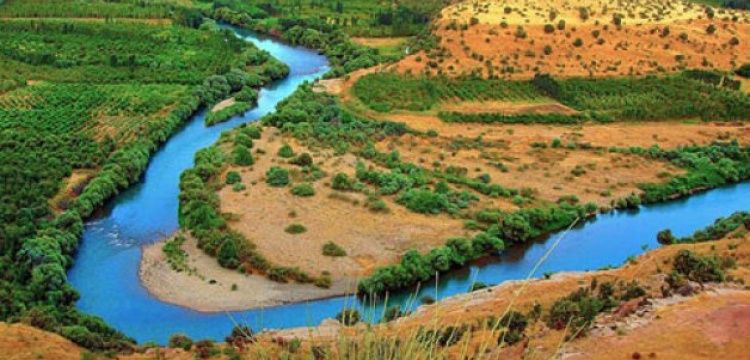
By constructing dams, artificial lakes, and long-distance canals, the Urartians created irrigated zones that supported vineyards, orchards, and grain production. Ancient sources describe landscapes filled with fruit trees, vineyards, and abundant harvests, sustained by controlled water distribution.
This agricultural surplus, in turn, fed urban centers, supported military campaigns, and strengthened the state’s economic base.
Engineering That Defied Time
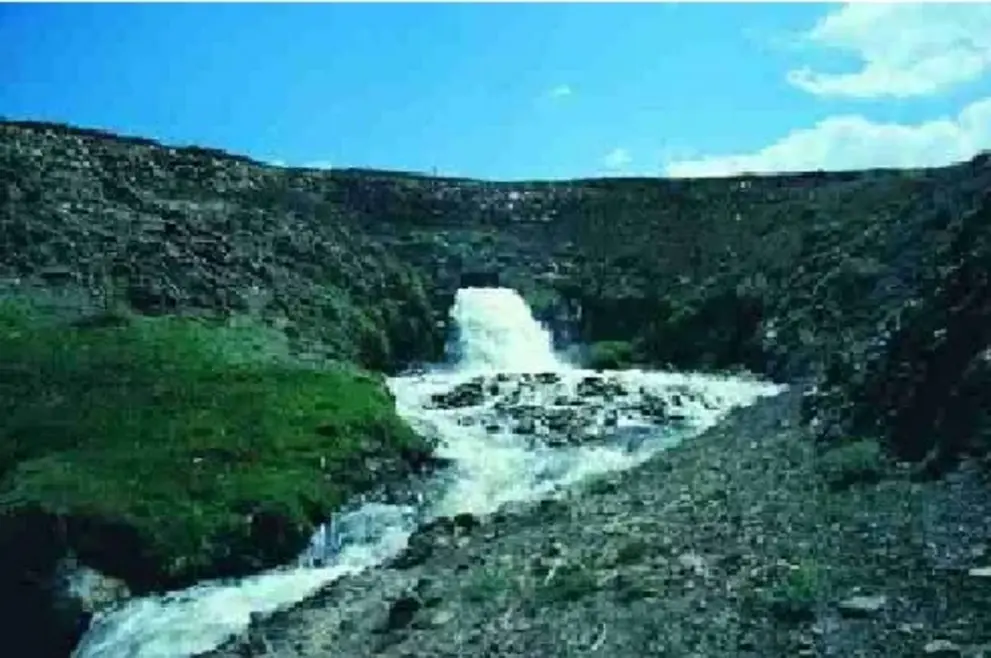
What sets Urartian dams apart is not just their scale—but their durability.
Some structures continued to function for 2,700–2,800 years, an almost unparalleled lifespan in hydraulic engineering.
Their resilience becomes even more striking when compared to later constructions. Roman and Byzantine water systems in the same region often collapsed under seismic stress, while many Urartian structures survived.
This suggests that Urartian engineers had an advanced understanding of:
Seismic stability
Hydraulic pressure management
Stone construction techniques
Massive stone blocks, layered fill systems, and carefully selected dam locations—often in narrow rock gorges—allowed these structures to withstand both earthquakes and seasonal flooding.
The Role of Metallurgy in Construction
One key to this engineering success was Urartu’s dominance in metallurgy.
The kingdom was one of the most advanced metal-producing societies of the early first millennium BCE. Iron tools—hammers, chisels, picks, and levers—enabled workers to quarry and shape vast quantities of stone efficiently.
Without these tools, the rapid construction of dams and canals across rugged terrain would have been impossible.
This technological edge allowed Urartu to execute projects that required:
Excavation of millions of cubic meters of earth
Transport and placement of heavy stone blocks
Construction within limited seasonal work windows
In eastern Anatolia, where winters are long and severe, construction seasons were often restricted to just a few months per year.
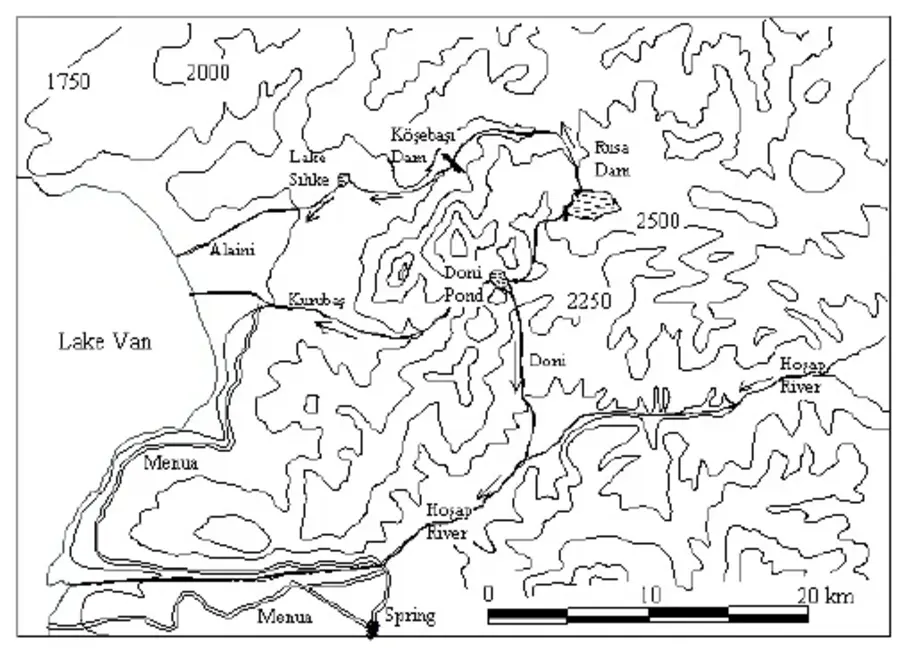
Topographical map of important Urartian irrigation system in Eastern Anatolia (from Belli 1997a). Credit: Kuşlu, Y., & Şahin, U. (2009), Journal of Applied Sciences Research
Monumental Examples: Dams That Shaped a Civilization
Archaeological surveys have identified numerous Urartian dams across the region. Among the most significant:
The Süphan Dam System
Located near Mount Süphan, this complex includes multiple dam phases and demonstrates early experimentation in hydraulic design. It irrigated the fertile Muradiye Plain, supporting agriculture on a large scale.
The Rusa (Keşiş Göl) Reservoir
Built under King Rusa II, this artificial lake supplied water to the capital region and surrounding farmland. Inscriptions explicitly state that tools and labor were provided by the state—evidence of centralized planning.
The Meydan Boğazı Dam
One of the largest known Urartian hydraulic structures, featuring multi-layered wall construction designed to withstand immense water pressure.
The Hırsız Deresi and Arç Dams
Constructed across flowing streams, these dams represent early examples of river damming techniques, similar in principle to modern systems.
These installations were not isolated—they formed an integrated network designed to capture, store, and redistribute water across entire valleys.
Water as Power—and Sacred Element
Water in Urartian culture was not only practical but symbolic.
Like other ancient Near Eastern societies, the Urartians likely viewed springs and water sources as sacred. While direct mythological texts are scarce, archaeological evidence suggests a spiritual dimension to water management, echoing earlier Anatolian traditions.
Royal inscriptions also contain curses against those who damage canals or dams, invoking divine punishment. This underscores how vital these systems were—not just economically, but ideologically.
A Centralized System of Control
Urartian irrigation systems reveal something deeper about the state itself.
These projects required:
Coordinated labor forces
Resource allocation (tools, materials, manpower)
Long-term planning and maintenance
In other words, they reflect a highly centralized political system capable of mobilizing large-scale public works.
Agricultural production was closely tied to state control. Harvests were collected as taxes and stored in fortified centers, where massive storage jars—sometimes holding up to 1,000 liters—have been discovered.
Water, therefore, was not just a resource—it was a mechanism of governance.
A Legacy Still Visible Today
Despite erosion, earthquakes, and modern construction, many Urartian dams and canals remain visible—and in some cases, functional.
Even more striking is their influence across time. Later civilizations, including medieval and Ottoman engineers, repaired and reused these systems, extending their lifespan well into the modern era.
In some regions, modern irrigation projects still follow the same routes first established by Urartian engineers.
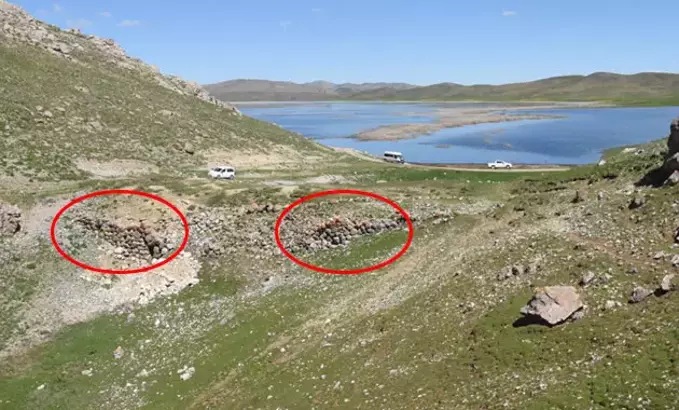
The Ancient System That Still Works Today
The Urartian water systems are more than archaeological curiosities. They offer insights into:
Early large-scale environmental engineering
Sustainable water management in arid regions
The relationship between infrastructure and state power
At a time when modern societies face increasing water scarcity, these ancient solutions feel unexpectedly relevant.
Nearly three millennia ago, the Urartians proved that with ingenuity, organization, and determination, even the harshest landscapes could be transformed.
Their dams still stand as silent testimony—stone by stone—to one of the ancient world’s most underestimated engineering achievements.
Belli, O. (1996). Doğu Anadolu Bölgesi’nde keşfedilen Urartu barajlarına toplu bir bakış. Belleten, 60(227), 631–682.
Hammer, E. (2022). The role and characteristics of irrigation in the Kingdom of Urartu. In S. Rost (Ed.), Irrigation in early states: New directions (pp. 267–303). Oriental Institute of the University of Chicago.
Cover Image Credit: Necmettin Dursun
