
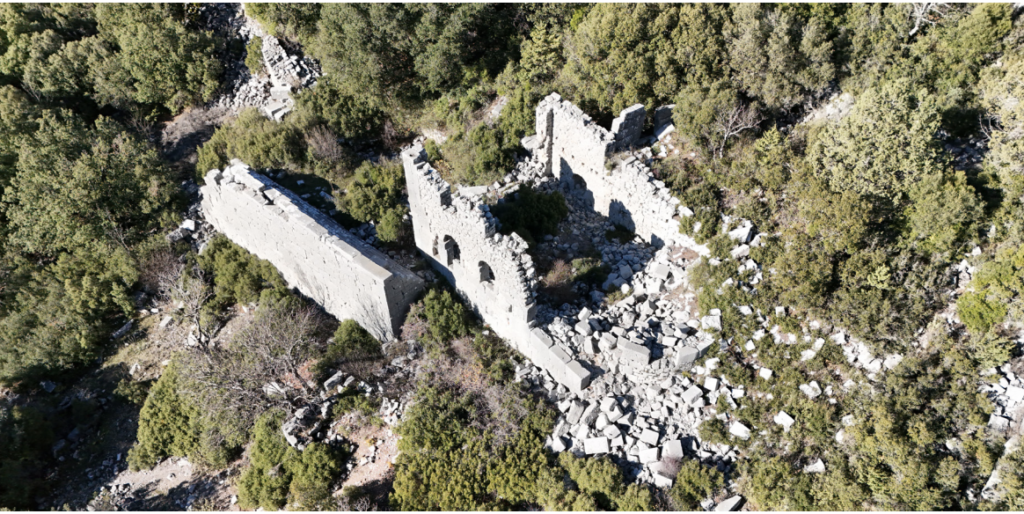
In the ancient city of Adada, located in southwestern Türkiye, seating steps dating back to the Roman period became part of a Christian church centuries later. New archaeological research suggests that this ancient architectural arrangement may have been used for the education of catechumens—those preparing for Christianity—while engravings of a ship, a human figure, and the Tree of Life on one of the steps raise new questions regarding the structure’s religious history.
The study, published in the Journal of Archaeology by archaeologists Nurittin Çelik and Ahmet Mörel from Süleyman Demirel University, examines the architectural evolution and potential functions of the South Valley Church in Adada during Late Antiquity. The research indicates that the church, built upon the ruins of an older Roman structure, may not have been used solely for worship, but also possessed a spatial arrangement suitable for religious education and ceremonies.
St. Paul’s Missionary Routes and the Rise of Christianity in Adada
Located near the village of Sağrak in the Sütçüler district of Isparta, Adada sat at the crossroads of routes connecting the Mediterranean coast with the interior of Anatolia in the ancient region of Pisidia. Having flourished in the Hellenistic period with its walls and public buildings, the city grew during the Roman Imperial Period with monumental temples.
Adada’s location was of significant importance during the spread of Christianity in Anatolia. The transportation networks connecting Perge and Pisidia Antiokheia, which Saint Paul utilized during his missionary journeys, passed near the ancient city. While it is not certain whether Paul visited Adada directly, researchers emphasize that he likely used the Via Sebaste to reach Pisidia Antiokheia, although alternative routes connecting Adada to surrounding cities also existed.
The importance of these roads extended beyond potential missionary journeys; these same routes facilitated the arrival of merchants, travelers, and religious ideas in the region. To understand the history of the Christian communities that developed in Adada over time, the city’s position within these transportation networks must be considered.
A striking finding of the research is the identification of 13 churches in and around Adada: six in the city center and seven in rural settlements. This distribution suggests that Christian life was not limited to the urban center but was deeply integrated into the religious organization of surrounding communities.
The fact that Adada is recorded as a bishopric center in later centuries reveals the institutional dimension of this development. In church records spanning from the 4th to the 12th century AD, the city appears as Adada, Dada, or Atada. Thus, archaeological remains and written sources collectively illuminate the religious history of the settlement from Early Christianity to the Middle Ages.
A Church Built Upon a Roman Structure
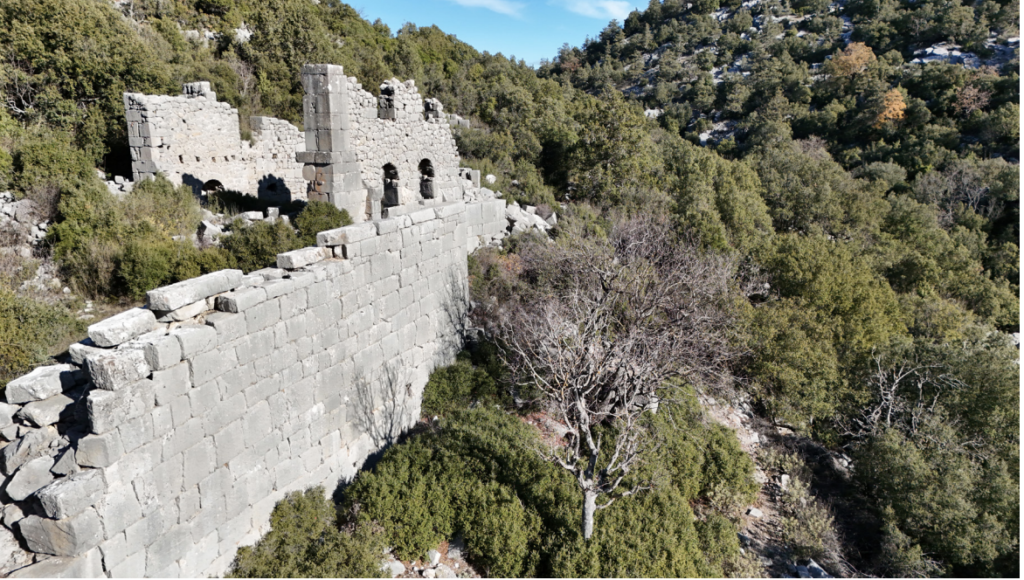
Among the 13 churches in Adada, the South Valley Church holds a unique position due to its preservation of architectural elements from an earlier structure. Located in the city’s southern valley along an ancient transport route, the church is notable for its three-aisled basilical plan opening into a wide courtyard.
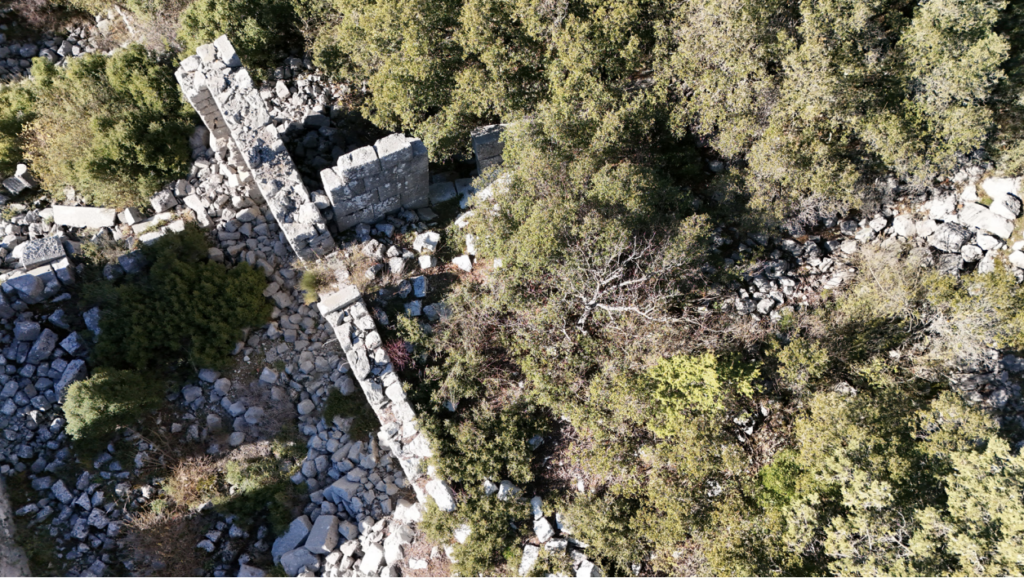
Researchers state that the church was built upon the remains of a public or religious building from the Roman Imperial Period. Roman walls that maintain their original position on the northern facade, the reuse of Hellenistic stone blocks, and varying masonry techniques indicate that the structure was not built in a single phase.
It remains unknown whether the original Roman structure was a temple or another public building; therefore, it would be inaccurate to define the South Valley Church as a direct conversion of a Roman temple into a church. However, architectural evidence clearly shows that the foundations and stones of an older building were utilized during the construction process of the Christian era.
Based on architectural similarities, the first construction phase of the church is dated to the 5th or 6th century AD. The arrangement at the eastern end, in particular, shares similarities with churches in Northern Syria and Cilicia. The apse and two side rooms are hidden behind a straight exterior wall, with a corridor behind the apse providing passage between these rooms.
The annex attached to the north of the church is thought to have served as a residence and service area for a clergyman. Door openings and different construction phases suggest that the connection between this section and the church changed over time, turning the South Valley Church into a complex consisting of a place of worship and associated structures.
Roman Seating Steps Acquired a New Function
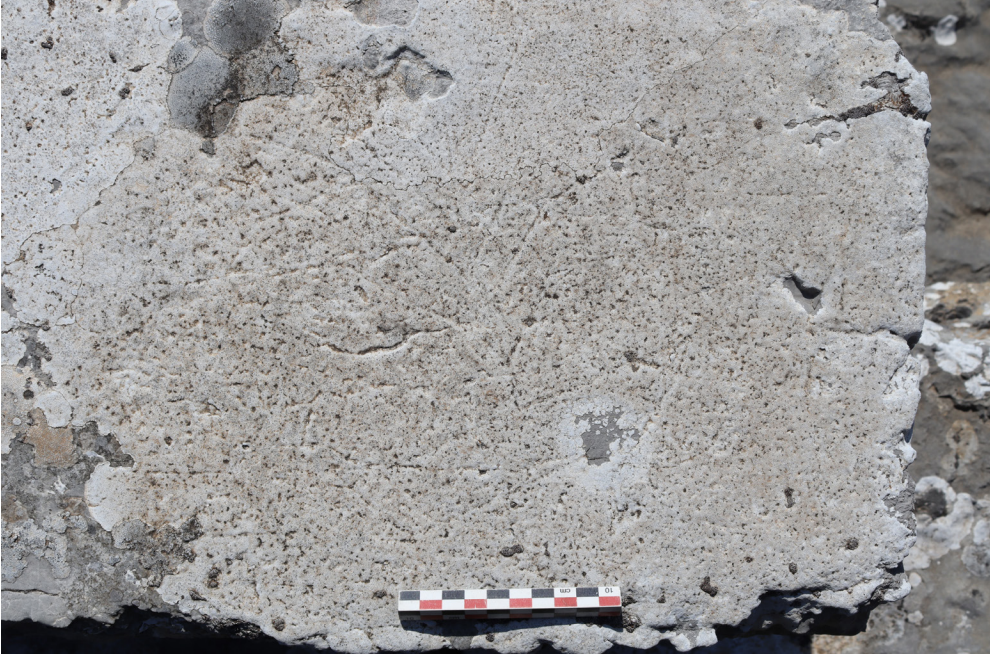
One of the most intriguing details of the church’s architecture is the seating steps found in the wide western courtyard. In the courtyard of the 832-square-meter church complex, stone rows from the Roman period extend along the southern and western edges.
The southern steps measure approximately 15.55 meters in total length. Some blocks in the western section feature lion-paw reliefs. The craftsmanship of the stones and their alignment, which does not fully coincide with the church walls, indicates that this seating arrangement predates the church.
How might these Roman-era steps have been used during the Christian period?
Çelik and Mörel suggest that the seating rows may be related to the education of those preparing to join Christianity. In Early Christianity, these individuals, known as catechumens, underwent religious training before being baptized and fully admitted into the church community.
According to the researchers, individuals gathered on the steps could have followed a route along the southern facade of the church to one of the side rooms, and from there to a possible baptismal area located behind the apse. This arrangement may have allowed unbaptized individuals to complete their preparatory process without entering the main worship area of the church.
The catechumen interpretation is not based solely on the existence of the seating steps. The transition openings to the south of the church, the connecting corridor behind the apse, and similar architectural practices in other Early Christian churches allow researchers to consider this possibility.
However, there is no inscription or direct document confirming that catechumen education took place in the structure. The function of the proposed baptismal area has also not been definitively established. The seating steps may also have been used for the congregation to gather during religious celebrations and collective worship.
The presence of similar seating arrangements in the Agora Church and Theatre Church in Adada allows researchers to evaluate these architectural practices within the broader context of Christian life in the city.
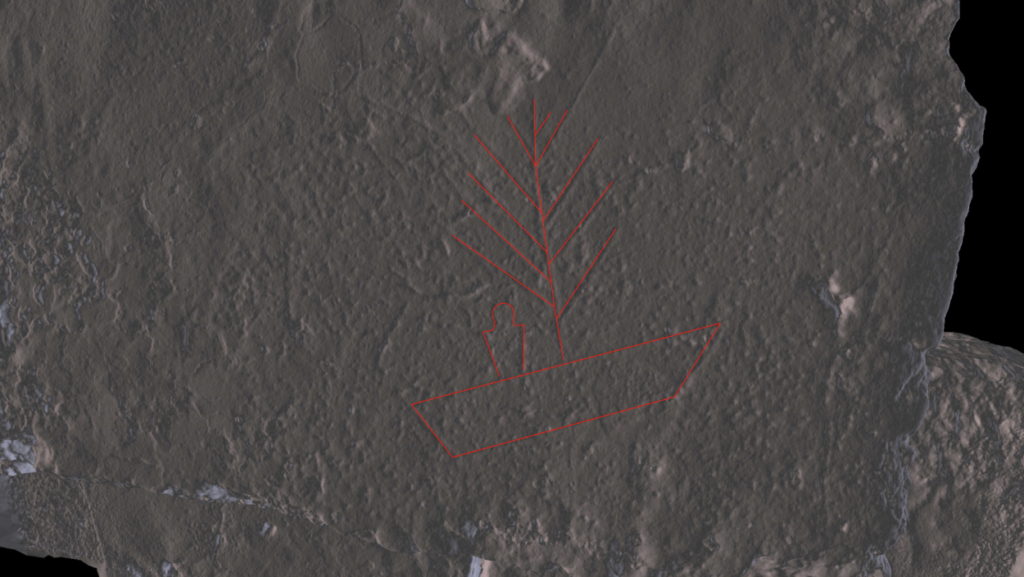
Highlighted tracing of the boat, human figure, and Tree of Life graffito carved into a stone block from the seating tiers of the South Valley Church of Adada, Türkiye. Red outlines help distinguish the weathered motifs. Credit: Çelik & Mörel (2026), Arkeoloji Dergisi, Fig. 13. CC BY 4.0.
The Ship, the Human, and the Tree of Life Engraved in Stone
The ancient seating steps of the South Valley Church are notable not only for their architectural features but also for their iconography. On one of the stone blocks in the top row of the steps, there is a motif depicting a small boat or ship, a human figure, and what is interpreted as the Tree of Life.
The ship, created using an engraving technique, is approximately 15 centimeters long and 3 centimeters deep. The human figure is only 2.55 centimeters high, while the Tree of Life motif reaches 12.7 centimeters.
Ship depictions are found in temples, churches, and public buildings across the ancient world. Such drawings are sometimes interpreted as personal marks related to maritime trade, fishing, or travel. What makes the example in Adada striking is the meaning researchers attribute to the motifs accompanying the ship.
According to the study, a human figure stands upon a simple boat, and in the section where a sail would normally be, the Tree of Life rises. Researchers believe this arrangement carries a religious meaning, distinguishing it from an ordinary nautical drawing.
Çelik and Mörel propose that the depiction may be associated with a person—likely of Jewish origin—who arrived in the region by sea and underwent Christian education. The symbolic place of the Tree of Life in Jewish religious tradition plays a key role in this interpretation.
However, there is no direct information regarding the identity, faith, or journey of the person who made the engraving. Therefore, it is not possible to definitively state that the depiction documents a specific individual’s conversion to Christianity. Nevertheless, the presence of the ship, human, and Tree of Life in a single composition enriches the discussion regarding the religious use of the steps.
The Changing Religious Life of Adada Through the Centuries
The architecture of the South Valley Church is part of a broader transformation in the history of Adada. A city that stood out for its monumental temples during the Roman period transformed into a settlement with numerous churches during Late Antiquity.
During this transition, older structures did not disappear entirely. Some of their foundations, walls, and stone blocks continued to be used in new buildings. The Roman seating steps in the South Valley Church represent one of the most prominent examples of this architectural continuity.
Changes the church underwent in later periods are also noteworthy. As Adada’s settlement area shrank and the need for defense increased, new defensive arrangements developed around Cevizli Tepe. The South Valley Church and its adjacent structures remained within the area covered by this defense system.
Researchers estimate that the church continued to function until the 12th century AD, through various repairs and additions. The bishopric records of the city and the high number of churches in the vicinity provide important data for understanding the long-term presence of Christian communities in Adada.
Mörel, A., & Çelik, N. (2026). Adada Güney Vadi Kilisesi: Mimari ve Geç Antik Dönemde Katekümenlik. Arkeoloji Dergisi, 37, 159-194. https://doi.org/10.51493/egearkeoloji.1908284
