
For more than a century, the foundations of a small temple stood unnamed on a windswept mountain above southwestern Türkiye. Archaeologists now say the building belonged to Hecate—one of Anatolia’s most ancient and enigmatic goddesses.
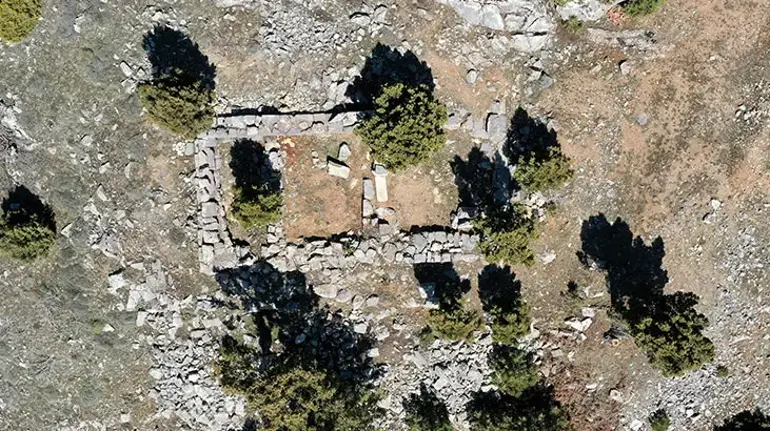
The structure lies within the Sanctuary of Men near Yalvaç in Isparta Province, approximately 1,600 meters above sea level on Mount Gemen. It was first excavated in 1912 and 1913 and was tentatively associated with Demeter, the Greek goddess of agriculture and fertility.
Because no conclusive identification could be made, archaeologists continued to refer to it simply as the “Small Temple.”
That century-old uncertainty has now been resolved, according to a team led by Professor Mehmet Özhanlı of Süleyman Demirel University. Figurines and reliefs depicting Hecate, together with the temple’s position inside a sanctuary dedicated to the lunar god Men, have led the researchers to identify it as a sanctuary of Hecate.
The team describes the building as only the second architecturally documented Hecate temple in Türkiye, after the celebrated sanctuary at Lagina in ancient Caria.
An ancient Anatolian goddess hidden behind a later image
Hecate is often introduced today as the goddess of witchcraft, ghosts and the night. But this familiar image represents only one stage in a far older and more complex religious history.
In Hesiod’s Theogony, composed around the eighth century BC, Hecate is not a marginal or sinister figure. She is presented as a powerful goddess whose authority extends across the sky, earth and sea.
Over time, her identity expanded to include crossroads, gates, borders, protection, transitions, childbirth, the moon and the passage between the worlds of the living and the dead. Her connection with magic and witchcraft became especially prominent during the Roman period.
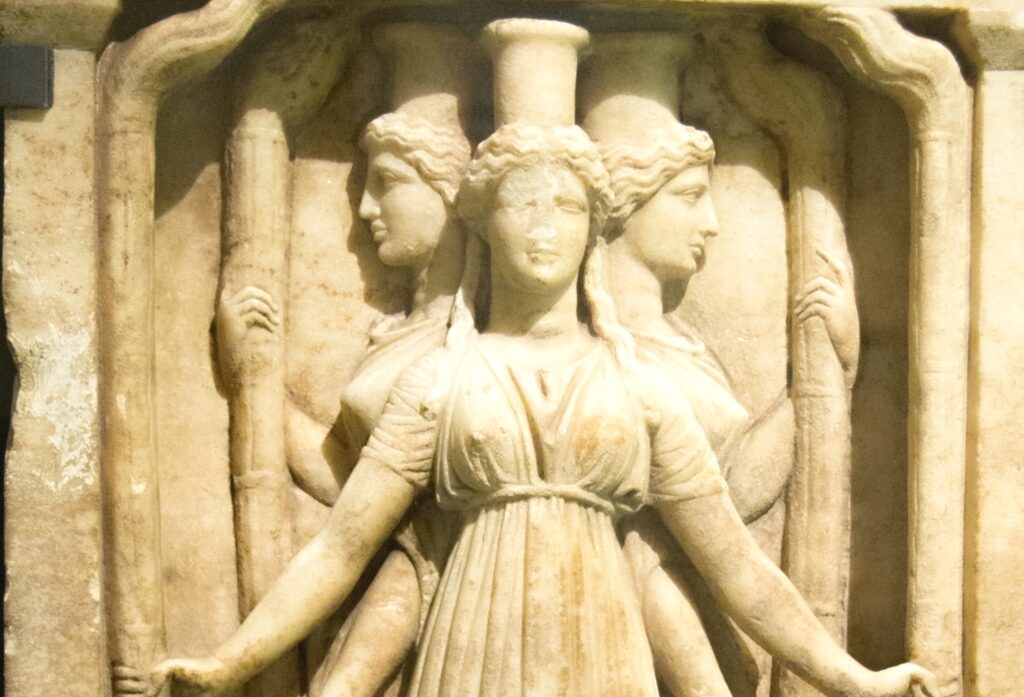
She was frequently represented in triple form, with three bodies or heads looking in different directions—an image suited to a goddess who governed boundaries and could watch several paths at once.
“Hecate represents both the moon and its dark side,” Özhanlı said, describing her as a deity associated with death and the afterlife. He called her “one of Anatolia’s oldest goddesses.”
The precise origin of Hecate remains debated. The earliest evidence for her worship appears in both mainland Greece and western Anatolia. However, the most widely accepted scholarly theory places her early cult in Caria, the ancient region covering parts of modern southwestern Türkiye.
Researchers have linked this theory to the strength of Hecate’s cult at Lagina, the frequency of personal names derived from her name in Caria and an early altar dedicated to her at Miletus. Academic studies nevertheless caution that the available evidence does not allow her birthplace to be established with certainty.
The newly identified temple at Yalvaç therefore matters for more than its architecture. It may reveal how the worship of an ancient Anatolian goddess travelled beyond Caria and became integrated into another regional religious landscape.
Why Hecate belonged beside the moon god Men
The temple stands inside a major sanctuary devoted to Men Askaenos, an Anatolian lunar deity widely worshipped in the interior of Asia Minor.
For the excavation team, that setting was one of the strongest arguments against the earlier Demeter interpretation.
Although Demeter was associated primarily with grain, fertility and the agricultural cycle, Hecate shared a much closer symbolic world with Men. Both deities were connected with the moon, celestial cycles and the darkness of night.
Hecate was sometimes shown wearing a tall headdress decorated with a crescent. Her lunar associations, combined with her role as a guardian of thresholds and the underworld, would have made her a natural presence within a sanctuary dedicated to Men.
The identification does not rest on symbolism alone. Archaeologists have recovered figurines and reliefs of Hecate during both early investigations and more recent excavations at the site.
Taken together, the images, the architectural setting and the temple’s relationship with the cult of Men created what the team considers a convincing body of evidence.
An octagonal base still marks the goddess’s place
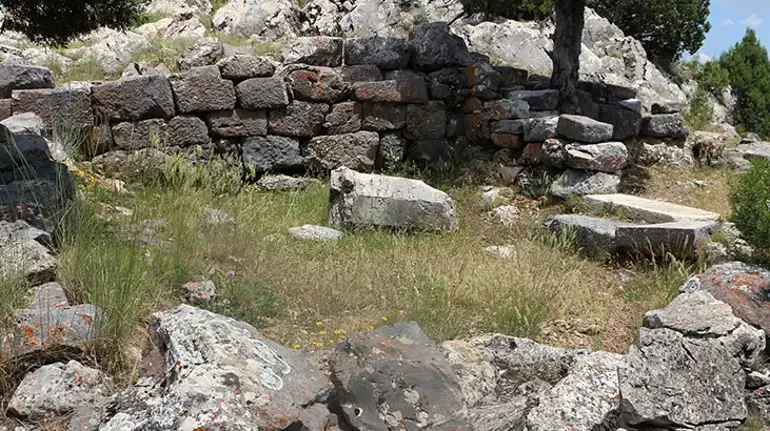
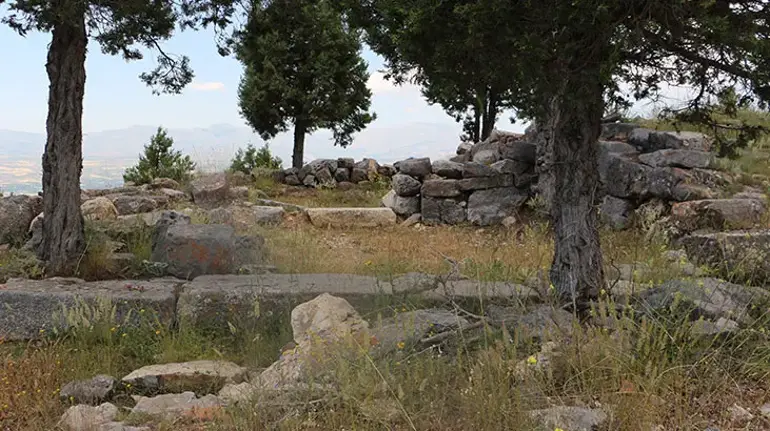
Although the temple survives largely at foundation level, its internal arrangement can still be reconstructed.
The building contained a pronaos, or entrance porch; a central naos, the sacred chamber that housed the cult image; and an opisthodomos, a rear room or porch.
At the center of the naos, an octagonal stone base remains in its original position. Archaeologists believe it once supported a statue of Hecate.
Ancient temples were not public halls in the modern sense. Ordinary worshippers usually gathered outside, where sacrifices, offerings and communal ceremonies took place. Access to the inner chamber was generally restricted to priests or other authorized religious personnel.
The surviving base therefore marks the most sacred point in the building—the place where the goddess was believed to be physically present through her cult statue.
Sacrificed dogs offer another clue
Two dog burials discovered at nearby Pisidian Antioch may provide additional evidence for a Hecate cult in the region.
Dogs were among the animals most closely associated with the goddess. In ancient belief, their barking could announce her approach through the night, while their ability to move between domestic and wild spaces reflected her command over boundaries.
Hecate was also linked with the entrance to the underworld and with Cerberus, the monstrous watchdog guarding the realm of Hades.
Özhanlı said the two animals found at Pisidian Antioch appeared to have been sacrificed. Although the burials alone cannot identify a temple, their presence strengthens the wider picture created by the figurines, reliefs and lunar context of the Men Sanctuary.
A sanctuary transformed by Christianity
Archaeological and numismatic evidence indicates that the Sanctuary of Men remained active from at least the second century BC until the late fourth century AD.
Its decline coincided with the Christianization of the Roman Empire and a series of imperial measures restricting or dismantling traditional cult sites. A church was later established near the sanctuary, while several pagan structures were damaged, abandoned or reduced to their foundations.
The Hecate temple suffered the same fate. Much of the building collapsed or was deliberately dismantled, but many of its original architectural blocks remain scattered nearby.
The excavation team plans to re-erect parts of the temple using these surviving stones, allowing visitors to understand its original form without replacing the ancient material with an entirely modern reconstruction.
More importantly, the identification restores a forgotten goddess to the sanctuary’s religious landscape.
What stood for 113 years as an anonymous “Small Temple” can now be understood as a rare monument to Hecate—not merely the later goddess of magic and darkness, but an ancient Anatolian power associated with the moon, protection, transition, and the uncertain boundary between worlds.
Cover Image Credit: Marble relief of Hecate – Public Domain

