
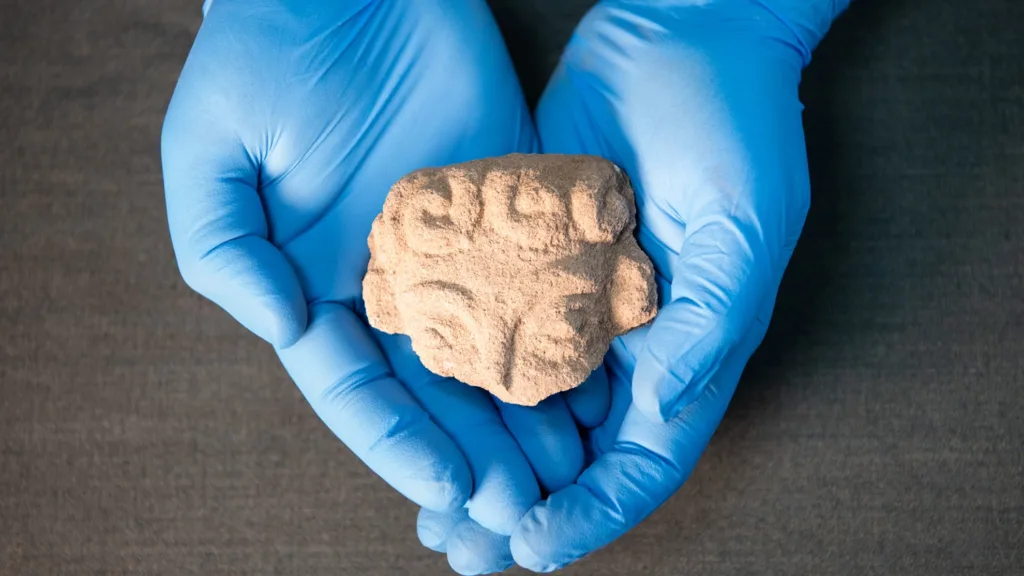
A violent storm that toppled a 1,200-year-old Pictish monument in Scotland has led archaeologists to two unexpected discoveries: a mysterious carved human face and a fragment of an older stone decorated with what appears to be a salmon. The finds emerged during excavations at Aberlemno III in Angus, where researchers also uncovered evidence that the monument may once have faced a different direction.
The discoveries came during an investigation by Historic Environment Scotland (HES) and AOC Archaeology, following the monument’s collapse in March 2025. What began as a conservation project has now revealed new evidence about the changing history of one of Scotland’s important early medieval carved stones.
An Older Pictish Stone Hidden Beneath the Base
Archaeologists discovered the first fragment beneath the stone base supporting Aberlemno III. The object had been reused as part of the monument’s foundations, although it originally belonged to another carved stone.
The surviving decoration appears to represent a salmon, an animal found among the distinctive symbols carved by the Picts. These early medieval communities occupied northern and eastern Scotland and developed a sophisticated tradition of stone sculpture featuring animals, abstract symbols and Christian imagery.
The fragment suggests that an older Pictish monument had already been broken before someone incorporated part of it into the base of Aberlemno III. However, archaeologists have not established when the original stone was damaged or how much time passed before the fragment was reused.
A Carved Human Face Raises New Questions
A second discovery came from the topsoil surrounding the monument. Archaeologists recovered a carved human head featuring facial details and curled hair, a fragment that appears consistent with early medieval sculpture.
Unlike the salmon-decorated stone, the head was not found within the monument’s foundations. Its original location and purpose remain unknown, and researchers have not identified another surviving monument at Aberlemno to which it might have belonged.
This uncertainty makes the discovery particularly intriguing. The carved head could represent a surviving fragment of a sculpture that has otherwise disappeared, but further examination will be necessary before researchers can establish its original form or function.
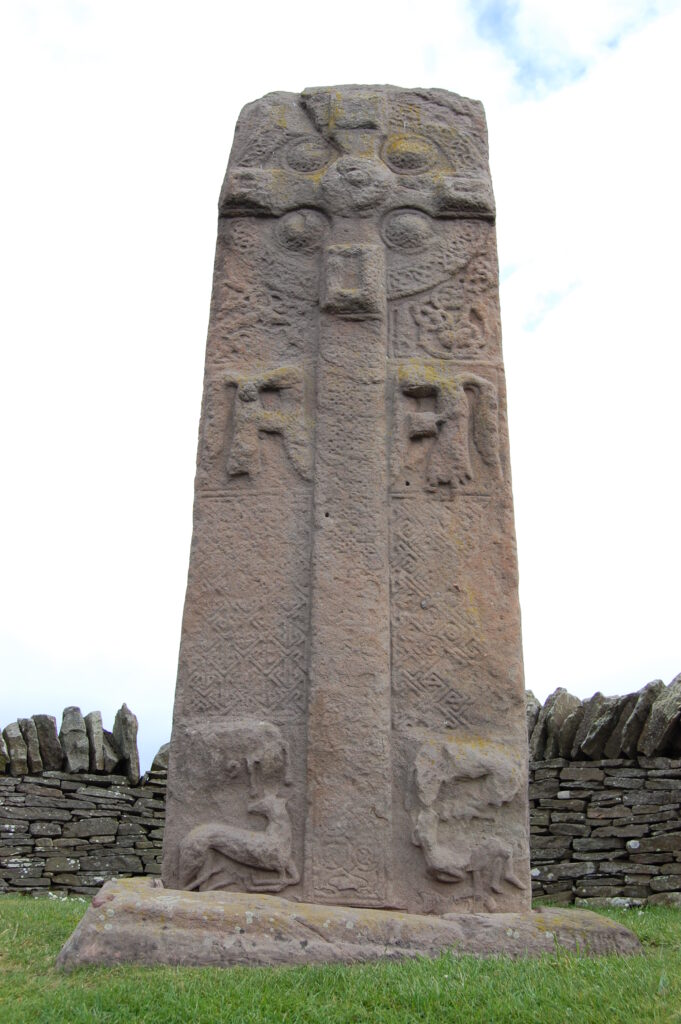
Aberlemno III, an early medieval Pictish cross-slab in Angus, Scotland. Archaeological investigations suggest the monument may have been repositioned during its history. Credit: Kylemunro1 / Wikimedia Commons.
Evidence That Aberlemno III Once Faced Another Direction
The excavation also revealed two features beneath the base stone that may represent earlier settings for upright monuments. One could indicate that Aberlemno III originally stood on a north–south alignment, facing towards Aberlemno Kirk, where another Pictish stone survives.
At some point, the monument may have fallen or been deliberately repositioned. Archaeologists believe the present east–west alignment could reflect a later arrangement associated with Christian traditions, although the evidence has not yet established when or why such a change occurred.
Aberlemno III stands among a group of four surviving Pictish carved stones in the village. Dating broadly to the later first millennium AD, these monuments preserve a combination of traditional Pictish symbols and Christian imagery, reflecting the artistic and religious developments of early medieval Scotland.
The approximately 2.8-metre-tall cross-slab includes a prominent cross, angels, animals and other carved figures. Its elaborate decoration makes the newly discovered fragments particularly relevant to understanding the wider landscape of sculpture that once existed around Aberlemno.
A Storm Creates an Unexpected Archaeological Opportunity
Aberlemno III fell during a storm in March 2025, prompting conservation specialists to assess the damage and develop a plan for its recovery. The incident also allowed archaeologists to investigate the monument’s foundations, which had remained largely inaccessible while the stone stood upright.
Stefan North-Sagrott, Senior Cultural Resources Advisor at Historic Environment Scotland, said the excavation had produced more information than initially anticipated.
“The initial results of the excavation by AOC have already exceeded our expectations.”
The findings suggest that the monument probably remained within its original setting, even if its orientation changed during an earlier phase of its history. The carved human head remains especially difficult to interpret because researchers have yet to establish a connection between the fragment and any known monument at the site.
Further Carvings May Still Be Revealed
The investigation is continuing in Edinburgh, where conservation specialists are examining the excavated base stone. A broken section of Aberlemno III remains embedded within it, and researchers hope to recover the fragment and examine any decoration that may have remained concealed for centuries.
Additional analysis of the archaeological material could help establish when the monument was repositioned and clarify how the older salmon-decorated stone came to form part of its foundations. The relationship between the newly discovered carved head and the surviving Pictish monuments will also require further investigation.
For archaeologists, the most important result may be the evidence that Aberlemno was not simply a collection of isolated standing stones. The excavation points to a more complicated history in which monuments were damaged, reused and possibly rearranged over generations, leaving traces that remained beneath the ground until the storm exposed them.
