
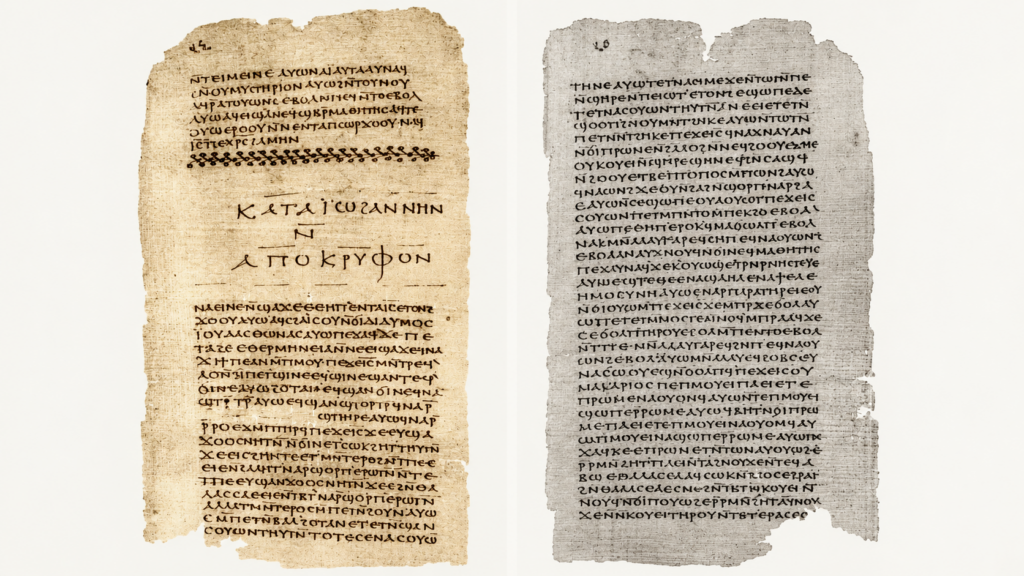
For centuries, much of what survived about Christianity’s rejected or forgotten traditions came from the writers who argued against them. The voices on the other side had largely disappeared. Then a cache of ancient books emerged from Upper Egypt, preserving texts that had almost vanished from history.
What scholars eventually found inside was far more significant than an isolated collection of old religious writings. The books preserved alternative accounts of Jesus’ teachings, mystical revelations, philosophical works, and versions of Christianity known for centuries mainly through the people who condemned them. Among them was a nearly complete copy of the Gospel of Thomas.
Nag Hammadi did not reveal a secret Bible that had simply been removed from Christianity. What it revealed was something historically more complicated: a Christian world in which ideas about Jesus, salvation, creation and divine knowledge were still being debated, rewritten and contested.
Written in Coptic and preserved for roughly 1,600 years, the manuscripts became known as the Nag Hammadi codices. Their rediscovery transformed the study of early Christianity and gave scholars direct access to traditions that had previously been known largely through hostile descriptions.
A discovery whose story is still uncertain
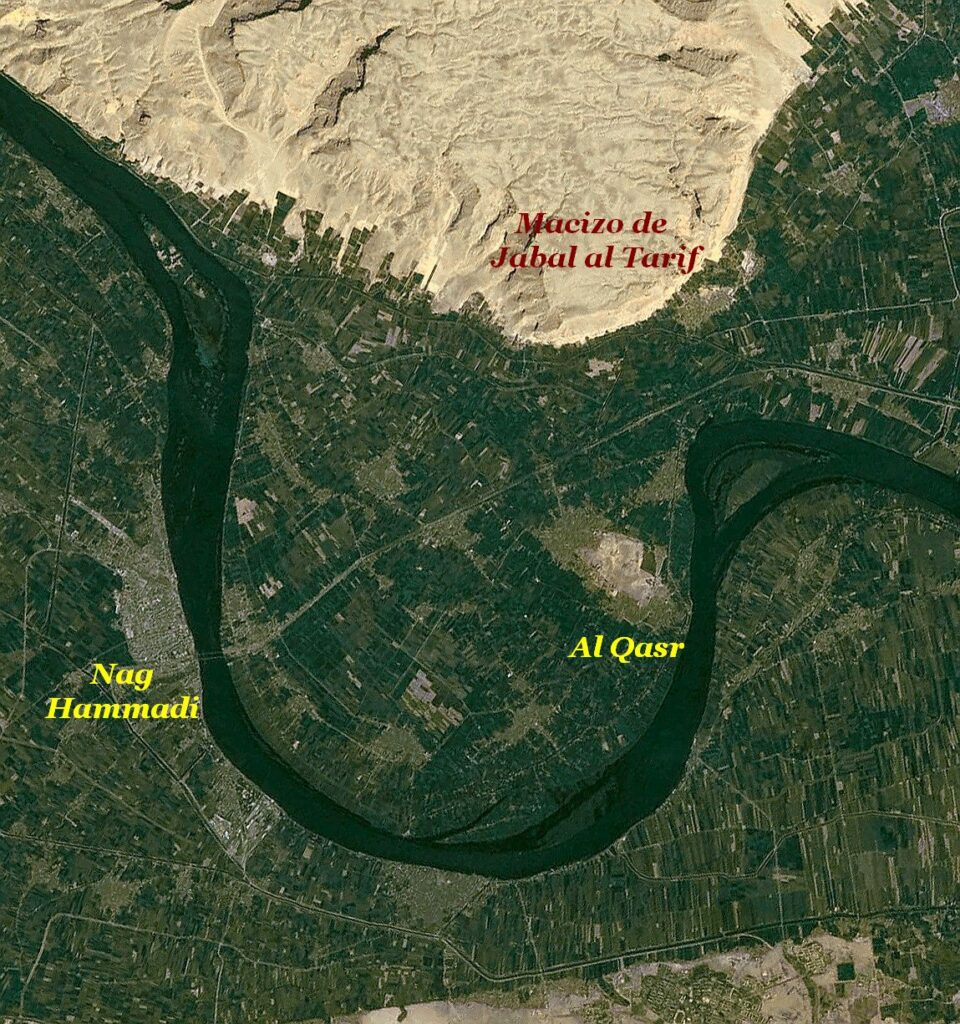
The traditional account places the discovery in December 1945 near the cliffs of Jabal al-Tarif, north of Nag Hammadi. Later testimony centered on an Egyptian farmer named Muhammad Ali al-Samman, who reportedly encountered a large ceramic jar while digging in the area. Inside were papyrus books protected by leather covers.
There is a problem with that story, however: no archaeologist witnessed the discovery. Everything we know about the circumstances was reconstructed later from testimony given after the manuscripts had already begun to circulate.
Different versions of the story were recorded afterward. Muhammad Ali himself reportedly gave varying descriptions of where the books were found, who accompanied him, and whether they came from a jar, a cave, a tomb, or another location near the cliffs. Modern scholarship therefore treats some of the most dramatic details cautiously, although the general location near Jabal al-Tarif is widely accepted.
The manuscripts subsequently became dispersed through antiquities dealers and the Cairo market before scholars could study the collection systematically. That chaotic history means we may never know whether every manuscript originally found with the group survived, or whether parts of the discovery disappeared before they were documented.
What did survive was extraordinary. The codices preserved a body of religious and philosophical writing that would profoundly change the modern study of early Christianity.
More than 50 texts that had almost vanished from history
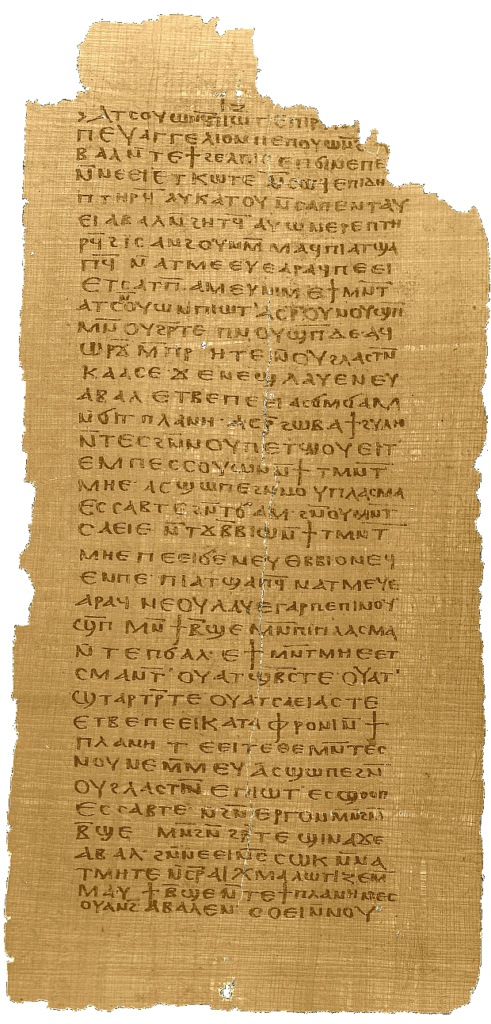
The collection is conventionally known as the thirteen Nag Hammadi codices, although the physical survival of the final codex is complicated: Codex XIII consists only of leaves that had already been inserted into another binding. Depending on how fragments and duplicate works are counted, scholarly totals vary slightly.
The Claremont Coptic Encyclopedia catalogs 51 texts representing 45 distinct works, 36 of which were previously unknown in any form. The manuscripts themselves were copied in Coptic, largely during the fourth century, but most of the works are believed to derive from earlier Greek compositions.
There is physical evidence for that fourth-century setting. Scrap papyri recycled into the cover of Codex VII include documents dated to AD 341, 346 and 348, meaning that particular binding could not have been manufactured before 348.
The titles are remarkable: the Gospel of Thomas, Gospel of Philip, Gospel of Truth, Apocryphon of John, Apocalypse of Paul, Thunder, Perfect Mind and numerous cosmological and revelatory works. The collection even contains philosophical material connected with Plato and texts belonging to Hermetic traditions.
For decades the group was routinely described as a “Gnostic library.” That label is now considered too simple. The codices contain material associated with several different intellectual and religious traditions, and scholars increasingly resist treating their owners as members of one unified Gnostic sect.
That diversity is precisely what makes Nag Hammadi so important.
The Gospel of Thomas opened another window onto Jesus’ traditions
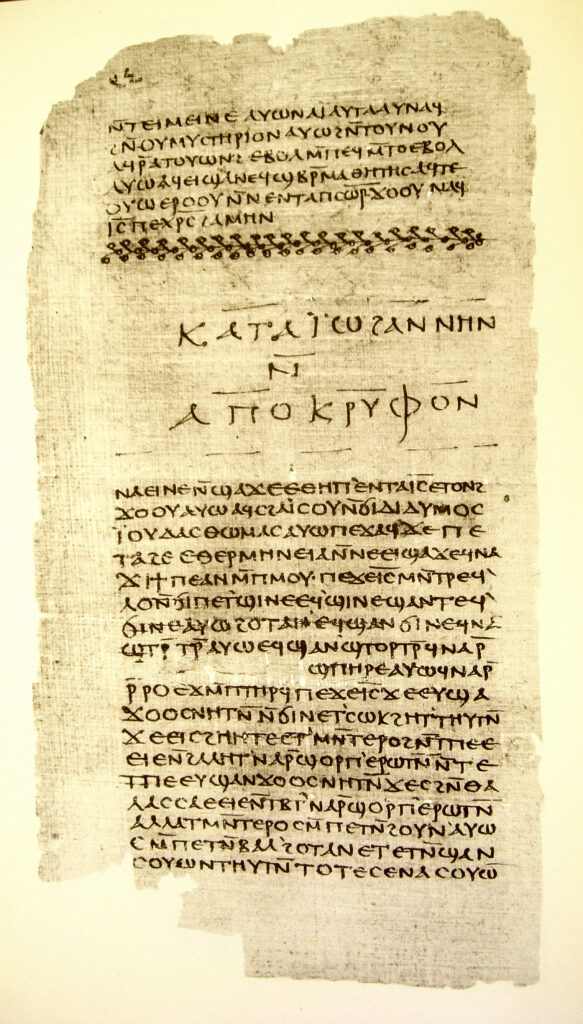
The most famous work in the collection is preserved in Codex II.
Unlike the canonical Gospels of Matthew, Mark, Luke and John, the Gospel of Thomas does not tell a continuous story of Jesus’ life. There is no narrative beginning with his birth or ministry and moving toward the Crucifixion and Resurrection. Instead, the surviving text presents 114 sayings attributed to Jesus, often introduced simply by the equivalent of “Jesus said.”
Some sayings resemble passages already familiar from the New Testament. Others appear in substantially different forms, while still others have no direct canonical equivalent.
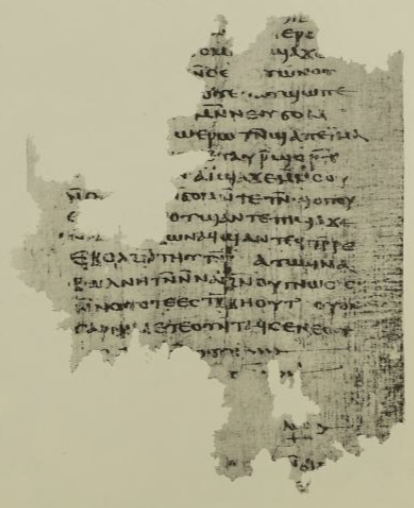
Nag Hammadi was not the first physical evidence that the text had existed. Greek papyrus fragments discovered at Oxyrhynchus in the late nineteenth and early twentieth centuries were later recognized as portions of the same work. But Codex II provided the first essentially complete surviving version, allowing scholars to understand what those fragments belonged to.
Exactly when the Gospel of Thomas was first composed remains debated. The surviving Coptic manuscript is centuries later than Jesus, and the text cannot simply be treated as a transcript of otherwise unknown sayings. Yet its existence demonstrates that early Christians collected and transmitted Jesus traditions in literary forms quite different from the four Gospels that eventually became canonical.
Nag Hammadi transformed the study of other movements as well. Before the discovery, much of what historians knew about Christians later classified as heretical came from their opponents, including writers such as Irenaeus. The manuscripts suddenly allowed scholars to read a large body of texts produced within, or much closer to, those alternative intellectual traditions themselves.
Who buried the books — and what were they afraid of?
This remains the great Nag Hammadi mystery.
One influential theory connects the codices with the Pachomian monasteries that flourished in the region during the fourth century. Material recovered from the bindings, scribal practices, and even notes within the manuscripts have strengthened arguments for a monastic context. A major 2024 study by Lund University scholar Paul Linjamaa concluded that the material evidence strongly supports an origin within Pachomian monasticism, although the wider provenance debate is not completely settled.
Another piece of the puzzle appeared in AD 367. Athanasius, bishop of Alexandria, issued his Thirty-Ninth Festal Letter and listed exactly the 27 books that later became the generally accepted New Testament. He also drew sharp distinctions between canonical books and other writings. It is the earliest surviving Christian document known to present precisely that 27-book New Testament collection.
The coincidence is tempting. Perhaps monks possessing increasingly unacceptable books chose to hide them rather than destroy them.
But there is no surviving evidence saying that this happened.
No note explains the burial, and nothing directly connects Athanasius’ letter with a jar beneath Jabal al-Tarif. The books might have been concealed during a period of religious pressure, stored for safekeeping, removed from a monastery library or deposited for reasons that have disappeared with the people who owned them.
That unanswered question may be what makes Nag Hammadi particularly compelling. Someone in late antique Egypt preserved a group of books containing ideas that largely vanished from mainstream Christian tradition. About sixteen centuries later, those manuscripts resurfaced and restored voices that history had almost silenced.
Today, the Nag Hammadi codices are among the most important manuscripts held by the Coptic Museum in Cairo. Their discovery did not replace the history of early Christianity, but it made that history considerably larger, stranger, and more diverse than scholars had previously been able to see.
Sources
Paul Linjamaa, 2024, The Nag Hammadi Codices and their Ancient Readers: Exploring Textual Materiality and Reading Practice. Cambridge University Press.
Claremont Coptic Encyclopedia – Gospel of Thomas.
Claremont Coptic Encyclopedia – Coptic Literature
NASSCAL – Gospel of Thomas
NASSCAL – Nag Hammadi Codex II.
