
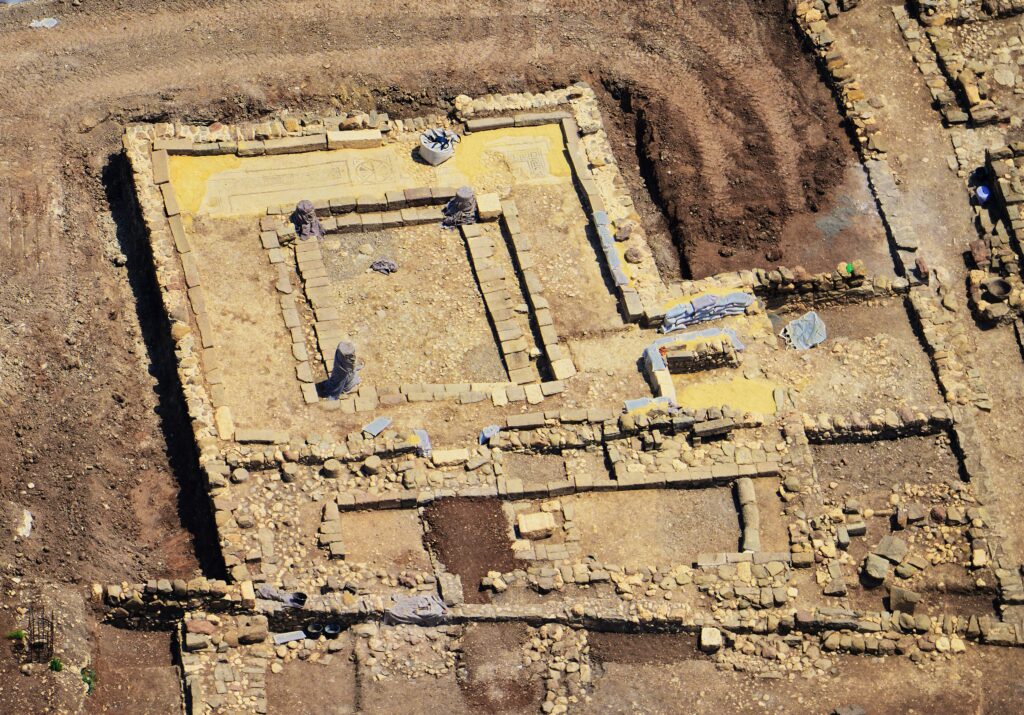
Nearly 2,000 years ago, people gathered inside a small synagogue overlooking the Sea of Galilee. They sat on stone benches, listened to readings and teachings, and lived at a time when Jerusalem’s Second Temple was still standing. Archaeology can tell us much about who they were and when they worshipped there. But one question remains impossible to answer with certainty: was Jesus ever among them?
The possibility is not based simply on tradition. The synagogue was operating in first-century Galilee, during the same historical period in which the Gospel accounts describe Jesus traveling through the region and teaching in synagogues. Matthew 4:23 states that Jesus “went throughout Galilee, teaching in their synagogues,” while Mark likewise describes him preaching in synagogues across Galilee.
Archaeologists cannot prove that Jesus entered this particular building. Yet its location and chronology place it directly inside the geographical and historical world described in those accounts.
A synagogue from the right place and the right time
The building was discovered unexpectedly in 2009 during archaeological work ahead of construction at ancient Magdala, on the northwestern shore of the Sea of Galilee. What emerged was one of the rare synagogues known from Galilee before the destruction of the Second Temple in AD 70.
The structure included a vestibule and a larger reading room surrounded by stone benches. Columns once supported its interior, sections of the walls retained traces of painted decoration, and part of the floor was covered with a carefully laid mosaic featuring a rosette and geometric patterns. According to the Israel Antiquities Authority, a coin dated to AD 43 was recovered from beneath the foundation of the mosaic in the reading room, while other finds place activity at the site firmly within the first century.
More recent scholarship has reinforced the Early Roman dating. A 2025 study by archaeologists Jordan J. Ryan and Marcela Zapata-Meza examined the architecture, identification, and chronology of the synagogue and argued that its use may have extended into the middle of the first century AD.
That chronological overlap is what makes the Jesus connection so compelling. The archaeology does not identify an individual visitor, but it places the synagogue in operation during the decades traditionally associated with Jesus’ ministry in Galilee.
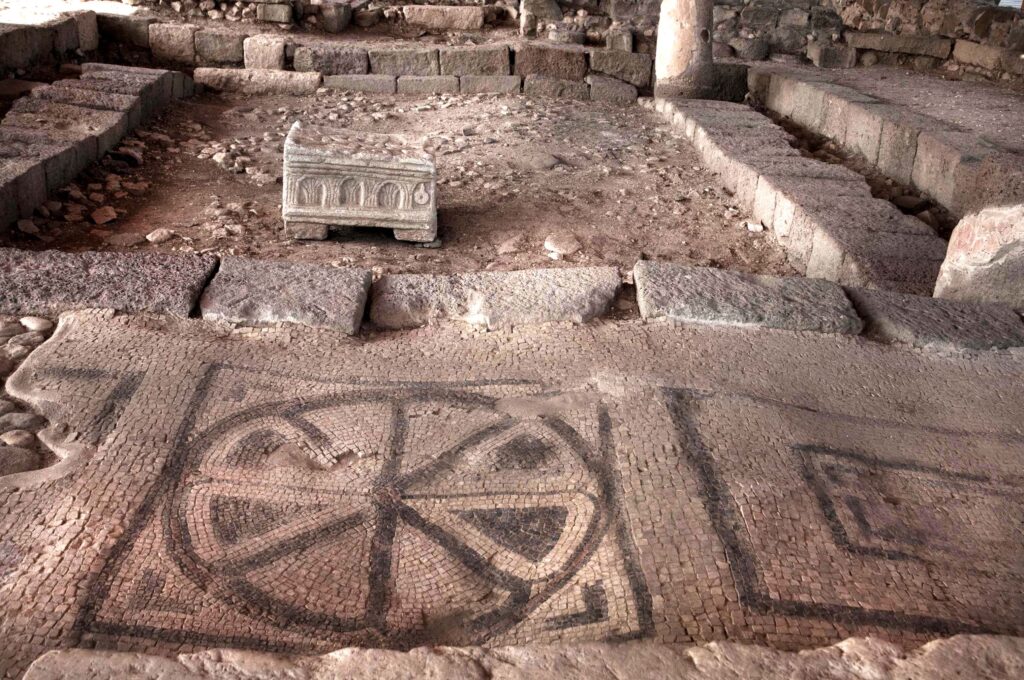
Interior of the first-century synagogue at Magdala, showing its mosaic floor, stone seating and a replica of the Magdala Stone positioned near where the original was discovered. Amos Gal / Wikimedia Commons
The mysterious stone at the center of the synagogue
Even without that possibility, the synagogue would rank among the most remarkable discoveries from first-century Galilee.
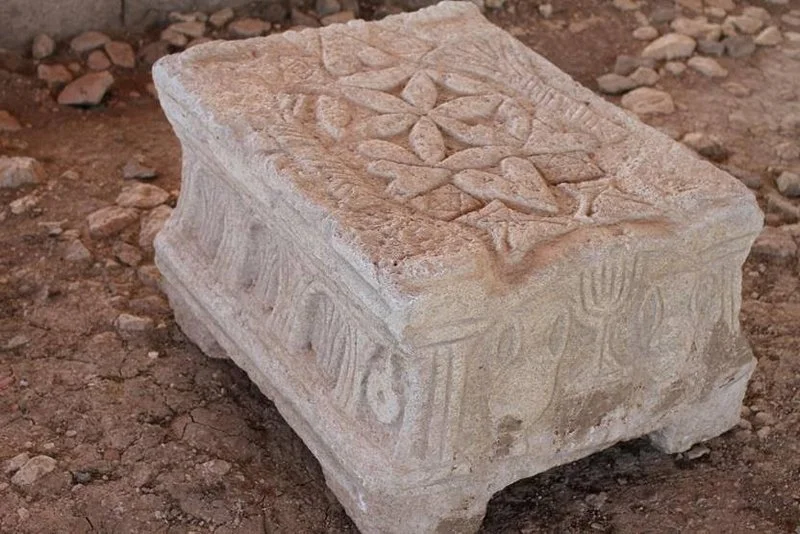
Near the center of the building, archaeologists found an elaborately carved limestone block now known as the Magdala Stone. Its surfaces are covered with religious imagery, including architectural motifs and a seven-branched menorah. The Israel Antiquities Authority described the menorah as the earliest known example from the Second Temple period found outside Jerusalem and, at the time of the excavation report, the earliest found inside a religious structure.
That detail matters because the stone was created while the Temple in Jerusalem still existed. Whoever carved the menorah may therefore have been depicting an object that could still have been seen in the Temple rather than reconstructing it from distant memory.
But the stone remains difficult to interpret.
Researchers have proposed that it was connected with the reading and handling of Torah scrolls, while its imagery has often been understood as evoking the Jerusalem Temple and its sacred furnishings. Exactly how the stone functioned inside the synagogue, however, continues to be debated. A 2026 peer-reviewed study by Wally Cirafesi of Lund University again placed the decorated stone within discussions of Judean connections and Jesus’ Galilean mission, showing that the find remains part of an active scholarly debate rather than a closed archaeological question.
Then archaeologists found another synagogue
The story became even stranger in 2021.
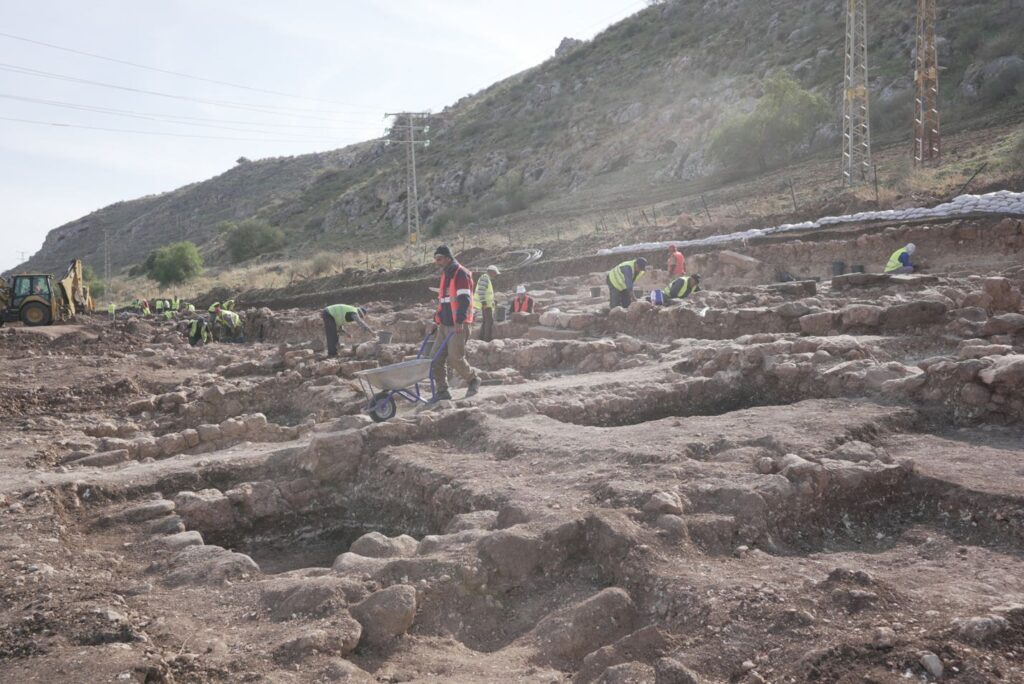
Archaeologists uncovered a second synagogue dating to the Second Temple period elsewhere in ancient Magdala. The discovery meant that this relatively compact Galilean settlement possessed two synagogues during roughly the same broad period, raising new questions about how these buildings functioned and who used them. Recent work on the first synagogue specifically notes that the second discovery has changed the discussion surrounding both structures and their relationship with Magdala’s inhabitants.
The wider excavations also reveal that Magdala was far more than an isolated fishing village. Archaeologists have uncovered streets, substantial houses, shops, water installations and Jewish ritual baths, while recent Israel Antiquities Authority research describes the town as reaching its peak during the Early Roman period.
It was, in other words, exactly the kind of active Jewish community in which a traveling teacher could have encountered an audience.
Whether that teacher was Jesus cannot be demonstrated archaeologically. No inscription records his presence, and no artifact from the synagogue bears his name. But that limitation does not erase what makes the discovery unusual: this is not a synagogue built centuries after the events described in the Gospels. It stood in Galilee during the same first-century world in which those texts describe Jesus moving from community to community and teaching inside synagogues.
Nearly two millennia later, the stone benches are still there. So is the room in which people gathered to hear Scripture read. Archaeology can reconstruct the setting with extraordinary precision; the identity of everyone who once walked through its doors remains beyond its reach.
Israel Antiquities Authority – Magdala synagogue excavation report
Ryan, J. J., & Zapata-Meza, M. (2025). A study of Magdala’s first synagogue: Identification, layout, and context of the synagogue discovered in 2009. In M. Zapata-Meza (Ed.), Ancient Magdala: Archaeological excavations (2010–2017). Vol. I: Daily life, first interpretations (pp. 25–48). Archaeopress.
Cirafesi, W. (2026). The decorated stone from the Magdala synagogue and Judean connections with Jesus’s Galilean mission in the Fourth Gospel. In P. N. Anderson (Ed.), Archaeology, Jesus, and the Gospel of John: What recent discoveries show us (pp. 243–267). William B. Eerdmans Publishing Company.
