
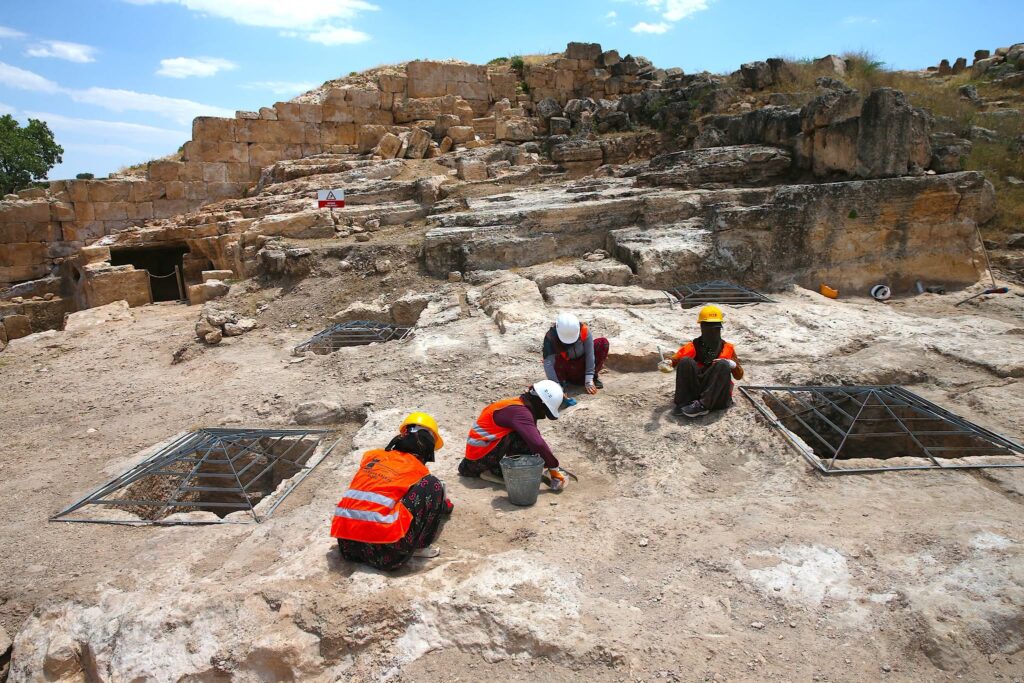
A newly deciphered inscription at Zerzevan Castle in southeastern Türkiye may record one of the clearest archaeological traces of how a Roman Mithras sanctuary was brought to an end after Christianity became dominant.
Researchers say the inscription, carved at the entrance of the underground Mithras Temple in Diyarbakır’s Çınar district, refers to the “holy cross” and appears to mark the formal closing of the sanctuary about 1,700 years ago. The text was examined through Aramaic and Syriac epigraphy by Prof. Dr. Mehmet Sait Toprak of Mardin Artuklu University.
The temple itself was uncovered in 2017 inside Zerzevan Castle, a Roman frontier garrison that controlled a strategic route between Diyarbakır and Mardin. For years, the inscription at its entrance could not be securely read. The new interpretation now gives the site a sharper historical meaning: the Mithras sanctuary was not simply abandoned, but symbolically sealed.
A Roman fortress with an underground cult space
Zerzevan Castle stood on Rome’s eastern frontier, in a region shaped by military traffic, imperial defense, and contact with the Persian world. The fortified settlement includes walls, a watchtower, a church, administrative buildings, cisterns, an arsenal, underground shelters, and rock-cut spaces.
Among the most unusual of these spaces is the Mithraeum, a temple dedicated to Mithras, a mystery god worshipped across the Roman Empire, especially among soldiers and officials in the 2nd and 3rd centuries A.D.
Unlike public temples, Mithraic sanctuaries were usually enclosed and often built underground. Their rituals were restricted to initiated members, and the evidence for what happened inside them is limited. That is why the Zerzevan temple is important: it preserves both the architectural setting of a closed cult and a later Christian mark placed directly at its threshold.
Inside the Mithras Temple at Zerzevan
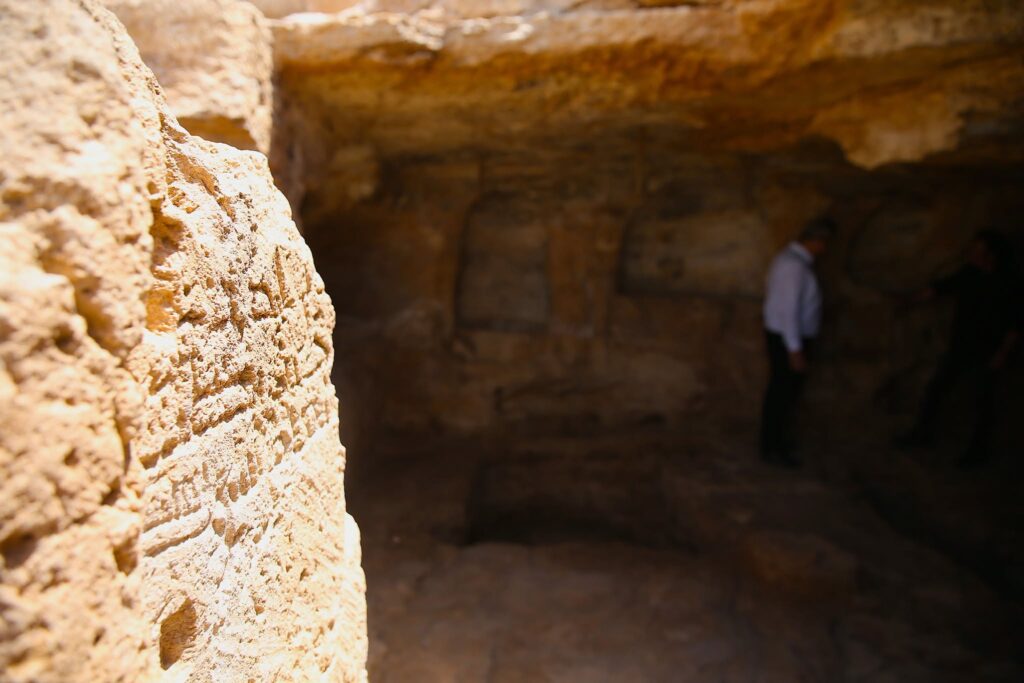
The Zerzevan Mithraeum was carved into the bedrock. It is a compact underground chamber, roughly 7 meters long, 5 meters wide, and 2.5 meters high. Its small size fits the nature of Mithraic worship, which was practiced by select groups rather than large public congregations.
The sanctuary includes rock-cut niches, a pool, and a channel system interpreted as part of ritual activity. UNESCO’s description of the site also notes features associated with sacrifice and water use, including ceiling points that may have been used during ceremonies.
These details matter because they show that the temple was not a casual room later labeled as religious. It was built and arranged as a specialized cult space.
Zerzevan is also significant because Mithras was closely connected with the sun, military loyalty, cosmic order, and secrecy. In Roman religious culture, Mithras was often linked with Sol Invictus, the “Unconquered Sun.” At Zerzevan, the later Christian inscription appears exactly where worshippers would once have entered that sacred underground world.
The inscription and the cross
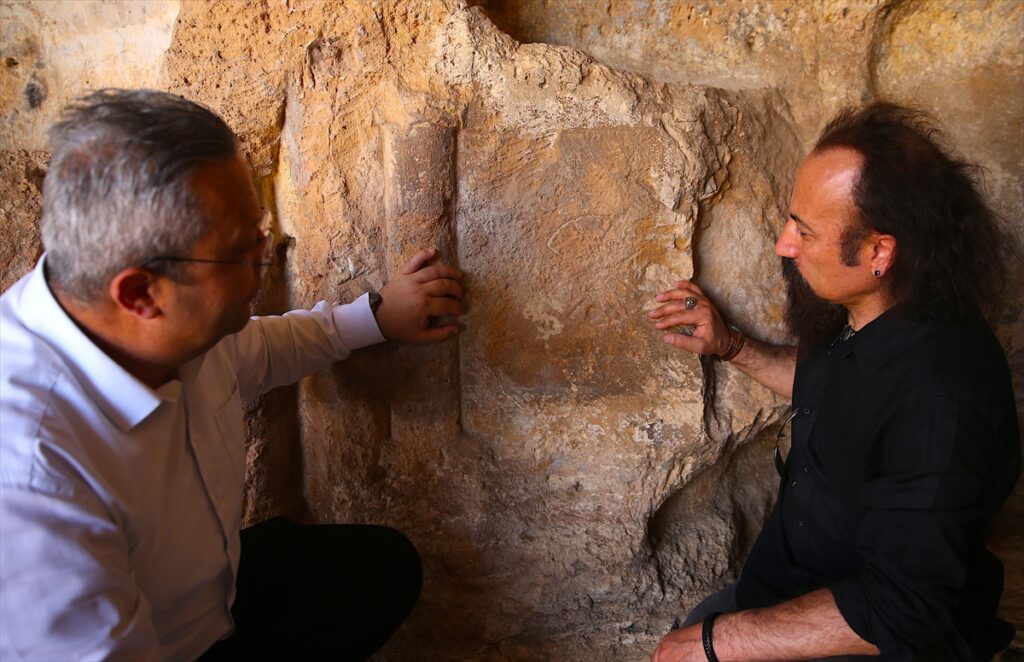
According to Prof. Dr. Toprak’s reading, the inscription includes references to the holy cross and invokes God as the one who orders, reforms, and spreads love. The writing has been compared with Syriac and Aramaic inscriptions from Late Antiquity, including examples kept in the Şanlıurfa Museum.
Excavation director Prof. Dr. Aytaç Coşkun said the inscription had been studied since the discovery of the temple, including by researchers in Türkiye and abroad. The latest reading connects the text with the Christian-period closure of the Mithras sanctuary.
The cross at the entrance is the key point. It was not placed in a neutral location. It stood at the boundary between the outside world and a chamber once used for secret Mithraic rites. In that position, the cross appears to have acted as a religious seal.
The message was simple but powerful: this space no longer belonged to Mithras.
A rare trace of religious transition
The end of Mithras worship is harder to trace than its spread. Mithraea have been found from Britain to the eastern provinces of the Roman Empire, but many were simply abandoned, damaged, or reused. Clear evidence showing how a Mithras temple was formally closed is much rarer.
That is what makes Zerzevan Castle unusual. The site preserves a Roman military sanctuary, an underground cult chamber, and a Christian inscription at the entrance. Together, they offer a physical trace of religious change at a specific doorway.
Zerzevan Castle was later repaired and reused in the periods of Anastasius I and Justinian I, and the settlement remained active until the Islamic conquest of the region in the 7th century. Today, the castle and its Mithraeum are on UNESCO’s World Heritage Tentative List.
The newly deciphered inscription does not only adds another text to the history of the site. It changes how the temple is understood. At Zerzevan, the rise of Christianity can be seen not as an abstract imperial process, but as a deliberate act carried out at the entrance of a once-secret Roman sanctuary.
Cover Image Credit: Aziz Aslan/AA
